


If you are thinking about buying a small plug-in heater for a chilly bedroom, bathroom or home office, the first question is usually simple: what will the Handy Heater Turbo actually cost to run? The sticker price is low, but the real expense shows up on your electric bill month after month.
The good news is that this heater is a low-wattage model, so it is cheap to operate compared with a full-size space heater. In this guide you will see the exact cost per hour, per day and per month, the formula so you can work it out for your own electricity rate, and practical ways to keep the bill down.
Quick answer
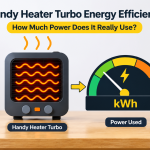
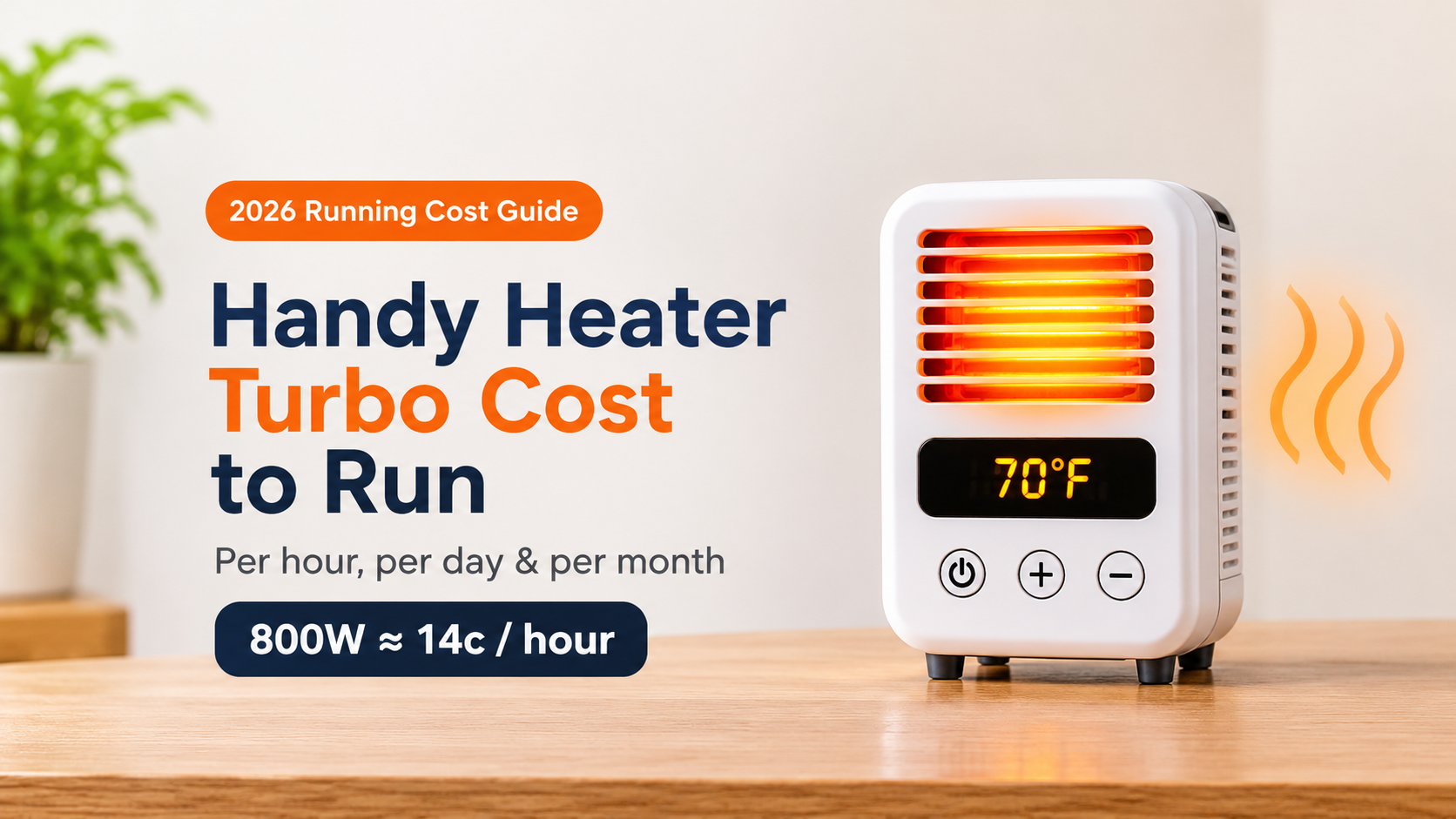
The Handy Heater Turbo is an 800 watt heater. At the 2026 US average of roughly 18 cents per kWh, it costs about 14 cents per hour, $1.15 for 8 hours, and about $34.56 for a full month of 8 hours a day at full power. With a thermostat cycling on and off, real-world cost is often lower.
What Is the Handy Heater Turbo?
The Handy Heater Turbo is a compact personal space heater that plugs directly into a standard wall outlet. Instead of sitting on the floor with a cord trailing across the room, it hangs on the wall socket itself, which saves floor space and keeps walkways clear.
Retailer listings for the Turbo 800 model describe these main features:
- 800 watt ceramic heating element for quick, focused warmth
- Adjustable thermostat so it does not run flat out all the time
- Digital LED display for temperature and settings
- Programmable timer of up to 12 hours
- Automatic shut-off protection and a stay-cool housing
- ETL listed for safety compliance
It is typically sold for somewhere around $20 to $30, depending on the store and any promotions. Because it is designed for small spaces, it suits bathrooms, bedrooms, offices, nurseries, dorm rooms and similar areas rather than large open living rooms.
Important: Handy Heater sells several different models, and wattage varies between them. The Turbo 800 is rated at 800 watts, but other products in the brand family may be lower or higher. Always check the wattage printed on the label of your own unit before using any calculation.
How Much Electricity Does an 800 Watt Heater Use?
Electricity is billed in kilowatt-hours (kWh). One kilowatt-hour is the energy used by a 1,000 watt device running for one hour.
An 800 watt heater draws 0.8 kilowatts when it is heating at full power. That means:
- In 1 hour it uses 0.8 kWh
- In 8 hours it uses 6.4 kWh
- In 30 days at 8 hours a day it uses 192 kWh
On a standard 120 volt household circuit, 800 watts equals roughly 6.7 amps of current. That is well within what a normal 15 amp outlet circuit can handle, though it is still wise not to share that circuit with other high-power appliances.
The Formula to Calculate Heater Running Cost
You do not need to rely on anyone else’s estimate. You can work out the exact cost with a simple formula that works for any electric heater:
(Watts ÷ 1,000) × Electricity Rate per kWh × Hours Used = Cost

Here is the worked example for the Turbo at the national average rate:
- Convert watts to kilowatts: 800 ÷ 1,000 = 0.8 kW
- Multiply by your rate: 0.8 × $0.18 = $0.144 per hour
- Multiply by hours: $0.144 × 8 = $1.15 per day
What Is the Average Electricity Rate in 2026?
Your result depends heavily on what your utility charges. Residential electricity prices in the United States have been climbing for several years. Recent figures from the US Energy Information Administration put the national average at roughly 18 to 19 cents per kWh in 2026, which is up noticeably from about 15 cents in 2022.
The price you pay depends on where you live. Some states with abundant hydropower or low-cost generation sit near 12 cents per kWh, while New England, New York, California and Hawaii often pay far more, with Hawaii the highest in the country. For this guide we use 18 cents as a realistic middle point, then show how the cost changes at other rates.
You can find your exact rate on your latest electric bill. Look for the price per kWh, or divide the total bill by the total kWh used for a rough all-in figure.
Handy Heater Turbo Cost Per Hour, Day and Month
The table below assumes the heater runs at full 800 watt power the whole time, which is the worst-case scenario. Thermostat cycling will usually bring real costs down.
| Electricity Rate | Per Hour | 8 Hours / Day | Per 30 Days (8 hrs/day) |
|---|---|---|---|
| 12¢ per kWh | $0.096 | $0.77 | $23.04 |
| 15¢ per kWh | $0.120 | $0.96 | $28.80 |
| 18¢ per kWh (US average) | $0.144 | $1.15 | $34.56 |
| 20¢ per kWh | $0.160 | $1.28 | $38.40 |
| 25¢ per kWh | $0.200 | $1.60 | $48.00 |
| 30¢ per kWh | $0.240 | $1.92 | $57.60 |
| 35¢ per kWh | $0.280 | $2.24 | $67.20 |

Cost by Hours of Daily Use
Most people do not run a small heater around the clock. Here is how the cost scales with realistic daily use at the 18 cent national average, still assuming continuous full power:
| Daily Use | Energy Used | Cost Per Day | Cost Per 30 Days |
|---|---|---|---|
| 1 hour | 0.8 kWh | $0.14 | $4.32 |
| 2 hours | 1.6 kWh | $0.29 | $8.64 |
| 4 hours | 3.2 kWh | $0.58 | $17.28 |
| 8 hours | 6.4 kWh | $1.15 | $34.56 |
| 12 hours | 9.6 kWh | $1.73 | $51.84 |
For a typical use case, such as warming a bedroom for a couple of hours in the evening or a bathroom for 30 minutes each morning, you are looking at only a few dollars a month.
Does the Thermostat Lower the Real Cost?
Yes, usually. The numbers above show the maximum, because they assume the element is powered the entire time. In practice, once the room reaches the temperature you set, the thermostat switches the heating element off and only turns it back on when the room cools down.
How much you save depends on room size, insulation, outside temperature and your setting. As an illustration only, if the heater is actively heating about half of the time, the 8-hour day at 18 cents falls from $1.15 to roughly $0.58. In a cold, drafty room it may run most of the time; in a small, well-sealed room it may cycle often.
The most accurate way to know your own cost is to plug the heater into an inexpensive plug-in electricity usage meter for a few days. It shows the real kWh used, which you can multiply by your rate.
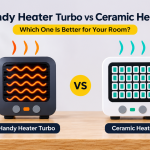
Handy Heater Turbo vs a 1,500 Watt Space Heater
Many popular space heaters are rated at 1,500 watts, which is the highest power a standard household outlet is generally designed to supply continuously. That is almost double the Turbo’s 800 watts, and the running cost is almost double as well.

At 18 cents per kWh, a 1,500 watt heater costs about 27 cents per hour, compared with about 14 cents for the Turbo. Over a month at four hours a day, that is roughly $32.40 versus $17.28.
The trade-off is heating capability. An 800 watt heater produces about 2,730 BTU of heat per hour. A common rule of thumb is around 10 watts per square foot, which suggests the Turbo is best for spaces up to about 80 square feet. A 1,500 watt unit can warm a larger room, but costs more every hour it runs. If your room is small, the lower wattage is the more economical choice. If your room is large, a small heater may run constantly and still struggle to make a noticeable difference.
Is the Handy Heater Turbo Worth It?
From a pure running cost point of view, yes: it is one of the cheapest ways to add targeted warmth. From a heating performance point of view, it depends on what you expect.
Who it suits well
- People who want to warm a small room, bathroom or desk area for a short time
- Renters and dorm residents who want a simple, low-cost option
- Anyone who wants to lift the chill in one space instead of heating the whole house
- Households that want a compact heater without a floor footprint
Who should look at a stronger heater
- People trying to heat a large living room or open-plan area
- Garages, workshops or rooms with poor insulation
- Anyone expecting it to replace central heating
Be realistic about the result. A low-wattage heater cannot create large temperature jumps in a big or draughty space. It works best as a supplement that makes a small area comfortable, not as a primary heat source for the whole home.
6 Ways to Lower Your Heater Running Cost

- Use the timer. Set it to switch off after the time you really need, so the heater never runs on while you sleep or leave the house.
- Heat only one room. Close the door so the warmth stays where you want it, and do not try to heat connected spaces.
- Choose a sensible thermostat setting. Every degree you add makes the heater run longer. A comfortable but modest setting costs less than the maximum.
- Seal drafts. Door gaps, window leaks and gaps under doors let heat escape. Draught excluders and weatherstripping are cheap and effective.
- Warm up, then cut back. Run it until the room is comfortable, then let the thermostat maintain the temperature instead of leaving it at full blast.
- Dress for the weather. A sweater, slippers and a blanket allow you to keep the heater setting lower while still feeling warm.
Safety Tips for Wall Outlet Heaters
Electric heaters are among the more common causes of home fires, so safe use matters as much as running cost. Follow these basics:
- Plug directly into the wall. Do not use extension cords, power strips or surge protectors with heaters.
- Keep clear space. Keep curtains, bedding, furniture and clothing away from the front of the unit.
- Do not leave it unattended in rooms where children or pets could touch it, and do not run it while you sleep unless the manufacturer’s instructions allow it.
- Check the outlet. If the outlet or plug feels hot, looks scorched or the heater cuts in and out, stop using it and have the outlet inspected.
- Keep it dry. Do not use it where it can get wet, and follow the manual’s guidance for bathroom use.
- Read the manual. Follow the instructions supplied with your exact model.
Frequently Asked Questions
How much does it cost to run a Handy Heater Turbo per hour?
At the 2026 US average of about 18 cents per kWh, the 800 watt Handy Heater Turbo costs roughly 14 cents per hour at full power. At 12 cents per kWh it is about 10 cents, and at 30 cents per kWh it is about 24 cents.
How much does it cost to run it all day?
Running at continuous full power for 24 hours uses 19.2 kWh. At 18 cents per kWh that is about $3.46. In reality the thermostat will switch the element off for part of that time, and the timer allows up to 12 hours, so the true cost is normally lower.
How much will it add to my monthly electric bill?
If you use it two hours a day, expect about $8.64 a month at 18 cents per kWh. At four hours a day it is about $17.28, and at eight hours a day it is about $34.56, all at continuous full power.
Is the Handy Heater Turbo energy efficient?
Like every electric resistance heater, it turns nearly all the electricity it uses into heat. Its advantage is its low 800 watt draw and small size, which makes it inexpensive to run in a small space. It is not more efficient than other electric heaters at producing heat; it simply uses less power overall.
Can it heat a whole room?
It is designed for personal and small-room use. As a guide, 800 watts suits roughly 80 square feet. In larger or cold rooms it may only warm the area close to the heater.
Is it cheaper than a 1,500 watt heater?
Per hour, yes. It uses about 47 percent less power than a 1,500 watt unit. But a stronger heater reaches the target temperature faster in a big room and may cycle off sooner, so the best choice depends on the size of the space.
Can I use it with an extension cord?
No. Heaters draw a lot of current, and extension cords and power strips can overheat. Plug it directly into a wall outlet.
Does the cost change with the season?
Your usage changes, not the heater. In deep winter the thermostat keeps the element on longer, so your cost rises. In milder weather it cycles off more often. Some utilities also use higher winter or peak-time rates, so check your plan.
Final Verdict
The Handy Heater Turbo is cheap to buy and cheap to run. At about 14 cents an hour at the national average rate, it costs far less than a typical 1,500 watt space heater, and the thermostat and timer help keep the real cost lower still. For a bathroom, bedroom, nursery or home office, it is a practical way to take the edge off the cold without raising the thermostat for the whole house.
Just keep expectations realistic. It is a small, low-power heater for small spaces. If you need to heat a large room, a higher-wattage unit will do the job better, even though it costs more per hour. Whichever you choose, use the formula in this guide with your own electricity rate to see what it will really cost you before you buy.
Cost figures are estimates based on an 800 watt rating and the 2026 US average residential electricity rate of roughly 18 cents per kWh. Your actual cost depends on your local rate, thermostat settings, room size and usage. Always check the label and manual of your specific model.