


Before you buy a plug-in heater, you need to know one thing: how much space can it actually heat? A heater that is too weak for your room will run nonstop and still leave you cold, while one that is too strong wastes money. That is why the Handy Heater Turbo heating capacity is the number worth checking first.
This guide explains the Turbo’s power rating, converts it into BTU, shows how many square feet it can realistically warm, and tells you honestly where it works well and where it falls short.
Quick answer
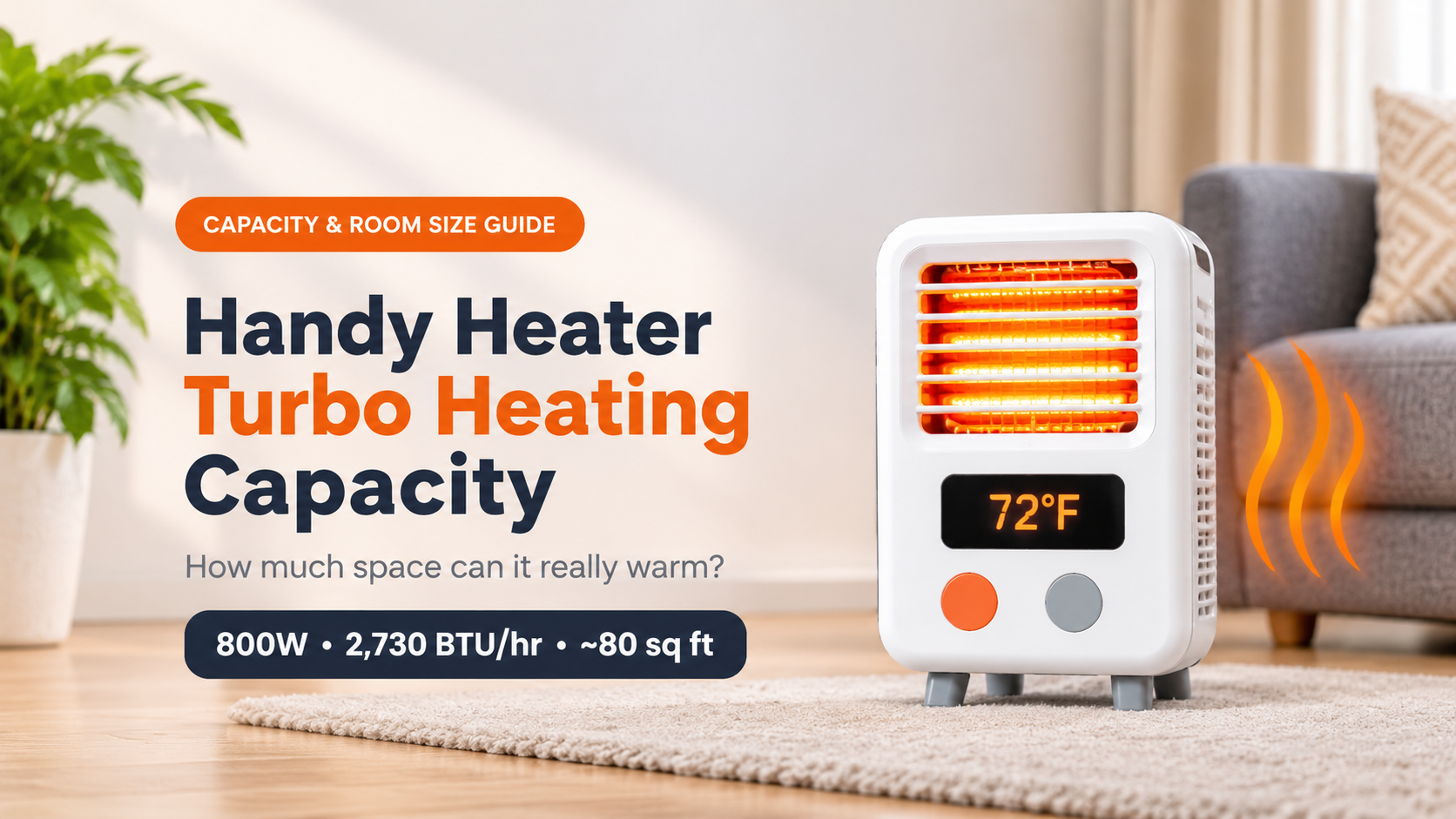
The Handy Heater Turbo 800 is rated at 800 watts, which equals about 2,730 BTU per hour. As a general rule, that is enough to keep roughly 80 square feet comfortable, such as a bathroom, small bedroom or home office with average insulation. It is a personal heater, not a whole-room or whole-house solution.
What Is the Handy Heater Turbo?
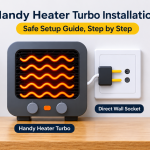
The Handy Heater Turbo is a compact ceramic heater that plugs straight into a wall outlet. It sits against the wall instead of on the floor, which makes it popular for small rooms where space is tight.
Retailer listings for the Turbo 800 describe these main specifications and features:
- Power: 800 watts
- Heating element: ceramic
- Controls: adjustable thermostat with a digital LED display
- Timer: programmable up to 12 hours
- Safety: automatic shut-off and a stay-cool housing
- Certification: ETL listed
Note: Handy Heater sells several models with different power ratings. Everything in this article is based on the 800 watt Turbo. Check the label on your own unit, because capacity changes directly with wattage.
Handy Heater Turbo Heating Capacity in Watts and BTU
Heating capacity is simply how much heat energy a heater produces. Electric heaters list it in watts, while many buyers compare heaters in BTU (British Thermal Units) per hour.
The conversion is straightforward: 1 watt of electric heat equals about 3.412 BTU per hour. For the Turbo:
800 watts × 3.412 = about 2,730 BTU per hour

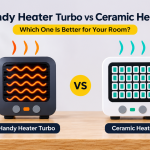
One useful fact: every electric resistance heater converts essentially all the electricity it draws into heat. This means an 800 watt electric heater produces the same 2,730 BTU of heat as any other 800 watt electric heater, no matter the brand or shape. Differences between models show up in how the heat is delivered, how quickly it spreads and how safe or convenient it is, not in total heat output.
| Heater Power | Heat Output (BTU/hr) | Approx. Room Size |
|---|---|---|
| 400 W | about 1,365 | about 40 sq ft |
| 800 W (Handy Heater Turbo) | about 2,730 | about 80 sq ft |
| 1,000 W | about 3,412 | about 100 sq ft |
| 1,500 W | about 5,118 | about 150 sq ft |
How Many Square Feet Can the Handy Heater Turbo Heat?
A common planning guideline for electric heaters is about 10 watts per square foot for a room with standard 8 foot ceilings and average insulation. Dividing the Turbo’s 800 watts by 10 gives approximately 80 square feet.
That is about the size of a bathroom or small bedroom, for example a room that measures 8 feet by 10 feet. It is not the size of a typical living room, which is often 200 square feet or more.

Treat 80 square feet as a ceiling, not a promise. It describes a room where the heater can keep the temperature comfortable, not a room it can quickly transform from freezing to warm.
What Rooms Is It Best For?
| Space | Typical Size | Suitability |
|---|---|---|
| Half bathroom or powder room | 20–40 sq ft | Excellent |
| Full bathroom | 40–60 sq ft | Very good |
| Small home office or nook | 50–80 sq ft | Good |
| Nursery or small bedroom | 70–90 sq ft | Good to borderline |
| Standard bedroom | 110–150 sq ft | Limited, spot heating only |
| Living room or open-plan area | 200+ sq ft | Not recommended |
| Garage or workshop | Varies, poorly insulated | Not recommended |
Why the 80 Square Foot Figure Is Only a Starting Point
Heating capacity is only half the story. The other half is how fast the room loses heat. A heater has to replace the warmth that leaks out through walls, windows, doors and the floor. If the room loses heat quickly, 800 watts covers a much smaller area.
Several factors change the real-world result:
- Insulation: well-insulated rooms hold heat; thin walls and old windows let it escape.
- Outside temperature: the colder it is outside, the more heat the room loses.
- Ceiling height: taller ceilings mean more air to warm.
- Drafts: gaps around doors and windows can cancel much of the heater’s output.
- Starting temperature: warming a very cold room takes much more energy than maintaining a mild one.
- Room layout: open doorways let warm air drift into other spaces.

Planning guides often raise the watts-per-square-foot figure for poorly insulated rooms, to roughly 12 to 15 watts. At that level the Turbo’s realistic coverage drops to about 53 to 67 square feet. In a very well-insulated room it can stretch to around 110 square feet. These are estimates, but they show why two people can have very different experiences with the same heater.
How Much Will It Raise the Room Temperature?
It is natural to ask, “How many degrees will it add?” No honest answer exists without knowing the room. The temperature rise depends on the balance between the heat the heater produces and the heat the room loses.
In a small, sealed bathroom with the door closed, 800 watts can make a noticeable difference in a short time. In a larger or drafty room, much of the heat is lost as fast as it is produced, so the improvement may be modest. Warm air from a small heater is also felt most strongly close to the unit, so you may feel warmer near it than on the far side of the room.
A realistic expectation is this: the Turbo is designed to take the chill off a small space and keep it comfortable, not to heat a cold room by 20 degrees.
Handy Heater Turbo vs a 1,500 Watt Space Heater
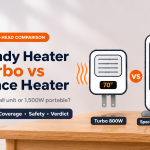
A 1,500 watt heater, which is the maximum most household outlets are designed to supply continuously, produces about 5,118 BTU per hour. That is almost double the Turbo’s output and, by the same rule of thumb, suits rooms around 150 square feet.
- Choose the Turbo for bathrooms, nurseries, desks and other small spaces where its 800 watts is enough and the wall-mounted design saves space.
- Choose a 1,500 watt heater for a standard bedroom, a larger office or any room where you want faster warm-up and more reserve power.
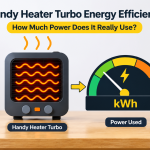
Running cost is the flip side. An 800 watt heater uses about 47 percent less electricity per hour than a 1,500 watt unit. At the 2026 US average of roughly 18 cents per kWh, the Turbo costs around 14 cents per hour to run at full power, compared with about 27 cents for a 1,500 watt heater.
The Role of the Thermostat and Timer
The Turbo’s thermostat does not change the heater’s maximum capacity, but it helps you use it wisely. Once the room reaches your set temperature, the heating element switches off and only returns when the room cools. This keeps the temperature steady and reduces energy use.
The programmable timer of up to 12 hours lets you decide how long the heater works. It is useful for warming a bathroom before you get up or switching off automatically after you leave.
6 Ways to Get the Most From 800 Watts

- Match it to a small room. Keep to spaces of about 80 square feet or less for the best results.
- Close the door. Containing the warm air in one room makes a big difference.
- Seal drafts. Weatherstripping, door draft stoppers and window film are inexpensive and effective.
- Keep the area clear. Do not block the front of the heater with furniture, curtains or bedding, which is also a safety rule.
- Use the thermostat. Set a steady target instead of leaving it on maximum.
- Dress warmly. A sweater or blanket lets you feel comfortable at a lower room temperature.
Safety Notes for Wall Outlet Heaters
- Plug the heater directly into the wall. Never use extension cords, power strips or surge protectors with a heater.
- Keep flammable materials such as curtains, bedding and clothing well away from the front.
- Stop using it and have the outlet checked if the plug or outlet feels hot, shows discoloration or the heater cuts in and out.
- Keep it away from water, and follow the manual’s guidance for bathroom use.
- Supervise it around children and pets, and follow the manufacturer’s instructions for your exact model.
Pros and Cons of the Handy Heater Turbo’s Heating Capacity
Pros
- Enough power for bathrooms, offices and other small spaces
- Low 800 watt draw means a low hourly running cost
- Wall-mounted design uses no floor space
- Thermostat, timer and auto shut-off give useful control and protection
Cons
- Limited to small rooms; not a whole-room heater for larger spaces
- Struggles in cold, drafty or poorly insulated areas
- Heat is strongest near the unit, so distant corners warm slowly
Frequently Asked Questions
What is the heating capacity of the Handy Heater Turbo?
The Turbo 800 is rated at 800 watts, which is about 2,730 BTU per hour.
How many square feet will it heat?
Using the common guideline of 10 watts per square foot, about 80 square feet. In drafty or poorly insulated rooms this may fall to roughly 50 to 65 square feet.
Can it heat a bedroom?
A small bedroom or nursery of around 80 square feet is a reasonable fit. A standard bedroom of 110 to 150 square feet will likely only warm the area close to the heater, and a higher-wattage heater is a better choice.
Can it heat a bathroom?
Yes. Bathrooms are usually 40 to 60 square feet, which is well within the Turbo’s capacity, especially with the door closed. Follow the manufacturer’s instructions about moisture and placement.
Can it heat a garage or basement?
It is not a good fit. These spaces tend to be large, cold and poorly insulated, and 800 watts will not make much difference.
Is it powerful enough to be my main heat source?
No. It is a supplemental, personal heater. Use it to add comfort in one small space, not to replace central heating.
Does a higher wattage heat faster?
Yes. More watts means more heat output per hour, so a 1,500 watt heater warms a room faster than an 800 watt heater, though it also uses more electricity.
How much does it cost to run?
At about 18 cents per kWh, roughly 14 cents per hour at full power. Because the thermostat cycles the element on and off, real cost is often lower.
Final Verdict
The Handy Heater Turbo’s heating capacity is exactly what you would expect from a compact, low-wattage plug-in heater: 800 watts, about 2,730 BTU per hour, and around 80 square feet of coverage in an average room. That makes it a solid choice for bathrooms, small offices, nurseries and other small spaces where you want quick, affordable warmth without a bulky floor heater.
It is not designed for large rooms, cold garages or whole-home heating. If your space is bigger than about 80 square feet, or poorly insulated, step up to a higher-wattage heater. Measure your room first, match the wattage to the space, and you will get the comfort you are paying for.
Coverage figures are estimates based on an 800 watt rating and common planning guidelines of about 10 watts per square foot for standard 8 foot ceilings. Real performance depends on insulation, climate, drafts and room layout. Always check the label and manual of your specific model.