







How High to Hang Wall Art Above Furniture: The Complete Height Guide
You have found the perfect piece of art, the furniture is in place and you are standing on a stool with a hammer in your hand. Then the big question hits: how high should I hang it? Hang the art too high and it floats away from the furniture, looking lost. Hang it too low and the whole arrangement feels cramped. Getting the height right is one of the easiest ways to make a room look professionally styled.
This guide explains how high to hang wall art above furniture, with exact measurements for sofas, beds, consoles, dressers, mantels and more. You will learn the famous 57-inch rule, how to size your art, how to calculate the hook position and how to avoid the most common mistakes.
Quick Answer
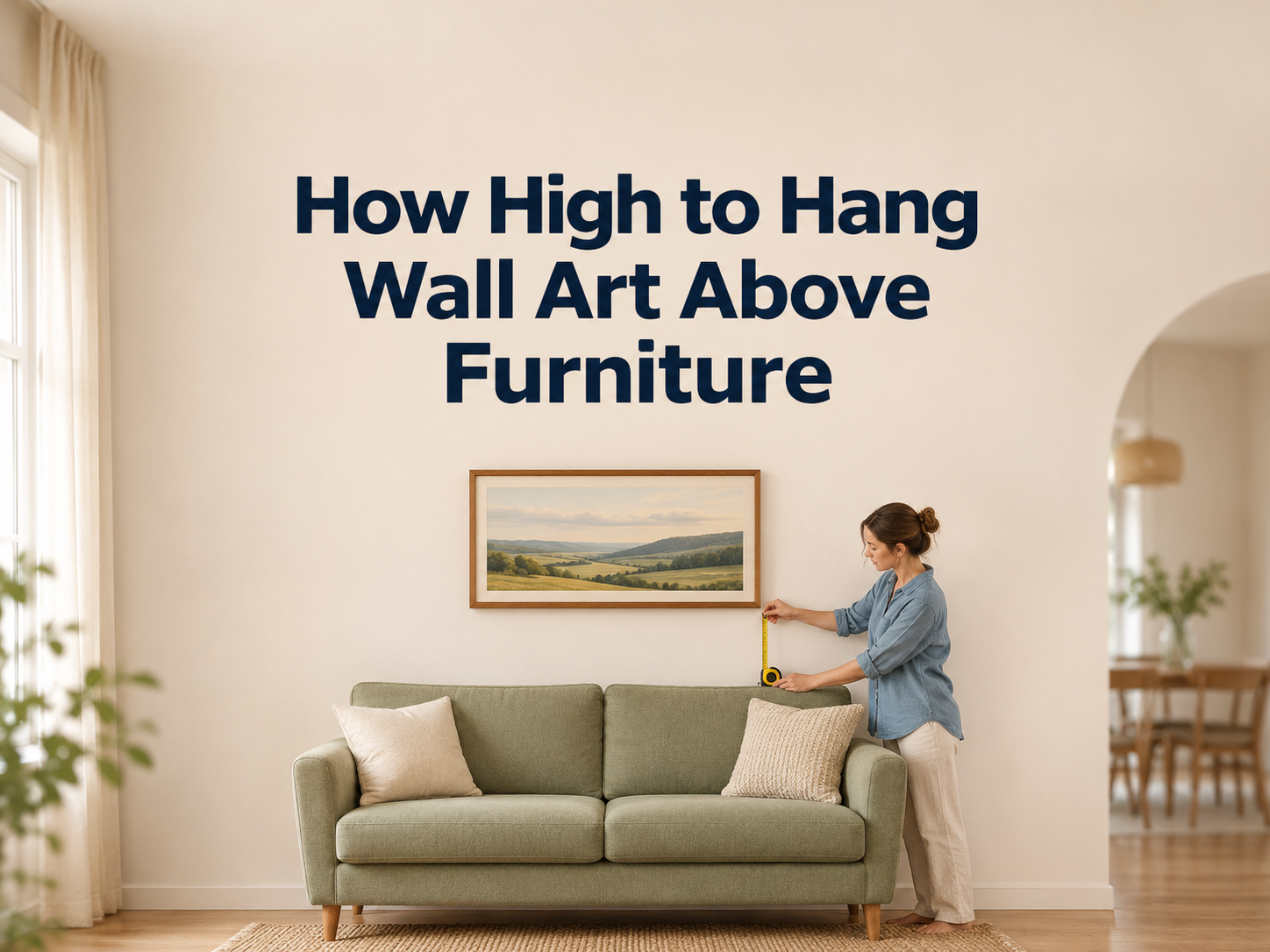
Hang wall art about 6 to 10 inches (15 to 25 cm) above the top of your furniture, such as a sofa, console or dresser. Make sure the center of the artwork sits at roughly 57 inches (145 cm) from the floor, which is average eye level, and choose a piece that is about two-thirds to three-quarters the width of the furniture below it. Above a bed, the gap is slightly smaller, and above a mantel it is usually 4 to 6 inches.
The 57-Inch Rule: The Starting Point for Every Wall
Galleries and museums hang art so that the center of the piece is about 57 inches (145 cm) from the floor. This matches the average human eye level, so the artwork feels natural to look at without craning your neck up or down. It is the best starting point for any wall, whether or not there is furniture underneath.
When art hangs above furniture, you balance two goals: keeping the center near eye level and keeping the art visually tied to the furniture below. That is why the gap between the furniture and the bottom of the frame matters so much.
How High Above a Sofa or Couch?
Hang art 6 to 10 inches (15 to 25 cm) above the back of the sofa. At this distance the art and sofa read as one grouped arrangement. If the gap is much larger than 12 inches, the artwork starts to feel disconnected and the wall looks empty in between.
Width matters as much as height. The artwork, or a group of pieces hung as one unit, should be roughly two-thirds to three-quarters the width of the sofa and centered on it, not on the wall.
How High Above Other Types of Furniture?
The ideal gap changes slightly depending on the furniture. Here is a simple guide you can use for every room in the house:
Above a Console Table or Entryway Table
Leave about 6 to 10 inches (15 to 25 cm) between the tabletop and the bottom of the frame. Consoles often hold lamps, vases and trays, so measure the tallest object and make sure it will not hide the artwork. A mirror is a popular choice here and follows the same rule.
Above a Bed or Headboard
Aim for about 4 to 8 inches (10 to 20 cm) above the top of the headboard. If you have no headboard, treat the top of the pillows as the starting point and leave a slightly larger gap so the art does not feel cramped when you sit up. Choose a piece or a pair that is about two-thirds the width of the bed.
Above a Dresser, Sideboard or Credenza
Use the same 6 to 10 inch gap. Because these pieces are long and low, a wide horizontal piece, a pair of matching frames or a mirror works well. Hang the art centered on the furniture rather than on the wall if the two are different.
Above a Fireplace Mantel
Hang the art about 4 to 6 inches (10 to 15 cm) above the mantel. Mantels sit higher than other furniture, so a larger gap quickly pushes the art far above eye level. If the mantel is very tall, you may place the art slightly higher but should still keep it as close as is comfortable.
Above a Desk or Workspace
Leave about 6 to 10 inches above the desk surface or monitor line, and keep the art out of your direct line of sight so it does not distract you. Consider a shelf or ledge to display lighter, changeable pieces.
How Big Should the Art Be?
The size of the artwork matters as much as its height. A small frame above a large sofa looks lost, even if it is at the perfect height. As a rule of thumb, the art should be about 60 to 75 percent (two-thirds to three-quarters) of the width of the furniture. Here are some handy examples:
| Furniture | Typical Width | Recommended Art Width |
|---|---|---|
| Large sofa | 84 in (213 cm) | 56 to 63 in (142 to 160 cm) |
| Loveseat | 60 in (152 cm) | 40 to 45 in (102 to 114 cm) |
| Console table | 48 in (122 cm) | 32 to 36 in (81 to 91 cm) |
| Queen bed headboard | 60 in (152 cm) | 40 to 45 in (102 to 114 cm) |
| King bed headboard | 76 in (193 cm) | 51 to 57 in (130 to 145 cm) |
| Dresser | 60 in (152 cm) | 40 to 45 in (102 to 114 cm) |
If you cannot find a single piece that large, use a pair, a triptych or a gallery wall. Treat the whole group as one big rectangle and apply the same height and width rules to the outside edges, with about 2 to 3 inches (5 to 8 cm) between frames.
Does Ceiling Height Change the Rule?
Standard 8-foot (2.4 m) ceilings work perfectly with the 57-inch rule. On taller walls, make the art bigger instead of simply hanging it higher. Here is how to adapt:
- Standard ceilings (8 ft / 2.4 m): follow the 57-inch center rule and a 4 to 8 inch gap above furniture.
- Taller ceilings (9 to 10 ft / 2.7 to 3 m): use larger pieces or a vertical arrangement, and a gap toward the upper end of the range.
- Very high ceilings (12 ft or more): choose oversized art or stack two pieces vertically so the wall feels filled without losing the connection to the furniture.
- Low or sloped ceilings: keep the art lower in the range and choose a horizontal piece so it fits comfortably.
How to Calculate Where to Put the Nail or Hook
This is the step where most people get stuck. The hook position is not the same as the top of the frame, because the wire sags a little when it is pulled tight by the hook. Follow this simple formula:
Wire drop is the distance from the top of the frame to the wire when it is pulled taut with your finger (usually 1 to 3 inches).
Example: A sofa is 34 inches tall. You want an 8-inch gap and the art is 30 inches high. The bottom of the art is at 34 + 8 = 42 inches and the top is at 42 + 30 = 72 inches. If the wire drops 2 inches, the hook goes at 72 – 2 = 70 inches. Check the result: the art center is at 42 + 15 = 57 inches, exactly the gallery standard.
Special Situations and How to Handle Them
When the Furniture Is Not Centered on the Wall
Center the art on the furniture, not on the wall. The art and furniture should look like one group. If a sofa sits slightly off-center, add a plant, lamp or small piece of art on the other side to balance the wall.
When the Sofa Is Very Low or Very High
A low sofa leaves a lot of wall space, so choose taller or larger art and still hang the center near 57 inches. A tall sofa or a high-back chair pushes the bottom of the frame up, so use a wider, shorter piece to keep the center from rising too far above eye level.
Hanging Art Above a TV Console
Art over a TV console works best when the TV is off-center or mounted to the side. If the TV is mounted above the console, hang the art to the side of the TV or on a different wall instead.
Gallery Walls Above Furniture
Plan the layout on the floor first. Keep the bottom edge of the lowest frames 6 to 10 inches above the furniture, and the center of the entire group near 57 inches where possible. Keep spacing between frames consistent.
Rooms Where People Mostly Sit
In dining rooms, living rooms and bedrooms where people often sit, the art can hang a little lower, with the center around 50 to 55 inches, so it sits comfortably in the line of sight of seated people.
Common Mistakes to Avoid
- Hanging art too high: it separates the art from the furniture and strains the neck.
- Choosing art that is too small: it looks lost above large furniture and wastes the wall space.
- Leaving a gap larger than 12 inches: this breaks the connection between the art and the furniture.
- Centering on the wall instead of the furniture: the art looks crooked even if it is level.
- Ignoring the wire drop: the picture ends up lower than planned.
- Skipping the level: a small tilt is very noticeable above a long piece of furniture.
- Using weak hardware: heavy art needs wall anchors or studs, not a single small nail.
- Forgetting items on the furniture: tall lamps and vases can block part of the artwork.
Tools and Products That Make Hanging Art Easier
With the right tools you can hang art accurately on the first try. Here is what to look for when shopping:
- Tape measure: a sturdy, locking measuring tape is essential.
- Spirit level or laser level: keeps frames perfectly straight.
- Stud finder: locates studs for heavy art and mirrors.
- Picture hanging kit: includes hooks, nails, wire and D-rings in a range of weight ratings.
- Wall anchors: for drywall when you cannot hit a stud.
- Painter’s tape and kraft paper: to make a template and preview the layout.
- Adhesive hanging strips: a damage-free option for light frames.
- Adhesive bumpers: keep frames straight and stop them shifting.
Frequently Asked Questions
How high should I hang art above a sofa?
Hang it about 6 to 10 inches (15 to 25 cm) above the back of the sofa, with the center of the art ideally around 57 inches from the floor.
What is the standard height to hang wall art?
The standard is 57 inches (145 cm) from the floor to the center of the artwork, which matches average eye level.
How high above a console table should art hang?
Leave about 6 to 10 inches between the tabletop and the bottom of the frame. Account for the height of lamps and decor on the table.
How high should art be above a bed?
Hang it about 4 to 8 inches above the headboard, or slightly higher if there is no headboard, and keep it centered on the bed.
How high above a fireplace mantel should art hang?
About 4 to 6 inches above the mantel is typical. Mantels are already high, so a small gap helps keep the art near eye level.
How big should art be above furniture?
It should be roughly two-thirds to three-quarters the width of the furniture below. Use a pair or a gallery wall if a single piece would be too small.
Should art be centered on the furniture or the wall?
Center it on the furniture so the two read as one group. If the furniture is off-center, balance the wall with a lamp, plant or small piece of art.
Is it okay to hang art lower than 57 inches?
Yes, especially in rooms where people sit, such as dining rooms and bedrooms. A center of about 50 to 55 inches works well in seated spaces.
Final Thoughts
Now you know exactly how high to hang wall art above furniture. Keep a gap of about 6 to 10 inches above most furniture, aim for the center of the art near 57 inches from the floor, choose art that is two-thirds to three-quarters of the furniture width and always center it on the furniture below.
Use the hook height formula, tape a paper template on the wall to preview the position and check your work with a level. A few careful measurements are all it takes to make your walls look balanced, intentional and professionally styled.