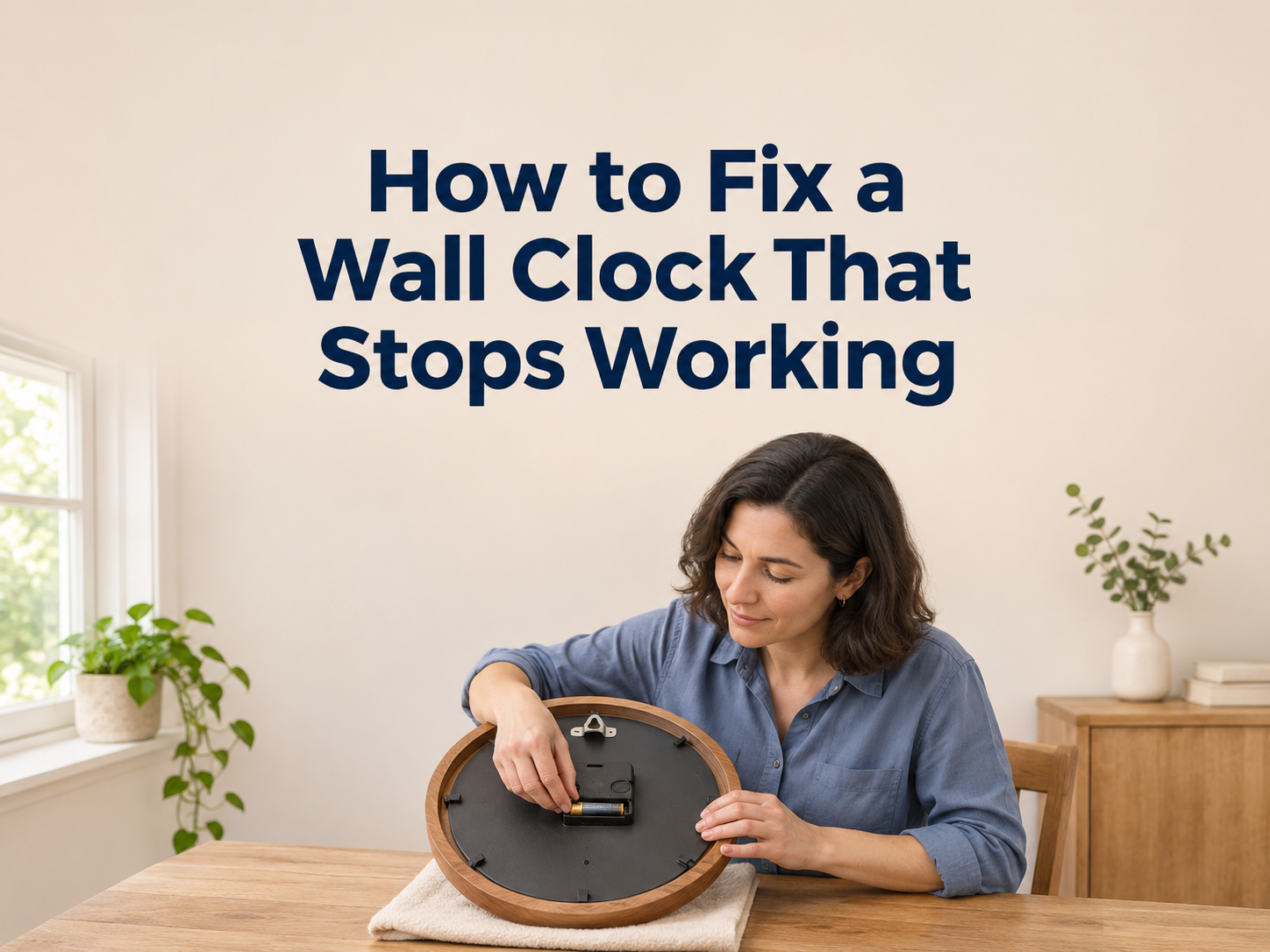










You set your wall clock perfectly on Sunday. By Friday, it is five minutes behind and you are running late for everything. It is one of the most common household annoyances — and the good news is that it almost always has a simple, inexpensive explanation.
In this guide, we will explain exactly why your wall clock loses time, how to diagnose the problem in a few minutes, and what you can do to keep any clock — quartz, pendulum, or radio-controlled — running accurately for years.
⏱ Quick Answer
The most common reason a wall clock loses time is a weak or wrong battery. As a battery drains, its voltage drops and the clock’s tiny motor no longer has enough power to move the hands reliably. Other common causes include hands rubbing against each other or the glass, hands that are too heavy for the movement, extreme temperature or humidity, dust, and a worn-out clock movement. For pendulum clocks, the pendulum may need regulating or the clock may be out of beat.
How a Wall Clock Keeps Time
Before you can fix a slow clock, it helps to understand what is going on behind the dial. The vast majority of wall clocks sold today use a quartz movement — a small plastic box mounted on the back of the dial that holds the battery, the electronics, and the gears.
Inside that box is a tiny quartz crystal shaped like a tuning fork. When electricity from the battery passes through it, the crystal vibrates at exactly 32,768 times per second. A circuit counts those vibrations and, once every second, sends a pulse to a small stepper motor. The motor turns a gear train, which moves the second, minute, and hour hands.
Here is the key insight: the quartz crystal itself is extremely accurate. A typical quartz clock in good condition drifts only about half a second a day, or roughly 15 seconds a month. So when your clock is losing several minutes a week, the crystal is rarely to blame. The problem is almost always somewhere else in the chain — usually the power supply or the mechanical load on the motor.
Traditional mechanical and pendulum clocks work differently. They are driven by a wound spring or hanging weights, and their speed is controlled by the swing of a pendulum or the oscillation of a balance wheel. These clocks are naturally less precise and are much more sensitive to adjustment, level, and lubrication. We cover them in their own section below.
10 Reasons Why Your Wall Clock Loses Time
1. The Battery Is Getting Weak
This is the culprit in most cases. A fresh AA alkaline battery starts at about 1.5 to 1.6 volts. As it drains, the voltage gradually falls. Long before the clock stops completely, the motor begins to struggle — it may miss steps, especially when the second hand has to climb upward from the 6 to the 12. Every missed step is a lost second, and they add up quickly.
A telltale sign: watch the second hand between the 7 and the 10 position. If it twitches, bounces back, or seems to stall before moving on, the battery is almost certainly weak.
2. You Are Using the Wrong Type of Battery
Not all AA batteries are created equal. Rechargeable NiMH batteries are rated at only 1.2 volts — the same level at which a standard alkaline battery is considered nearly dead. Many clock movements are designed around 1.5 volts, so a rechargeable cell can make the clock run slow from day one. Heavy-duty zinc-carbon batteries can also sag in voltage faster than alkaline ones.
Best practice: use a fresh, name-brand 1.5 V alkaline battery, and check the date stamp on the package. Lithium AA batteries also work well in most clocks, though they start at a slightly higher voltage.
3. Corroded or Loose Battery Contacts
If a battery has been left in the clock for a long time, it may have leaked, leaving white or greenish crust on the metal terminals. Corrosion increases electrical resistance, which means less power reaches the motor — even with a brand-new battery. Loose or bent spring contacts cause the same problem by creating an intermittent connection.
Clean light corrosion with a cotton swab dipped in a little white vinegar or lemon juice, then wipe dry. Gently bend the contacts so they press firmly against the battery.
4. The Hands Are Touching Each Other, the Dial, or the Glass
This is the second most common cause and is often overlooked. If the minute hand brushes against the hour hand, if the second hand scrapes the glass cover, or if the hour hand drags on the dial face, the friction slows down the movement. Often the clock keeps good time for part of the day and then loses minutes at the specific moment the hands overlap — which makes the problem seem random.
Look at the clock from the side as the hands pass each other. Each hand should sit parallel to the dial with a small, even gap between all layers. If two hands touch, carefully bend the offending hand slightly toward or away from the dial with your fingers, or press the hand a little further onto its shaft.
5. The Hands Are Too Heavy or Too Long
Standard quartz movements are designed to carry relatively short, lightweight hands — roughly up to 6 or 7 inches for the minute hand. If you have a large decorative clock or have replaced the original hands with longer metal ones, the motor may not have enough torque to lift the minute hand from the 6 back up to the 12. The clock then loses time on the upward climb, typically during the second half of each hour.
If you have a clock with a dial larger than about 12 inches or heavy ornamental hands, make sure it uses a high-torque movement, which is built specifically to handle the extra weight.
6. The Clock Movement Is Worn Out
Quartz movements are inexpensive and are not designed to last forever. After many years of continuous operation, the plastic gears wear, the lubricant dries out, and the motor becomes weaker. If you have tried a fresh battery, checked the hands, and the clock still loses time, the movement itself is probably at the end of its life.
The good news is that replacement movements are affordable and widely available. As long as you match the shaft length to the thickness of your dial and choose a movement that accepts your existing hands (or comes with new ones), swapping it out takes about 15 minutes and requires no special tools.
7. Temperature and Humidity Swings
Quartz crystals are tuned to be most accurate at around room temperature, roughly 25°C (77°F). They run slightly slower in both hotter and colder conditions. On top of that, cold weather reduces battery performance, and humidity can make lubricants sticky and encourage corrosion.
A clock hung above a radiator, next to an oven, in a sunny window, on an exterior wall that gets cold in winter, or in a steamy bathroom will often drift more than one hung on a stable interior wall.
8. Dust, Dirt, and Grease
Dust and kitchen grease can find their way into a clock movement over time, especially if the clock does not have a sealed glass front. Grit adds friction to gears and pivots, and the weak motor in a quartz clock has very little power to overcome it. Kitchen clocks are particularly vulnerable to a sticky film from cooking vapors.
9. Magnetic or Electrical Interference
The stepper motor in a quartz clock uses a small magnet. Placing a clock very close to strong magnets, large speakers, or certain electrical equipment can occasionally disturb the motor and cause irregular timekeeping. It is not a common cause, but if your clock only misbehaves in one particular spot, interference is worth considering.
10. A Radio-Controlled Clock Cannot Receive Its Signal
Radio-controlled (often called “atomic”) clocks automatically correct themselves by receiving a time signal broadcast from a national transmitter. Between updates, they run on an ordinary quartz movement. If the clock cannot pick up the signal — because of thick walls, metal structures, electronic interference, or distance from the transmitter — it simply drifts like a normal quartz clock and may appear to lose time.
Try placing the clock near a window facing the direction of the transmitter, away from TVs, computers, and routers. Reception is usually strongest overnight, so leave it in place until morning before deciding it is not working.
Pendulum and Mechanical Clocks: Special Causes
If you own a mechanical wall clock, such as a regulator, schoolhouse, or cuckoo clock, there are a few extra reasons it may run slow:
- The pendulum needs regulating. The length of the pendulum controls the clock’s speed. A longer pendulum swings more slowly, so if the clock is losing time, the pendulum is effectively too long.
- The clock is out of beat. The “tick” and “tock” should sound evenly spaced. An uneven, limping rhythm means the clock is not hanging level or the escapement needs adjustment, which can cause it to lose time or stop.
- The mainspring is running down. Many spring-driven clocks run slower near the end of their wind. Wind the clock fully on a regular schedule, ideally at the same time each week.
- The movement needs cleaning and oiling. Old, dried oil turns into a gummy paste that robs the clock of power. Most mechanical clocks benefit from professional servicing every few years.
- The clock is not mounted securely. A clock that wobbles on the wall wastes the pendulum’s energy. Make sure it hangs firmly and is plumb.
How to Regulate a Slow Pendulum Clock
Find the small adjustment nut at the bottom of the pendulum bob. To make the clock run faster, turn the nut to raise the bob (on most clocks this is clockwise when viewed from below). Make small adjustments — one full turn can change the rate by roughly a minute a day on many clocks — then let the clock run for 24 hours and compare it with an accurate time source before adjusting again. Remember the old clockmaker’s rule: “Raise to speed up, lower to slow down.”
Step-by-Step: How to Fix a Wall Clock That Loses Time
Work through these steps in order. Most clocks are fixed by step one or two.
- Replace the battery. Install a brand-new 1.5 V alkaline battery, even if the old one still seems to work. Avoid rechargeable cells.
- Inspect the battery contacts. Clean away any corrosion and make sure the springs press firmly against the battery.
- Check the hands for clearance. Remove the clock from the wall and view it from the side. Make sure no hand touches another hand, the dial, or the glass at any point in its rotation.
- Tighten the hands properly. A loose minute hand can slip on its shaft and look like lost time. Press it gently but firmly onto the shaft, or tighten the small cap nut if there is one.
- Relocate the clock. Move it away from heat sources, cold exterior walls, direct sunlight, and humid rooms.
- Clean the clock. Wipe the dial and glass and blow away dust with a can of compressed air. Do not spray liquid cleaner into the movement.
- Replace the movement. If the clock still runs slow, install a new quartz movement with the correct shaft length and torque rating for your hands.
Symptom Checker: What Your Clock Is Telling You
How to Choose a Wall Clock That Keeps Accurate Time
If you are shopping for a new clock, or replacing one that keeps letting you down, these features make the biggest difference to long-term accuracy:
- Radio-controlled (atomic) timekeeping. These clocks set themselves automatically and correct any drift, usually once a day. They also adjust for daylight saving time where applicable. Just confirm the clock supports the time signal used in your region.
- A quality quartz movement. Clocks from established brands generally use better-made movements with more consistent motors and gears.
- A high-torque movement for large clocks. If the dial is larger than about 12 inches or the hands are metal, high torque is essential.
- A silent sweep (continuous) movement. Besides being quiet enough for bedrooms and offices, sweep movements spread the motor’s effort smoothly, though they typically use batteries faster than ticking movements.
- A sealed glass or acrylic front. A cover protects the hands and movement from dust, grease, and curious fingers.
- Lightweight hands with plenty of clearance. Look for even spacing between hands and enough depth between the hands and the cover.
💡 Pro Tip
Write the date on a small piece of tape and stick it inside the battery compartment every time you change the battery. Most quartz wall clocks run for about a year on a single AA alkaline battery — if yours starts slowing much sooner, you will know the problem is the clock, not the battery.
Prevention Tips to Keep Your Clock on Time
- Change the battery once a year, before it gets weak, rather than waiting for the clock to slow down.
- Remove the battery if you store a clock for a long period to prevent leaks and corrosion.
- Keep a spare pack of fresh alkaline batteries stored in a cool, dry place.
- Hang clocks on interior walls, away from heat, steam, and direct sunlight.
- Dust the clock regularly, especially in kitchens.
- Handle the hands as little as possible when setting the time — use the setting knob on the back of the movement instead.
- Have mechanical and pendulum clocks professionally cleaned and oiled every few years.
- Wind spring-driven clocks fully, on the same day each week.
Frequently Asked Questions
How much time is it normal for a wall clock to lose?
A healthy quartz wall clock usually stays within about 15 to 30 seconds per month. Losing more than a minute per week indicates a problem, most often a weak battery or hands that are rubbing. Mechanical pendulum clocks are less precise and may need occasional adjustment to stay within a minute or so per week.
Why does my clock lose time even with a new battery?
Check that the battery is a 1.5 V alkaline and not a rechargeable one, and that the contacts are clean. If the power side is fine, the next most likely causes are hands touching each other or the glass, hands too heavy for the motor, or a worn-out movement that needs replacing.
Can a wall clock lose time because of a cold room?
Yes. Quartz crystals are most accurate at room temperature, and battery output drops in the cold. A clock on a cold exterior wall or in an unheated room can run slower than one in a warm, stable environment.
Do rechargeable batteries make clocks run slow?
They can. Rechargeable NiMH batteries deliver about 1.2 volts, compared with 1.5 volts for a fresh alkaline battery. Many clock motors do not have enough power at that lower voltage to keep perfect time, particularly with larger hands.
Why does my clock lose time only at a certain hour?
This almost always means the hands are touching at that point in their rotation — for example, when the minute hand passes over the hour hand. View the clock from the side and adjust the hands so they have clearance.
Is it worth fixing a cheap wall clock?
Usually yes, because the fix is so simple. A new battery or a slight hand adjustment costs little or nothing, and even a full replacement movement is inexpensive. If you love the look of the clock, replacing the movement is far more economical than buying a new one.
Do atomic clocks ever lose time?
An atomic (radio-controlled) clock only stays accurate when it can receive its time signal. If reception is blocked, it runs on its internal quartz movement and can drift like any other clock until it successfully syncs again.
Final Thoughts
A wall clock that loses time is rarely broken — it is usually asking for a little attention. In most cases, a fresh 1.5 V alkaline battery solves the problem instantly. If it does not, checking the hands for clearance, moving the clock to a more stable spot, or installing an inexpensive new movement will almost always bring it back to reliable timekeeping.
And if you are ready for a clock you never have to think about, a quality radio-controlled model with a well-built movement is one of the simplest upgrades you can make for your home or office. Either way, with the steps in this guide, you will never have to wonder why your wall clock is running behind again.