
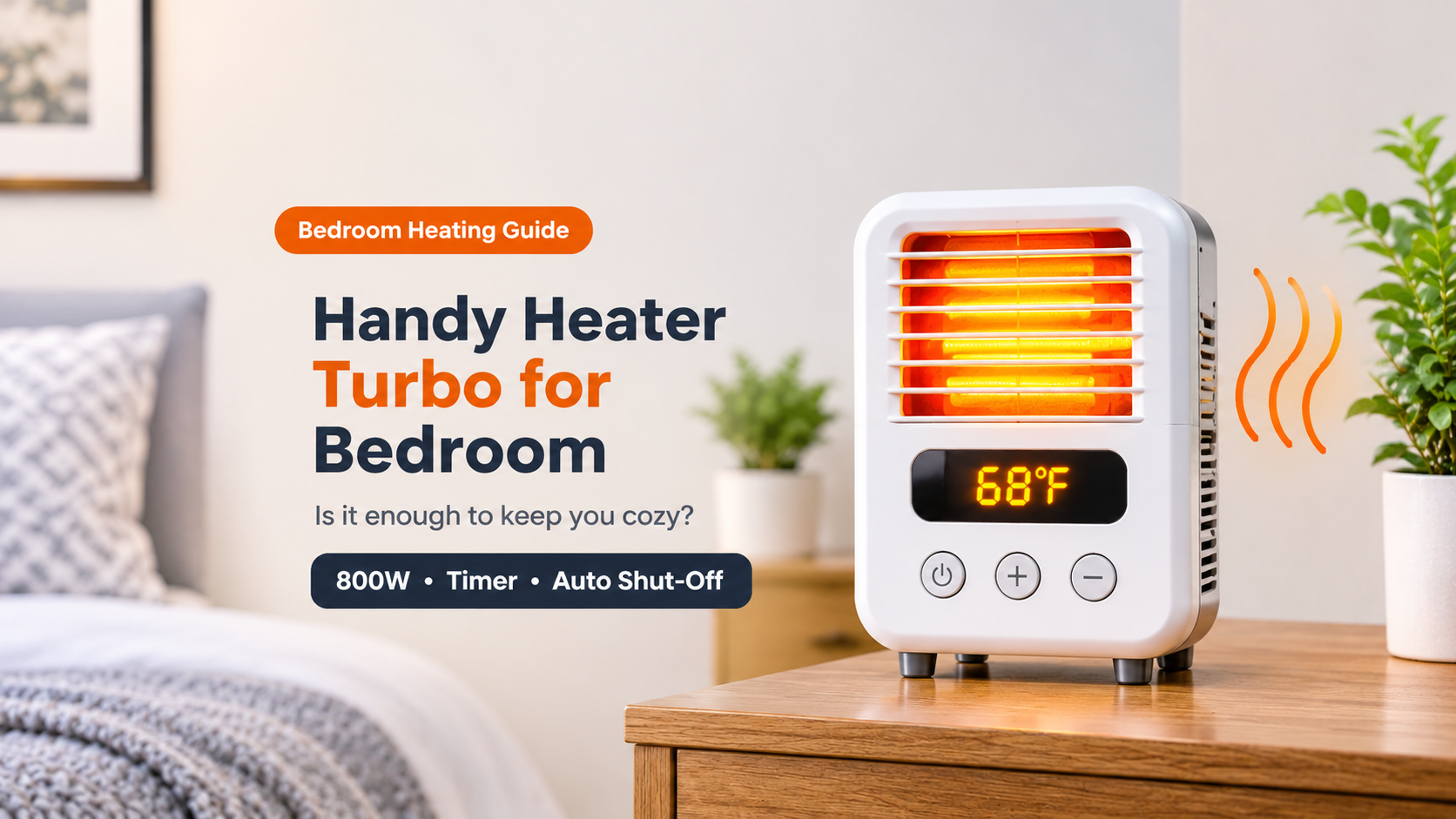

A cold bedroom makes it hard to relax, fall asleep and get out of bed in the morning. Turning up the central heating for the whole house just to warm one room is expensive, so many people look at a small plug-in heater instead. One that comes up often is the Handy Heater Turbo.
But is the Handy Heater Turbo for bedroom use actually a good idea? In this guide you will learn how much room it can really warm, what it costs to run, how to place it safely, and whether it is a smart choice for your own bedroom.
Quick answer
The Handy Heater Turbo 800 is a good match for a small bedroom, nursery or guest room of up to about 80 square feet. In a standard or large bedroom it works best as a spot heater near the bed or desk. It costs about 14 cents per hour at full power, and is best used to warm the room before bedtime with the timer set, rather than left running unattended.
What Is the Handy Heater Turbo?
The Handy Heater Turbo is a compact ceramic heater that plugs directly into a wall outlet, so there is no cord stretching across the floor and no floor space used. Retailer listings for the Turbo 800 describe these features:
- 800 watts of ceramic heating power
- Adjustable thermostat to hold a steady temperature
- Digital LED display
- Programmable timer of up to 12 hours
- Automatic shut-off protection and a stay-cool housing
- ETL listed for safety compliance
It usually sells for about $20 to $30. Handy Heater makes several models with different power levels, so everything below assumes the 800 watt Turbo. Always check the label on your own unit.
Why People Choose It for a Bedroom
- No floor footprint. In a bedroom already full of a bed, dresser and nightstands, a heater that plugs into the wall saves valuable space.
- Quiet operation. Retailer descriptions highlight quiet performance suited to bedrooms and personal spaces, though you should still expect some fan or heating sound.
- Timer and thermostat. You can pre-warm the room, hold a comfortable temperature, and have the unit turn itself off.
- Low running cost. At 800 watts it draws far less than a 1,500 watt space heater.
- Low purchase price. It costs little to try, which suits renters and guest rooms.
How Big a Bedroom Can It Heat?
An 800 watt heater produces about 2,730 BTU of heat per hour. A common planning guideline for electric heaters is about 10 watts per square foot, which gives roughly 80 square feet of coverage in a room with average insulation and standard ceilings.
Now compare that with typical bedroom sizes. A nursery or small guest room often measures 70 to 100 square feet, a standard bedroom 110 to 150 square feet, and a primary suite 200 square feet or more.

| Bedroom Type | Typical Size | How the Turbo Performs |
|---|---|---|
| Nursery or child’s room | 60–90 sq ft | Good fit if well sealed (see child safety notes below) |
| Small guest room or box room | 70–100 sq ft | Good to borderline |
| Standard bedroom | 110–150 sq ft | Takes the edge off near the unit; spot heating only |
| Large or primary bedroom | 200+ sq ft | Not enough on its own |
| Attic, loft or basement bedroom | Varies, often poorly insulated | Likely to struggle |
Remember that 80 square feet is a guideline for a well-insulated room. A bedroom with old windows, an exterior wall facing the wind, or gaps under the door can lose heat as quickly as the heater makes it, which reduces effective coverage to somewhere around 50 to 65 square feet.
How Much Does It Cost to Run in a Bedroom?
An 800 watt heater uses 0.8 kWh per hour at full power. At the 2026 US average electricity price of about 18 cents per kWh, that is roughly 14 cents per hour. How much you actually spend depends on how long you run it.

| Bedroom Routine | Cost Per Night | Cost Per 30 Nights |
|---|---|---|
| 1 hour before bed | $0.14 | $4.32 |
| 2 hours before bed | $0.29 | $8.64 |
| 3 hours before bed | $0.43 | $12.96 |
| 8 hours | $1.15 | $34.56 |
| 12 hours (maximum timer setting) | $1.73 | $51.84 |
These are worst-case figures that assume the element is on the entire time. The thermostat switches it off when the room reaches your chosen temperature, so actual cost is often lower. If your electricity rate is higher than 18 cents, such as in New England, New York, California or Hawaii, multiply accordingly. The formula is simple: watts divided by 1,000, times your rate, times hours.
Can You Leave It On While You Sleep?
This is the most important question for any bedroom heater, and it deserves a careful answer.
The Turbo includes safety features such as automatic shut-off and a stay-cool housing, and it is ETL listed. Even so, fire safety organizations commonly advise turning off portable electric heaters when you leave the room or go to sleep, because a heater that is running unattended near bedding is a risk with any brand. The correct approach is to read your own manual and follow the manufacturer’s instructions for your exact model.
A safer routine that works well in practice:
- Switch the heater on 30 to 90 minutes before bedtime to pre-warm the room.
- Use the timer so the unit switches itself off, and do not leave it set open-ended.
- Get into bed in a room that is already comfortable, and use warm bedding to hold your body heat through the night.
This approach costs only a few dollars a month and avoids the biggest risks.
Where to Place It in a Bedroom

- Plug directly into the wall. Never use an extension cord, power strip or surge protector with a heater.
- Keep a clear zone of at least 3 feet around the front of the unit. Safety guidance for space heaters commonly uses this distance.
- Keep it away from the bed. Bedding, comforters, pillows and pajamas are flammable.
- Keep curtains, laundry and furniture clear so nothing blocks the airflow or touches the unit.
- Choose a working, undamaged outlet. If the outlet or plug becomes hot, discolored or loose, stop using the heater and have the outlet checked.
- Pick a spot on the cold side of the room if possible, near an outside wall or window, to counter where heat is lost.
Handy Heater Turbo in a Nursery or Kids’ Room
The Turbo’s size makes it tempting for a nursery. If you consider it, take extra care. The stay-cool housing is helpful, but it is not a reason to relax. Keep it out of a child’s reach, make sure cribs and cots are far away from the heater and its airflow, do not leave a child alone in a room with it, and check your local pediatric and fire-safety advice. For babies, the safest approach is to keep the room at a steady, moderate temperature and consult your pediatrician about what is appropriate.
Handy Heater Turbo vs Other Bedroom Heaters
| Heater Type | Strengths | Weaknesses |
|---|---|---|
| Handy Heater Turbo (800W, wall outlet) | No floor space, low cost, timer and thermostat | Small coverage; fixed to the outlet position |
| 1,500W ceramic tower or fan heater | Warms larger rooms faster; can be moved | Higher running cost; needs floor space |
| Oil-filled radiator | Steady, quiet heat that lingers | Slow to warm up; heavy and bulky |
| Electric blanket or mattress pad | Warms you directly, very cheap to run | Does not heat the room |
For a small bedroom, the Turbo is an affordable, space-saving option. For a bigger bedroom you may be happier with a higher-wattage heater, or a combination of the Turbo for the room and warmer bedding for the bed.
Pros and Cons of Using the Handy Heater Turbo in a Bedroom
Pros
- Wall-mounted, so no floor space is used
- Low 800 watt power use and inexpensive to run
- Programmable timer, thermostat and auto shut-off
- Affordable to buy, useful for guest rooms and rentals
- Suited to small bedrooms and nurseries
Cons
- Limited heating capacity for standard or large bedrooms
- Position is fixed by the location of the outlet
- Not a replacement for central heating
- Needs careful placement and a safe routine at night
6 Tips for Using a Plug-In Heater in a Bedroom

- Pre-warm the room. Heat it before bedtime so you walk into a comfortable room.
- Always set the timer. Do not leave it open-ended.
- Mind the distance. Keep the bed and bedding at least 3 feet away.
- Close the door. Keeping warm air in one room helps a small heater do its job.
- Seal drafts. Weatherstripping, door draft stoppers and window film are cheap and effective.
- Add warm bedding. A good duvet, flannel sheets or a hot water bottle keep you warm at a lower room temperature.
Who Should Buy the Handy Heater Turbo for a Bedroom?
It is a good choice if you:
- Have a small bedroom, nursery or guest room of around 80 square feet or less
- Want to pre-warm the room before bed or take the chill off in the morning
- Need to save floor space and have a free, working wall outlet
- Want a low-cost heater with a timer and thermostat
Look at something else if you:
- Have a large bedroom or a poorly insulated attic, loft or basement room
- Want one heater strong enough to be your main source of heat
- Plan to run a heater unattended all night
Frequently Asked Questions
Is the Handy Heater Turbo good for a bedroom?
Yes, for small bedrooms of about 80 square feet or less. For larger bedrooms it works as a spot heater only.
Can the Handy Heater Turbo heat a whole bedroom?
It can comfortably heat a small, well-insulated bedroom. A standard bedroom of 110 to 150 square feet will warm mainly near the heater, and a large bedroom will not be fully heated.
Is it safe to leave it on all night?
Safety organizations generally advise switching off portable electric heaters when you sleep or leave the room. The Turbo has auto shut-off, a timer and a stay-cool housing, but you should follow your manual’s instructions and use the timer for pre-warming rather than unattended overnight use.
How much does it cost to run in a bedroom?
About 14 cents per hour at full power at 18 cents per kWh. Two hours before bed costs roughly $8.64 a month, and eight hours every night about $34.56 a month. The thermostat usually lowers real cost.
Does it have a timer?
Retailer listings for the Turbo 800 describe a programmable timer of up to 12 hours, plus an adjustable thermostat and automatic shut-off.
Is it quiet enough for sleeping?
It is described as quiet, but any heater makes some noise. Try it in your room before you rely on it, and use it to pre-warm rather than as a constant background sound.
Can I use it with an extension cord?
No. Plug it straight into a wall outlet. Extension cords and power strips can overheat when used with heaters.
Is it safe for a baby’s room?
Take extra care. Keep the heater well out of reach, keep the crib far from it, never leave a child alone with it running, and ask your pediatrician about the right room temperature for your baby.
Will it dry out the air?
Electric resistance heaters do not burn oxygen or add fumes, but warming air lowers its relative humidity, so some people find a room feels drier. A small humidifier or a bowl of water can help if it bothers you.
Final Verdict
The Handy Heater Turbo can be a smart, inexpensive solution for a small bedroom, nursery or guest room. It saves floor space, costs about 14 cents an hour at full power, and its timer, thermostat and auto shut-off make it easy to pre-warm the room before bed.
It is not a substitute for proper heating in a large or poorly insulated bedroom, and it should be used with care: plugged directly into the wall, kept at least 3 feet from bedding and curtains, and run on a timer rather than left unattended while you sleep. Measure your room, match it to the heater’s roughly 80 square foot capacity, and follow the manual for your exact model. Do that, and you will get a warmer, cozier bedroom without a big jump in your electric bill.
Cost and coverage figures are estimates based on an 800 watt rating, the 2026 US average residential electricity rate of roughly 18 cents per kWh, and a planning guideline of about 10 watts per square foot. Actual results depend on your insulation, climate, local rates and settings. This article is general information, not safety certification; always read and follow the manual and warnings supplied with your specific heater.