
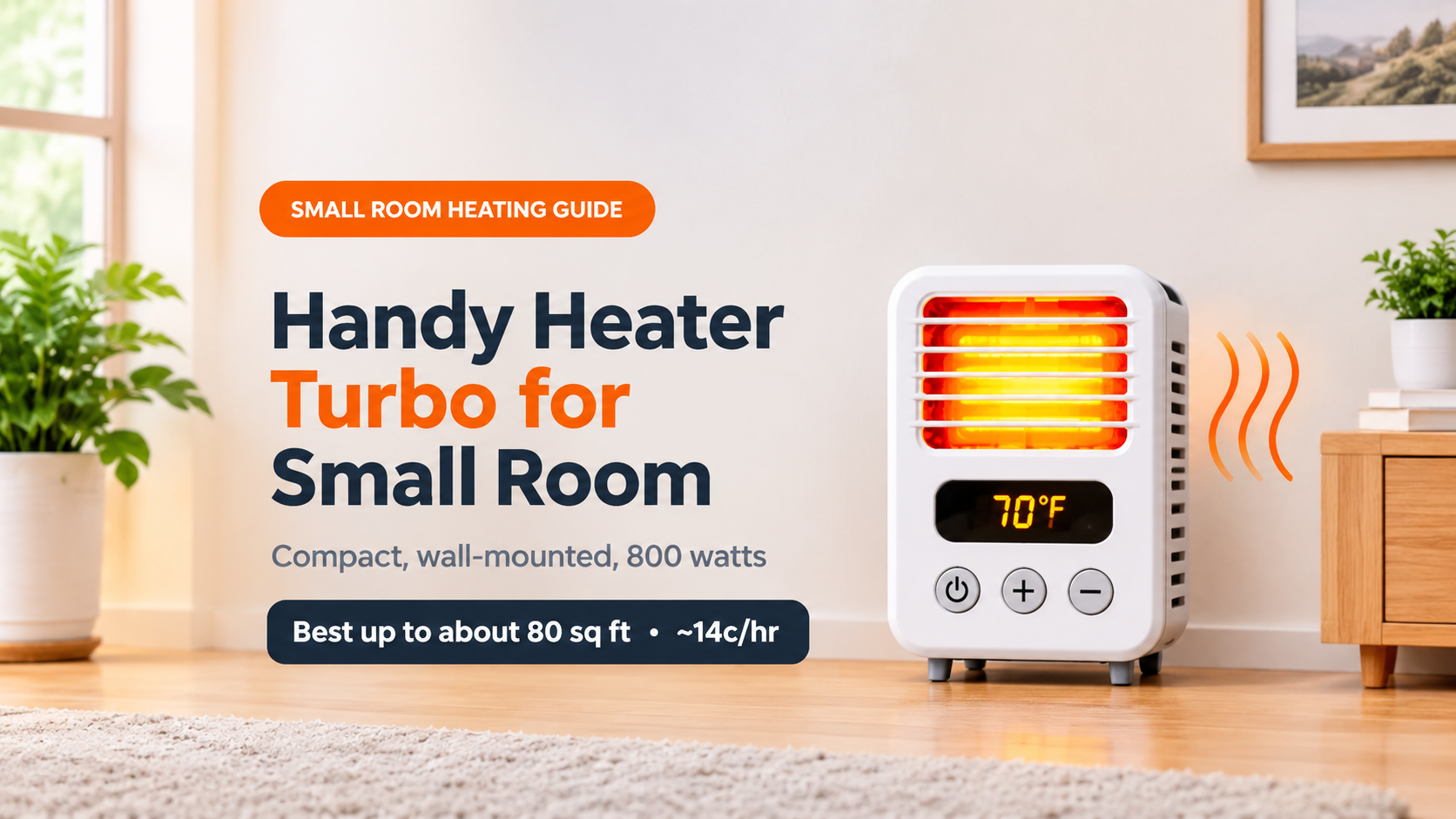

Small rooms are often the coldest rooms in the house: a bathroom with tile floors, a home office tucked at the end of a hallway, a laundry room off the garage. Running the whole furnace to fix one chilly space wastes money, so a compact plug-in heater makes sense. That is exactly the job the Handy Heater Turbo is built for.
This guide covers whether the Handy Heater Turbo for small room use is a good fit: which rooms it suits, how to check your own room size in three steps, what it costs to run, where to put it, and when you should choose something stronger.
Quick answer
The Handy Heater Turbo 800 is an 800 watt wall outlet heater that suits rooms of up to about 80 square feet, such as bathrooms, laundry rooms, closets, nurseries and small home offices. It costs about 14 cents per hour to run at full power at the 2026 US average electricity rate, and it saves floor space because it plugs straight into the wall.
What Is the Handy Heater Turbo?
The Handy Heater Turbo is a compact ceramic heater that plugs directly into a standard wall outlet. There is no stand, no long cord and no floor footprint. Retailer listings for the Turbo 800 describe these features:
- 800 watt ceramic heating element
- Adjustable thermostat and a digital LED display
- Programmable timer of up to 12 hours
- Automatic shut-off protection and a stay-cool housing
- ETL listed for safety compliance
It usually sells for roughly $20 to $30. Handy Heater offers several models at different power levels, so check the wattage printed on the label of your own unit. Everything below is based on the 800 watt Turbo.
Why a Small Room Is the Right Match
An 800 watt heater produces about 2,730 BTU of heat per hour. That is modest next to a 1,500 watt space heater, but a small room does not need much. There is little air to warm, fewer walls and windows to lose heat through, and a closed door keeps the warmth in.
The reasons the Turbo suits compact spaces are practical:
- No floor space used. In a bathroom or office nook, every square foot matters.
- Targeted warmth. You heat one room instead of the whole house.
- Low running cost. Lower wattage means a lower hourly cost.
- Control. A thermostat, timer and auto shut-off let you set it and stop thinking about it.
- Low purchase price. It is inexpensive enough to buy for each problem room.
Which Small Rooms Suit the Handy Heater Turbo?
The common planning guideline for electric heaters is about 10 watts per square foot for standard 8 foot ceilings and average insulation. Dividing 800 watts by 10 gives approximately 80 square feet. Here is how that compares with common small spaces.

| Small Room | Typical Size | Suitability |
|---|---|---|
| Walk-in closet or pantry | 20–40 sq ft | Excellent |
| Powder room or half bath | 20–40 sq ft | Excellent |
| Laundry room | 35–55 sq ft | Very good |
| Full bathroom | 40–60 sq ft | Very good |
| Home office nook | 50–80 sq ft | Good |
| Nursery or small guest room | 70–90 sq ft | At the limit |
| Dorm room | 100–130 sq ft | Spot heating only |
| Living room | 200+ sq ft | Not suitable |
How to Check If Your Room Is Small Enough
You do not need to guess. Use this simple three-step check before buying.

- Measure the room. Measure the length and width in feet.
- Calculate the area. Multiply length by width to get square feet.
- Estimate the watts needed. Multiply the area by 10. If the result is 800 or less, the Turbo is in range.
For example, a room of 8 by 9 feet is 72 square feet, which needs about 720 watts, so the Turbo’s 800 watts is enough. But if the room is cold, has old windows, or has an exterior wall, add 20 to 50 percent to your number. A 72 square foot room that needs 900 watts in practice would be better served by a stronger heater, or by sealing the drafts first.
How Much Does It Cost to Run in a Small Room?
An 800 watt heater uses 0.8 kWh per hour at full power. At about 18 cents per kWh, the 2026 US average residential rate, the cost works out to roughly 14 cents per hour. Small-room use is usually short, so the monthly cost stays low.

| Use Case | Cost Per Day | Cost Per 30 Days |
|---|---|---|
| Bathroom, 30 minutes | $0.07 | $2.16 |
| Laundry room, 1 hour | $0.14 | $4.32 |
| Nursery or guest room, 3 hours | $0.43 | $12.96 |
| Home office, 4 hours | $0.58 | $17.28 |
| Home office, 8 hours | $1.15 | $34.56 |
These are maximums. In a small room the thermostat will switch the element off once the target temperature is reached, so real costs are usually lower. To calculate your own, use: watts ÷ 1,000 × your rate per kWh × hours used. Rates are higher in places such as New England, New York, California and Hawaii and lower in parts of the Midwest and South.
Best Uses for the Handy Heater Turbo in a Small Room
Bathroom
A cold bathroom is miserable first thing in the morning. A short run before you shower takes the edge off. Follow the manufacturer’s instructions about moisture and keep the heater clear of water, splashes and wet towels.
Home office or study nook
For a desk in a cool corner, the Turbo can keep the space comfortable while you work, and the timer lets you stop the heater when the workday ends.
Laundry room or mudroom
These rooms are often unheated. A short burst of heat makes folding clothes more pleasant. Keep lint, towels and laundry well away from the unit and never use it to dry clothes.
Nursery or small guest room
The Turbo can pre-warm a small room before use. Take extra care around children: keep it out of reach and away from cribs and bedding, and do not leave a child alone with it running.
Closet, pantry or hobby room
Craft rooms, sewing nooks and walk-in closets are tiny, so a short run is usually enough.
Where to Place It
- Plug directly into the wall. Do not use extension cords, power strips or surge protectors with any heater.
- Keep at least 3 feet clear in front of the unit. Safety guidance for space heaters commonly uses this distance.
- Keep flammables away such as curtains, towels, bedding, paper and clothing.
- Choose an undamaged outlet. If the plug or outlet gets hot, shows discoloration, or the heater cuts in and out, stop using it and have the outlet inspected.
- Close the door. A closed door is the cheapest way to make a small heater more effective.
Handy Heater Turbo vs Other Small Room Heaters
| Heater Type | Strengths | Weaknesses |
|---|---|---|
| Handy Heater Turbo (800W wall outlet) | No floor space, low cost, timer and thermostat | Limited to about 80 sq ft; fixed to outlet |
| 1,500W ceramic fan or tower heater | Heats larger rooms faster; portable | Higher running cost; needs floor space |
| Oil-filled radiator | Quiet, steady heat that lingers | Slow to warm; heavy and bulky |
| Small 400W personal heater | Very low cost; fine for a desk | Barely warms a room |
For a closet, bathroom or office nook, the Turbo hits a useful middle ground. For a room above about 80 square feet, a 1,500 watt unit will warm it faster, although it will cost nearly twice as much per hour to run.
6 Ways to Make a Small Room Feel Warmer

- Close the door. Keep the warm air where you need it.
- Seal door gaps. A draft stopper under the door is inexpensive and effective.
- Cover the window. Thermal curtains or window insulation film reduce heat loss through glass.
- Use the thermostat. Pick a steady temperature instead of running at full power.
- Clear the front. Keep furniture and fabric from blocking airflow.
- Warm the floor. A rug on a cold tile or concrete floor makes the room feel noticeably more comfortable.
Pros and Cons
Pros
- Compact and wall-mounted, with no floor footprint
- Low 800 watt power use and low hourly cost
- Thermostat, timer and auto shut-off
- Affordable enough to use in several rooms
Cons
- Best only up to about 80 square feet
- Position is tied to the outlet you plug into
- Struggles in drafty, cold or poorly insulated spaces
- Not a replacement for central heating
Who Should Buy It?
Choose the Turbo if you:
- Need heat for a bathroom, laundry room, closet, nursery or small office
- Want a space-saving, low-cost heater with a timer and thermostat
- Prefer to heat only the room you are in
Choose something else if you:
- Have a room larger than about 80 square feet that is cold or drafty
- Need a heater you can move between rooms easily
- Want to heat a garage, workshop or basement
Frequently Asked Questions
Is the Handy Heater Turbo good for a small room?
Yes. It is designed for small spaces and suits rooms of about 80 square feet or less when the door is closed and the room is reasonably insulated.
How many square feet can it heat?
Roughly 80 square feet using the common guideline of 10 watts per square foot. In a drafty room this may be closer to 50 to 65 square feet.
How much does it cost to run?
About 14 cents per hour at full power at 18 cents per kWh. A 30 minute bathroom run costs around 7 cents, and four hours in a home office costs about 58 cents.
Can it heat a bathroom?
Yes, most bathrooms are within range. Follow the manufacturer’s instructions on moisture, keep it clear of water and wet items, and do not place it where it could be splashed.
Can I leave it on all day?
Not unattended. Use the timer and thermostat, switch it off when you leave the room, and follow the safety instructions for your exact model.
Can I use an extension cord?
No. Plug it straight into a wall outlet. Extension cords and power strips can overheat with heaters.
Will it heat my whole house or apartment?
No. It is a personal, single-room heater and works best as a supplement to your normal heating.
Is it quiet?
Retailer descriptions call it quiet, but every heater makes some sound. Try it in your room to see whether the noise suits you.
Is it cheaper than a 1,500 watt heater?
Per hour, yes. It uses about 47 percent less electricity. But a larger heater reaches temperature faster in a bigger room, so the better value depends on the size of your space.
Final Verdict
For a genuinely small room, the Handy Heater Turbo is a sensible buy. It takes up no floor space, costs about 14 cents an hour at full power, and gives you a thermostat, timer and auto shut-off at a low price. Bathrooms, laundry rooms, closets, nurseries and small home offices are where it makes the most sense.
Be realistic about its limits. It is an 800 watt heater, so keep to rooms of about 80 square feet or less, seal drafts, close the door, and treat it as a supplement rather than a replacement for central heating. Measure your room first with the three-step check above, follow the safety guidance in your manual, and you will end up with a warmer room without a big jump in your electric bill.
Cost and coverage figures are estimates based on an 800 watt rating, the 2026 US average residential electricity rate of roughly 18 cents per kWh, and a planning guideline of about 10 watts per square foot. Actual results depend on insulation, climate, local rates and settings. Always read and follow the manual and warnings supplied with your specific heater.