
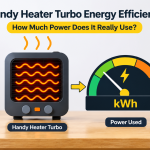
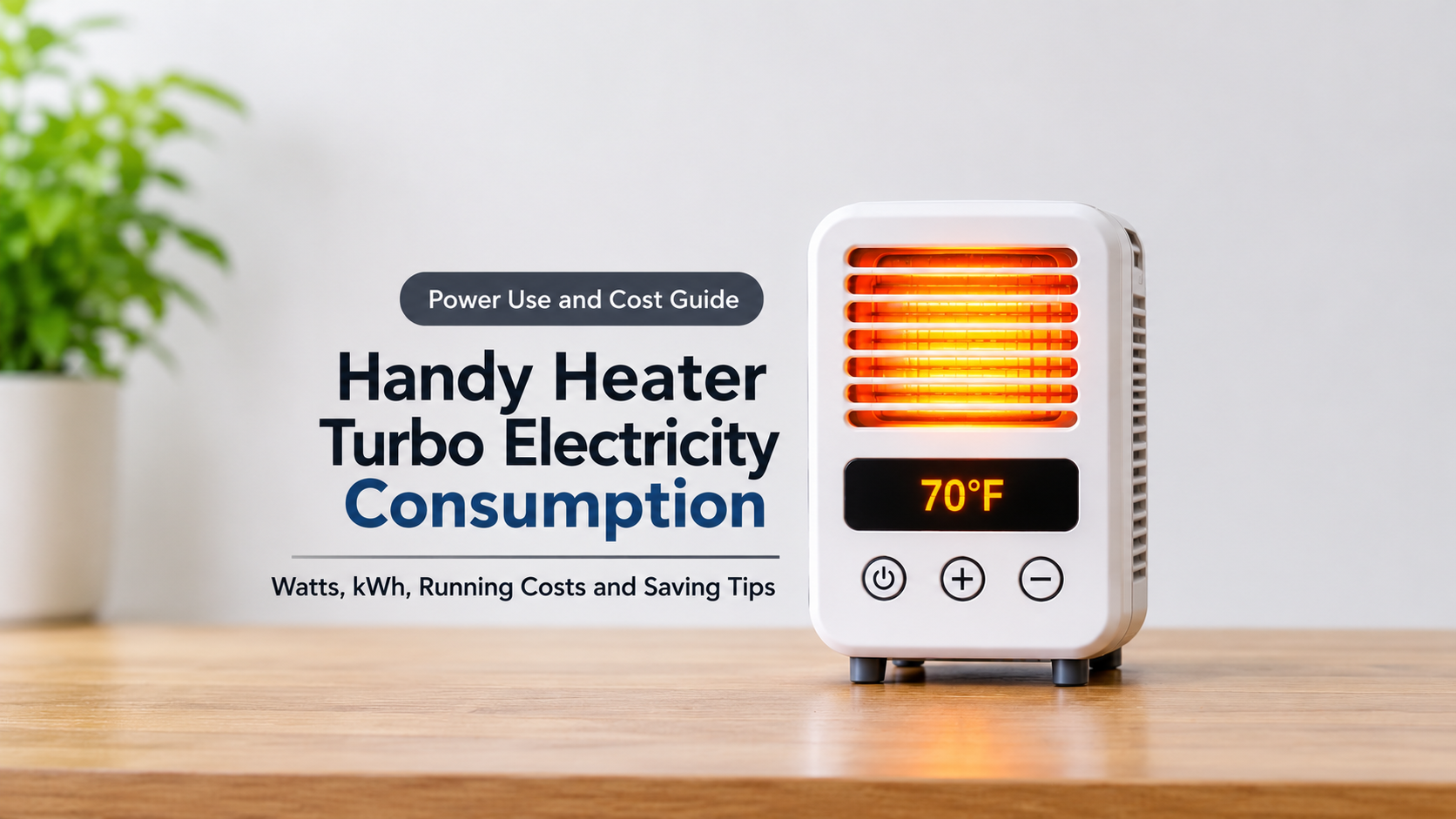
Handy Heater Turbo Electricity Consumption: How Much Power Does It Use and What Does It Cost?
Before buying a space heater, most people ask the same question: how much will it add to my electricity bill? The Handy Heater Turbo is a small plug-in heater that is often promoted as a low-cost way to warm a compact room, but “small” does not automatically mean “cheap to run.” This guide explains the Handy Heater Turbo electricity consumption in plain numbers: its wattage, how many units (kWh) it uses, what it costs per hour, per day and per month, how the thermostat changes the real figure and how to reduce your usage.
Quick Answer
- Power rating: 800 watts (0.8 kW) at full power.
- Energy use: about 0.8 kWh for every hour it heats continuously.
- Cost per hour: 0.8 multiplied by your electricity rate. At 0.15 per kWh, that is about 0.12 per hour.
- Real-world use: usually lower than the maximum, because the thermostat switches the heater off once the room reaches the set temperature.
- Best for: heating a small area for a limited time, not a whole home all day.
How Much Power Does the Handy Heater Turbo Use?
The Handy Heater Turbo 800 is rated at 800 watts, as the name suggests. Watts measure how much power the heater draws while it is heating. Your electricity bill is based on kilowatt-hours (kWh), which is the power in kilowatts multiplied by the hours of use. Since 800 watts equals 0.8 kilowatts, the heater uses 0.8 kWh in each hour of continuous heating.
In electrical terms, an 800-watt load draws about 6.7 amps on a 120-volt supply, or about 3.5 amps on a 230-volt supply. That is well below a typical household outlet limit, but you should still avoid sharing the same circuit with other high-power appliances, and you should never use an extension cord or power strip with a heater.
How to Calculate the Running Cost

- Convert watts to kilowatts: 800 W divided by 1,000 equals 0.8 kW.
- Multiply by the hours used: 0.8 kW multiplied by 4 hours equals 3.2 kWh.
- Multiply by your electricity rate: 3.2 kWh multiplied by your price per kWh gives the cost. At 0.15 per kWh, that is 0.48.
Your price per kWh is shown on your electricity bill. It varies widely between countries, providers and time-of-use plans, so use your own figure for an accurate result.
Running Cost Table at Full Power
This table shows what the heater would cost if it ran at full power for the entire time. The numbers work in any currency, so just match the column to your electricity rate.

| Hours at Full Power | Energy Used | At 0.10 / kWh | At 0.15 / kWh | At 0.20 / kWh | At 0.30 / kWh |
|---|---|---|---|---|---|
| 1 hour | 0.8 kWh | 0.08 | 0.12 | 0.16 | 0.24 |
| 4 hours | 3.2 kWh | 0.32 | 0.48 | 0.64 | 0.96 |
| 8 hours | 6.4 kWh | 0.64 | 0.96 | 1.28 | 1.92 |
| 12 hours | 9.6 kWh | 0.96 | 1.44 | 1.92 | 2.88 |
Why Your Real Consumption Is Usually Lower
The Handy Heater Turbo has an adjustable thermostat from 60°F to 90°F. When the room reaches your chosen temperature, the heater switches off, then switches on again when the room cools. During the “off” periods it uses very little electricity. This means that a heater set to a modest temperature in a small, well-closed room may only be actively heating for a portion of the time.
How much of the time the heater actually heats depends on the room size, outside temperature, drafts, insulation and your set temperature. A heater working in a cold, drafty room may run almost continuously, while the same heater in a small, sealed room may cycle on and off often.

As an example, using the heater for 4 hours a day over 30 days gives 120 hours of operation. If it heated non-stop, that would be 96 kWh, which costs 14.40 at a rate of 0.15 per kWh. If the thermostat keeps it heating only 40 percent of the time, the same period uses about 38.4 kWh and costs about 5.76. Your own result will fall somewhere in this range.
Does the Timer Save Electricity?
The 12-hour timer does not reduce the heater’s wattage, but it prevents the heater from running when you do not need it. For example, running the heater for 2 hours instead of leaving it on for 6 hours cuts the maximum possible energy use by two thirds. Setting the timer every time is one of the easiest ways to control your bill.
How Does 800 Watts Compare With Other Heaters?
| Heater Power | Energy per Hour at Full Power | Cost per Hour at 0.15 / kWh |
|---|---|---|
| 400 W mini heater | 0.4 kWh | 0.06 |
| 800 W (Handy Heater Turbo) | 0.8 kWh | 0.12 |
| 1,500 W standard space heater | 1.5 kWh | 0.225 |
| 2,000 W large heater | 2.0 kWh | 0.30 |
A key point: almost all the electricity an electric resistance or ceramic heater uses ends up as heat in the room. This means that, per unit of electricity, one electric heater does not heat more than another. An 800-watt heater costs less per hour than a 1,500-watt heater simply because it draws less power, but it also produces less heat. At full power, 800 watts gives out roughly 2,700 BTU of heat per hour.
Will It Actually Save You Money?
Marketing for plug-in heaters often suggests big savings. The honest answer depends on how you use it. A small heater can reduce your total bill if it lets you lower the thermostat on your main heating system and heat only the room you are using. It can also be cheaper than running central heating for a single room for a few hours. However, if you use it in addition to your normal heating, or you run it for many hours a day, it will simply add to your bill. And because it is a low-power unit, it will not heat a large or drafty room effectively, no matter how long it runs. Compare your electricity price with the cost of your main heating fuel before deciding.
6 Ways to Reduce the Electricity Your Heater Uses

- Use the timer. Choose a run time so the heater does not stay on by accident.
- Choose the lowest comfortable temperature. Each extra degree makes the heater work longer. A setting of 68–72°F (20–22°C) is a common starting point.
- Heat only the room you are in. Close the door so the warm air stays where you need it.
- Block drafts. Gaps under doors and around windows cause heat loss, which makes the heater work harder.
- Dress warmly. A sweater or blanket lets you use a lower set temperature.
- Keep the vents clean. Dust restricts airflow and can cause the heater to overheat and shut off, which wastes energy and makes the room harder to warm.
How to Measure Your Own Consumption
If you want an exact figure instead of an estimate, you can use a plug-in energy meter between the outlet and the appliance. Note that heaters should be plugged directly into the wall, so check that the meter is rated for the load and fits firmly. A safer option is to read your electricity meter before and after a period of heater use while other major appliances are off, or to check the usage data in your electricity provider’s account. Compare days with and without the heater for a rough idea of the difference.
Safety Considerations Related to Power Use
- Plug the heater directly into a firm, undamaged wall outlet. Do not use extension cords or power strips.
- Avoid sharing a circuit with other high-power appliances such as kettles or hair dryers.
- Do not leave the heater running unattended for long periods or while you sleep.
- Stop using it if the plug or outlet becomes very hot, or you smell burning.
Wall-outlet heaters place their full weight and electrical load on one socket, and consumer testing organizations have raised safety concerns about this style of heater in some markets. Make sure the heater is approved for your country and fits your outlets properly.
Frequently Asked Questions
How many watts does the Handy Heater Turbo use?
It is rated at 800 watts when heating at full power.
How many kWh does it use per hour?
Up to 0.8 kWh per hour of continuous heating. It can use less than that over an hour if the thermostat switches the heater off part of the time.
How much does it cost to run per hour?
Multiply 0.8 by your electricity price per kWh. At 0.15 per kWh, the cost is about 0.12 per hour at full power.
How much does it cost to run for 8 hours?
At full power it uses 6.4 kWh. At 0.15 per kWh, that is about 0.96. Real cost is usually lower if the thermostat cycles the heater off.
Is the Handy Heater Turbo energy efficient?
Like all electric heaters, it turns nearly all the electricity it uses into heat. Its low 800-watt rating keeps the hourly cost low, and the thermostat and timer help avoid wasted energy, but it will not heat a large room.
Does it use electricity when turned off?
The heater uses very little power when off, but an electronic display or standby circuit may draw a tiny amount while it is plugged in. Unplugging it when you are not using it is a good habit and also adds a safety margin.
Is an 800-watt heater enough for my room?
It is designed for small personal spaces such as a desk area, a small bedroom or a bathroom. For larger rooms you would need a more powerful heater, which would also use more electricity.
Final Thoughts
The Handy Heater Turbo uses up to 0.8 kWh per hour, which costs roughly 0.08 to 0.24 per hour at common electricity rates. Your real consumption will usually be lower than the full-power figure, thanks to the thermostat, and you can reduce it further by using the timer, heating one small room and blocking drafts. Use the formula and tables in this guide with your own electricity rate, and remember that cost savings should never come at the expense of safety: use a firm outlet, avoid extension cords and never leave the heater running unattended.