
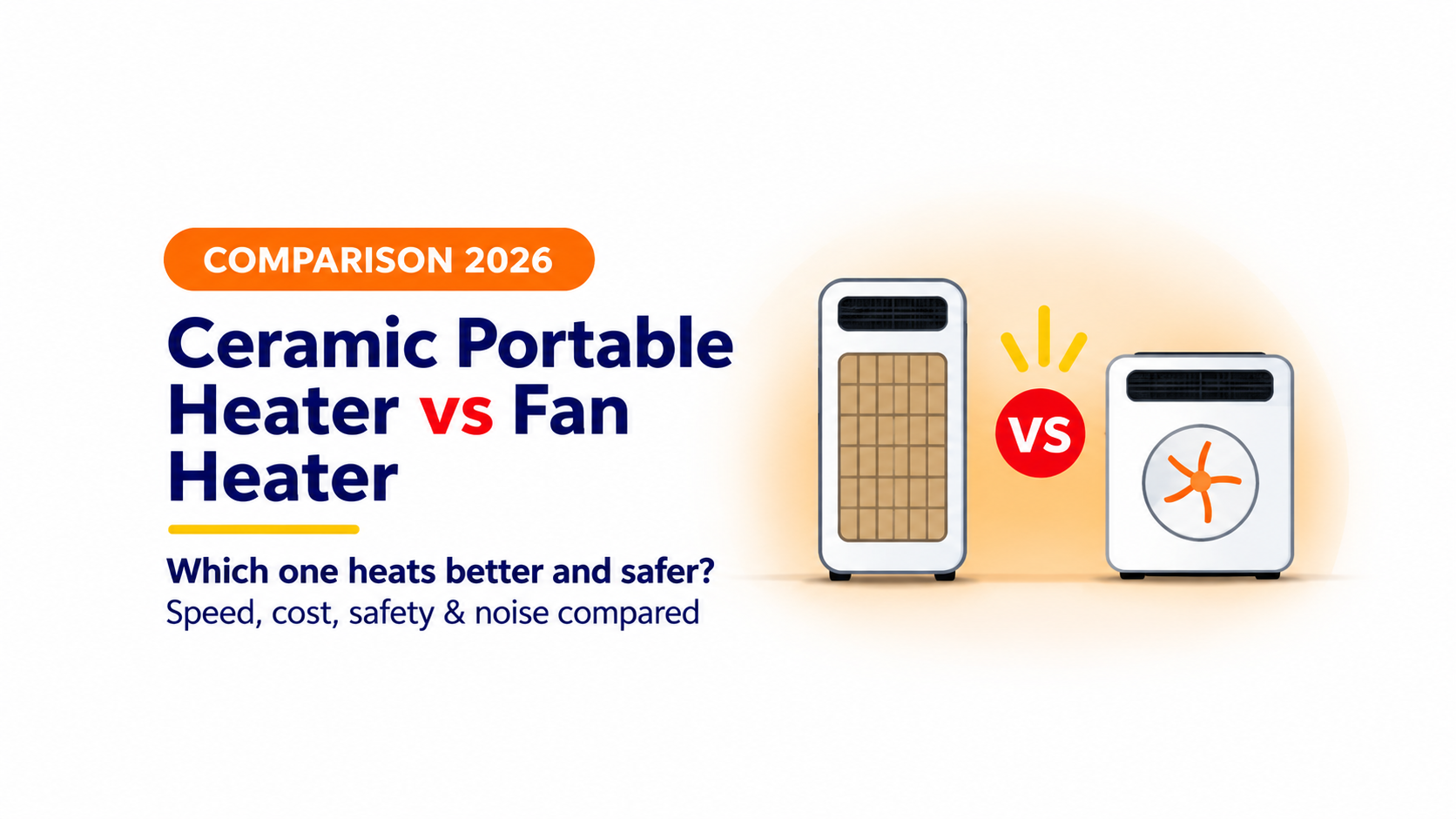
Walk into any store or browse any online marketplace and you will see two types of compact heaters everywhere: ceramic heaters and fan heaters. They look alike, they cost about the same and both promise quick warmth. So the question ceramic portable heater vs fan heater is one of the most common for anyone shopping for a small heater. The confusing part is that the two terms overlap, and many products are actually both at once.
In this complete guide you will learn what the real difference is, how each type works, how they compare in safety, speed, noise, running cost and lifespan, and which one is best for your bedroom, bathroom, office or garage. By the end, you will know exactly what to look for.
What Is the Real Difference?
This is the point most guides skip. “Fan heater” describes how the heat is moved: a fan blows air across a hot element and into the room. “Ceramic heater” describes what the heating element is made of: ceramic plates rather than a bare metal coil. That means a heater can be both a ceramic heater and a fan heater at the same time. In fact, most modern ceramic heaters include a fan.
For this comparison, we use these working definitions:
- Ceramic heater: A heater that uses ceramic heating plates, often a self-regulating type, usually with a fan, sometimes without.
- Fan heater (classic): A heater that uses a metal wire coil element and a fan to blow warm air.
How Each Heater Works
Ceramic Heater
Electricity flows through ceramic plates or stones made from special material, commonly called PTC (positive temperature coefficient) ceramic. As the plates warm, their electrical resistance rises, which naturally limits how hot they can get. That self-regulating behaviour is a major safety advantage. A fan then pushes air through the hot plates, or in some models the plates simply warm the air that rises past them. Ceramic heaters often come in compact tower or box shapes.
Fan Heater (Metal Coil)
A classic fan heater passes electricity through a coil of resistance wire, often made from nichrome. The coil heats up very quickly and may glow red or orange. A fan blows air across the coil, which carries heat into the room. These heaters have been around for decades and are common in cheap, light models.
Quick Comparison Table
| Feature | Ceramic Heater | Metal Coil Fan Heater |
|---|---|---|
| Heating element | Ceramic plates (often PTC) | Metal wire coil |
| Heat-up speed | Fast | Very fast |
| Self-regulating | Yes, in PTC models | No, relies on thermostat and cut-outs |
| Element glow | No visible glow | Often glows red or orange |
| Smell when new or dusty | Less common | More common |
| Noise | Fan hum, quiet models exist | Fan hum, can be louder |
| Lifespan | Generally longer | Generally shorter |
| Price | Moderate | Usually lowest |
| Best for | Bedrooms, offices, daily use | Occasional, budget heating |
Heating Speed and Performance
Both types are fast, and both can make a small room feel warmer within minutes. A metal coil heats up almost instantly and may give a quick blast of warm air, which is why cheap fan heaters feel powerful at first. Ceramic elements take a few seconds longer to reach full temperature, but they hold a steady heat output and do not overshoot.
For the same wattage, there is no big difference in total heat. A 1,500 W ceramic heater and a 1,500 W metal coil fan heater both turn nearly all of their electricity into heat. What changes is how the heat is delivered and how consistent it feels over time.
Safety Comparison
This is where ceramic heaters often have an edge. Both types should always be used correctly and never left unattended, but the design differences matter.
Ceramic Heaters
- Self-regulating elements (PTC): As temperature rises, resistance rises, which limits heat output and reduces the chance of dangerous overheating.
- No glowing element: Fewer exposed hot parts and less risk of igniting fabric or dust that gets close.
- Cooler body on many models: A cool-touch housing is easier to design around ceramic plates.
- Still need safety features: Tip-over and overheat protection should be present.
Metal Coil Fan Heaters
- Very hot coil: A glowing coil can reach high temperatures, which raises the risk if fabric or dust touches it.
- Dust burn-off: Dust on the coil can burn and create a smell, which can be an irritation and a warning sign.
- Relies on safety switches: Without self-regulation, protection depends on thermostats and thermal cut-outs. Cheap models may have weaker versions of these.
- Can still be safe: A well-made fan heater with tip-over, overheat and thermostat protection used correctly is suitable for many homes.
Essential Safety Features for Either Type
- Tip-over protection.
- Overheat protection.
- Adjustable thermostat.
- Protective grille with narrow spacing.
- Timer or auto shut-off where possible.
- Recognised safety certification, and a heavy-duty cord and plug.
Noise Levels
Because most ceramic heaters and all classic fan heaters use a fan, both produce some hum. The sound depends more on fan quality and design than on the element type. Some ceramic models include a low-noise mode or a quiet fan, which helps in bedrooms and offices. Cheap fan heaters with a rattling fan can be louder, and the sound often gets worse over time as the motor ages.
If silence is a top priority, look for a ceramic heater with a quiet mode or consider a fanless option such as an oil-filled radiator or panel heater.
Running Cost and Energy Use
There is no meaningful difference in efficiency between a ceramic heater and a metal coil fan heater at the same wattage. Both convert nearly all of their electrical energy into heat. A 1,500 W heater uses 1.5 kWh for each hour at full power, whichever type it is.
What really affects your bill:
- Thermostat quality: A good thermostat cycles the heater off when the room is warm. This reduces energy use and holds a steady temperature.
- Power settings: Using a lower setting once the room is warm saves electricity.
- Room insulation: A well-insulated room keeps the heat in.
- Timer use: A timer prevents the heater running for hours unnecessarily.
To estimate cost, multiply kilowatts by hours of use and by your price per kWh. For example, a 1.5 kW heater used for 3 hours at full power uses 4.5 kWh.
Durability and Lifespan
Ceramic elements are generally more durable than thin metal coils, which can weaken, sag or burn out over time. Ceramic heaters tend to have longer lifespans, and many come with better construction overall. A cheap metal coil fan heater may last only a few seasons, while a quality ceramic model can last many years with proper care. The fan motor is often the first part to wear out in either type, so cleaning the vents and fan area regularly helps.
Design, Size and Portability
Both types are compact and light, so portability is a strength of each. Ceramic heaters come in many shapes: slim towers with oscillation, small cubes for desks and larger units with remote controls and digital displays. Classic fan heaters often look like simple boxes with a handle. Because ceramic technology is popular, you will usually find more feature-rich models, such as oscillation, digital thermostats, timers, eco modes and remote control.
Features Commonly Found on Each Type
- Oscillation: Common on ceramic tower heaters, it spreads warm air over a wider area.
- Digital thermostat and display: More common on ceramic models.
- Remote control: Often included on mid-range and premium ceramic models.
- Multiple heat settings: Both types offer low, medium and high options.
- Eco mode: Adjusts power to maintain the temperature with less energy.
- Cool-air fan mode: Some heaters double as a fan in summer.
- Carry handle: Useful on both types.
Best Choice for Specific Rooms
Bedroom
A ceramic heater with a thermostat, timer and quiet mode is usually the better pick. Remember that heaters should be turned off while you sleep, or at least used with a thermostat and timer and kept far from bedding.
Bathroom
Choose a model specifically rated for bathroom or damp conditions, and place it away from water. Compact ceramic heaters designed for bathrooms are popular for fast warmth.
Home Office or Desk
A small ceramic heater with a quiet mode is ideal, as it warms your area without heavy noise. A cheap fan heater may be too loud for calls.
Living Room
A ceramic tower with oscillation can add warmth quickly and spread it around the room. For large spaces, consider a more powerful unit or an additional heater.
Garage or Workshop
A higher-power fan heater is a common choice for fast heat in large, drafty spaces, though high-power industrial ceramic or forced-air heaters are also used. Check the rating and ventilation, and keep flammables away.
Children’s Room and Nursery
A ceramic heater with cool-touch housing, tip-over protection and a control lock is a safer option than a basic coil heater, provided it is placed out of reach with a barrier. A wall-mounted panel heater is also a strong choice.
Budget or Occasional Use
If you only need a heater for a few chilly evenings a year and have a tight budget, a basic fan heater can be perfectly adequate when it has the essential safety features.
Pros and Cons Summary
| Ceramic Heater | Metal Coil Fan Heater |
|---|---|
| Pros Self-regulating (PTC) safety No glowing element Longer lifespan More features and styles Less burning-dust smell |
Pros Lowest price Very fast initial heat Light and simple Widely available |
| Cons Usually costs more Fan noise on many models Slightly slower to reach full heat |
Cons Very hot coil Shorter lifespan Dust smell more common Often noisier and less refined |
Which One Should You Choose?
- Choose a ceramic heater if: you want better safety design, longer life, more features and a steady, controlled heat for daily use in a bedroom, office or living room.
- Choose a metal coil fan heater if: you need the lowest price, want quick heat for short, occasional use and you are happy with basic features.
- The best choice: A ceramic fan heater with a thermostat, timer, tip-over protection and overheat protection gives most households the best mix of safety, comfort and value.
How to Size Your Heater
A rough guide is about 10 watts per square foot (about 100 watts per square metre) for a room with average insulation. Poor insulation or high ceilings require more power.
| Room Size | Approx. Area | Suggested Wattage |
|---|---|---|
| Small | Up to 100 sq ft | Up to 1,000 W |
| Medium | 100 to 150 sq ft | 1,000 to 1,500 W |
| Large | 150 to 250 sq ft | 1,500 to 2,500 W |
Safety Rules for Both Types
- Plug directly into a wall outlet and avoid extension cords and power strips.
- Keep at least three feet (about one metre) clear of curtains, bedding, furniture and clothes.
- Place on a flat, stable, hard surface, never on a bed or soft furniture.
- Never cover the heater or dry clothes on it.
- Do not leave it running unattended or while you sleep.
- Clean dust from the vents and grille regularly with the heater unplugged and cool.
- Check the cord and plug for damage, and stop using a heater if it smells of burning or trips the breaker.
- Keep children and pets away from it.
Common Mistakes When Choosing
- Assuming ceramic and fan heaters are completely different, when many ceramic heaters use fans.
- Buying the cheapest model without checking for tip-over and overheat protection.
- Expecting a small heater to warm a very large room.
- Believing that ceramic automatically means much lower electricity cost.
- Ignoring noise levels for bedrooms and offices.
- Not cleaning dust from vents, which affects performance and safety.
- Using a heater in a bathroom that is not rated for damp conditions.
Frequently Asked Questions (FAQ)
Is a ceramic heater better than a fan heater?
In most cases, a ceramic heater has better safety design, a longer lifespan and more features. A basic fan heater costs less and heats quickly, which can suit occasional use.
Are ceramic heaters also fan heaters?
Many are. Most popular ceramic heaters use a fan to blow air over the ceramic plates. Some are fanless and rely on natural convection.
Which is cheaper to run, ceramic or fan heater?
At the same wattage, both use about the same electricity. Your thermostat, power setting and room insulation matter far more than the element type.
Are ceramic heaters safer?
They often have an advantage because PTC ceramic elements limit their own temperature and do not glow. They still need tip-over and overheat protection and must be used with proper clearance.
Why does my fan heater smell like burning?
Dust on the heating element can burn off, especially when the heater is new or has been stored. A slight smell at first use may be normal, but a strong or persistent burning smell is a warning sign. Switch it off, unplug it and check it.
Which heater is quieter?
Both use fans, so noise depends on the model. Ceramic heaters with a quiet mode are usually better for bedrooms. For almost silent heating, consider an oil-filled radiator or panel heater.
Can I use a ceramic heater in a bathroom?
Only if it is specifically rated for bathroom or damp use, and placed well away from water and following the maker’s instructions.
Which lasts longer, ceramic or fan heater?
Ceramic heaters generally last longer because their elements are more durable than thin metal coils. Good care and regular cleaning help either type last.
Final Thoughts
In the ceramic portable heater vs fan heater debate, the key point is that the two are not always opposites. Ceramic describes the heating element, and fan describes how the air is moved. A ceramic fan heater combines both and is often the best all-round choice for safety, comfort and long-term value. A basic metal coil fan heater is a fine budget option when you need quick, occasional heat and it includes essential safety protection.
Choose a model with a thermostat, timer, tip-over and overheat protection, pick the right wattage for your room and follow safe placement rules. Do that, and either type can keep you warm all winter.