

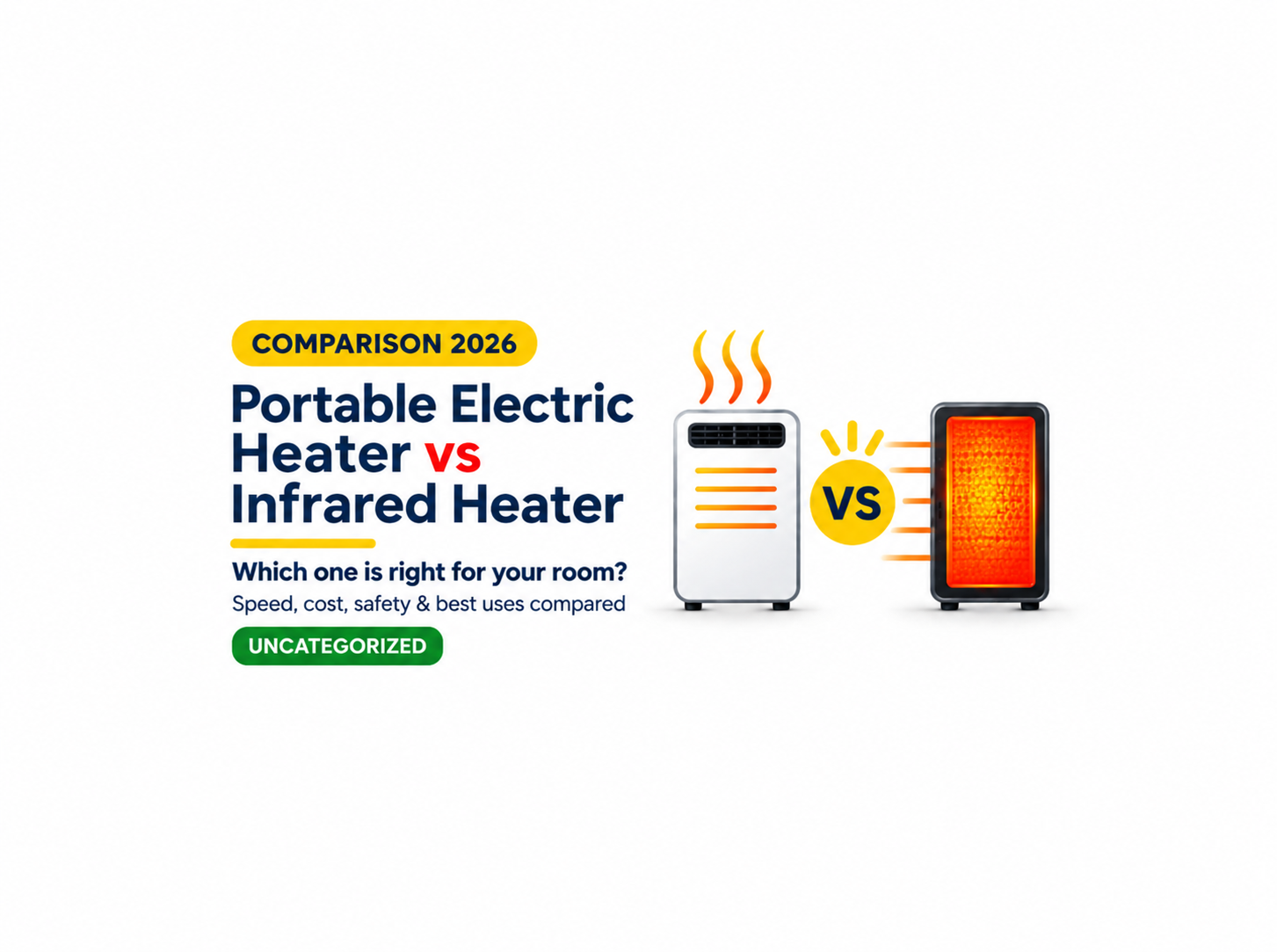
Two heaters can both plug into the same wall socket, use the same amount of electricity and still feel completely different. That is the heart of the portable electric heater vs infrared heater question. One warms the air in the room. The other warms you and the objects in front of it, much like sunshine on a cold day. Choosing the wrong one can leave you with a heater that is hot in front, chilly everywhere else and disappointing in practice.
In this complete comparison you will learn how each type works, how they differ in heating speed, comfort, running cost, safety, noise and portability, and which one suits your bedroom, bathroom, garage, office, patio or living room. By the end, you will know which heater fits your needs.
First, a Quick Clarification
Infrared heaters are electric and many are portable, so technically they are portable electric heaters too. In this article, “portable electric heater” refers to the convection-style heaters that warm the air, such as fan heaters, ceramic heaters and convector heaters. “Infrared heater” refers to heaters that give off radiant heat, such as quartz, carbon, halogen or panel infrared models.
How Each Heater Works
Portable Electric Heater (Convection / Fan / Ceramic)
These heaters heat a metal coil or ceramic element. The element warms the surrounding air, and a fan or natural convection pushes that warm air into the room. Over time, the whole room air temperature rises. This type is ideal for filling a space with even warmth, as long as the room is reasonably closed and insulated.
Infrared Heater
Infrared heaters produce radiant energy, a form of invisible heat that travels in straight lines and warms any solid surface it hits, including your skin, clothes, furniture and floor. They do not need to heat the air first. That is why you feel warmth almost immediately when you stand in front of one, even if the room is still cold.
Quick Comparison Table
| Feature | Portable Convection / Fan Heater | Infrared Heater |
|---|---|---|
| Heating method | Warms the air | Warms people and objects |
| Feels warm | After the room warms up | Almost instantly in front of it |
| Room coverage | Whole room, even warmth | Targeted, line-of-sight |
| Noise | Fan models make noise | Usually silent |
| Draughts and dust | Fan models move air and dust | No air movement |
| Works well in draughty areas | Less effective | More effective |
| Heat after switching off | Fades gradually as air cools | Stops quickly |
| Best for | Closed, insulated rooms | Spot heating and open spaces |
Heating Speed: Which Feels Warm Faster?
Infrared heaters win in terms of how quickly you feel warm. Because they heat you directly, the effect is nearly immediate once the heater has reached operating temperature. A convection heater first has to warm the air, and in a cold room that can take several minutes before you notice a clear difference. Fan models speed this up, but the sense of warmth is still tied to the air temperature.
The two behave very differently when you leave the heater’s reach. With infrared, step out of the beam and the warmth disappears fast. With a convection heater, warm air spreads through the space, so you stay comfortable as you move around the room.
Energy Use and Running Cost
Here is a point that surprises many buyers. Electric heaters of all kinds convert almost all the electricity they use into heat. A 1,500 W infrared heater and a 1,500 W convection heater both draw the same power and release about the same heat energy. Claims that infrared heaters are far more “efficient” are often marketing exaggeration.
The real difference is how well that heat serves you:
- Infrared for spot heating: If you only need to warm yourself at a desk, workbench or sofa, infrared can make you comfortable at a lower overall room temperature, so you may use the heater for fewer minutes or at a lower setting.
- Convection for whole-room heating: If you want the entire room comfortable for hours, a convection heater heats the air and keeps everyone warm, so it generally suits closed rooms better.
- Drafty or open spaces: Warm air escapes quickly from garages, porches and open areas, which wastes convection heat. Infrared still warms people and objects directly.
- Insulation matters: In a well-insulated room, convection heat is held in, which makes it more economical.
To estimate cost, multiply the heater’s kilowatts by hours of use and your electricity price per kWh. A 1.2 kW heater running for 3 hours uses 3.6 kWh.
Comfort and Heat Quality
A convection or fan heater gives a stream of warm air. It can feel pleasant in a closed room, but the air may feel dry, and fan models can stir up dust. The warmth is strongest near the heater and weaker at the edges, though it gradually evens out.
Infrared heat feels natural, similar to standing in the sun. There is no draught and no dust movement, which many people find more comfortable. However, only areas in the heater’s line of sight get the benefit. If something blocks the heat, such as furniture, you will not feel warmth behind it.
Noise
Fan heaters hum, which can be annoying in a bedroom or home office. Convector and ceramic models without fans are quieter. Infrared heaters are usually silent, apart from small clicks as the element warms up, which makes them popular for quiet spaces.
Safety Comparison
Both types can be safe when used correctly, and neither should be left running unattended or while you sleep.
Convection / Fan Heaters
- The grille may become very hot on some models.
- Fan inlets can collect dust, so regular cleaning is needed.
- Many have tip-over, overheat and thermostat protection.
Infrared Heaters
- Radiant heat can ignite fabric, paper and other flammable items placed in front of the heater, even without contact, so clearance matters.
- Some models have exposed glowing elements or very hot panels.
- Staying too close can overheat skin. Keep a comfortable distance.
- Many have tip-over protection and safety guards, but always check.
Safety Features Both Should Have
- Tip-over protection.
- Overheat protection.
- Adjustable thermostat or power settings.
- Protective grille or guard.
- Timer or auto shut-off where possible.
- Recognised safety certification, and a suitable heavy-duty cord and plug.
Types of Infrared Heaters
- Quartz infrared: Compact, glows orange and gives instant radiant heat. Popular for personal spot heating.
- Carbon infrared: Gentle, broad heat that many find more comfortable for long periods.
- Halogen infrared: Bright, very fast heat, often with visible light.
- Infrared panel heaters: Flat panels that mount on a wall or ceiling and give soft, even radiant warmth.
- Cabinet or “wood-look” infrared units: Some models combine infrared with convection and look like furniture. Check the specifications to see how they actually heat.
Best Heater for Specific Spaces
Bedroom
A quiet convector, oil-filled radiator or panel heater is generally better for whole-room warmth. Infrared can warm you at the bed edge or desk, but its heat does not fill the room. Remember that heaters should be switched off while sleeping, or used with a thermostat and timer and kept far from bedding.
Bathroom
Both can work if the model is specifically rated for bathroom use and placed away from water. Infrared is great for quick warmth after a shower. A bathroom-rated convection heater warms the air and helps with comfort and drying.
Garage or Workshop
Infrared is often the better pick for drafty, poorly insulated spaces because it warms you and your workbench directly. A high-power fan heater suits closed, insulated garages.
Home Office
A silent infrared panel warms your legs and torso at the desk without noise. For a whole room, a convector or oil-filled model is more suitable.
Living Room
Convection or oil-filled heaters give even background warmth. A radiant heater can add a cosy warm spot near the sofa.
Patio, Porch or Open Space
Only use heaters that are specifically rated for outdoor use. Infrared heaters rated for outdoors can be effective in open areas, because warm air would simply escape. Indoor-only heaters must never be used outside.
Nursery or Children’s Room
Choose a stable, cool-touch convection or oil-filled model, or a wall-mounted panel, kept out of reach with strict clearance. Strongly radiant heaters need extra caution and barriers.
Pros and Cons Summary
| Portable Convection / Fan Heater | Infrared Heater |
|---|---|
| Pros Warms the whole room Even heat in closed rooms Wide choice and lower prices Thermostat controls the room temperature |
Pros Instant warmth Silent, no draught or dust movement Great for spot heating Works well in drafty or open spaces |
| Cons Slower to feel warm Fan noise on some models Dry air and dust movement Poor in drafty spaces |
Cons Warms only line of sight Heat fades quickly when you move away Radiant heat can ignite nearby items Does not raise room air temperature much |
Which One Should You Choose?
- Choose a convection or fan heater if: you want to warm an entire closed room, you spend long periods in it and you prefer a thermostat to hold the room temperature.
- Choose an infrared heater if: you need instant warmth at a specific spot, you want silence and no draught or the space is open, drafty or poorly insulated.
- Choose both if: you want a convection heater for general background warmth and an infrared unit for quick targeted comfort.
How to Size Your Heater
For convection heaters, a rough rule is about 10 watts per square foot (about 100 watts per square metre) in an average insulated room. Poor insulation or high ceilings require more. For infrared spot heating, wattage matters less than distance and direction. A 750 W to 1,500 W unit is usually enough for a personal zone, placed at the recommended distance in the manual.
| Use Case | Heater Type | Typical Wattage |
|---|---|---|
| Small room, up to 100 sq ft | Convection | Up to 1,000 W |
| Medium room, 100 to 150 sq ft | Convection | 1,000 to 1,500 W |
| Desk or sofa spot | Infrared | 400 to 1,200 W |
| Workbench or garage spot | Infrared | 1,200 to 1,500 W |
Safety Rules That Apply to Both
- Plug directly into a wall outlet and avoid extension cords and power strips.
- Keep at least three feet (about one metre) clear of curtains, bedding, furniture and clothes, or more if the manual says so.
- Place on a flat, stable surface, or mount according to the maker’s instructions.
- Never cover the heater or dry clothes on it.
- Do not leave it running unattended or while you sleep.
- Check the cord and plug regularly for damage or warmth.
- Keep children and pets away from it.
- Follow the manual for exact distances and use.
Common Mistakes When Choosing
- Buying an infrared heater to warm a whole room and expecting it to behave like a convection heater.
- Assuming infrared heaters use far less electricity at the same wattage.
- Placing an infrared heater too close to furniture, curtains or bedding.
- Putting something between you and the heater and wondering why it feels cold.
- Using an indoor heater outdoors.
- Choosing a fan heater for a quiet bedroom or office.
- Ignoring safety features to save money.
Frequently Asked Questions (FAQ)
Is an infrared heater cheaper to run than a portable electric heater?
At the same wattage, both use about the same electricity. An infrared heater can feel cheaper if you only heat a small area for short periods, because you feel warm sooner and may run it less. For whole-room heating, convection is usually more practical.
Do infrared heaters heat the whole room?
Not very well. They warm people and objects in their line of sight rather than the air. Some warming of the room happens as objects release heat, but it is slow compared with a convection heater.
Which heater is better for a bedroom?
A quiet convector, oil-filled radiator or panel heater is usually better for warming the room. Infrared works better as a targeted heater, for example near a desk or a chair.
Are infrared heaters safe?
They are safe when used according to the manual and with proper clearance. Their radiant heat can ignite flammable items in front of them, so keep a safe distance and never cover them.
Which one is better for a garage?
Infrared is often better for drafty or uninsulated garages because it warms you directly. A powerful fan heater works well in a closed, insulated garage.
Do infrared heaters dry the air?
They do not blow air or remove moisture, so many people find them less drying than fan heaters. Normal winter dryness may still be present.
Can I use an infrared heater in a bathroom?
Only if it is specifically rated for bathroom or damp use and installed away from water, following the maker’s instructions.
Which heater is best for a home office?
A silent infrared panel is excellent for desk heating without noise. For a full room, a convector or oil-filled radiator is better.
Final Thoughts
In the portable electric heater vs infrared heater comparison, the right choice depends on what you want to warm. A convection or fan heater is the better pick when you want to heat the whole room and keep everyone comfortable. An infrared heater is the better pick when you want quick, silent warmth for yourself in a specific spot, especially in drafty or open spaces.
Think about the size and insulation of your room, how long you stay in it, whether noise matters and who lives in your home. Choose a model with a thermostat, tip-over and overheat protection, keep it a safe distance from anything flammable and you will enjoy a warm, comfortable winter either way.