Almost every home has that one room that never feels quite warm enough. Maybe it is the far bedroom at the end of the hall, a home office over the garage, a basement den or a sunroom with big windows. The central heating is on, yet you still reach for a blanket. That is exactly where a portable electric heater for supplemental heating earns its place. Used wisely, it fills the gaps your main heating system leaves behind, and it can even help you lower your overall heating costs.
In this complete guide you will learn what supplemental heating means, when it makes sense, how to choose the right type and size, how zone heating can save money, how to place and use a heater safely and which mistakes to avoid. By the end you will know how to make a heater work as a smart addition to your home.
What Is Supplemental Heating?
Supplemental heating means adding a secondary heat source to boost or support your main heating system. The main system could be a central furnace, a heat pump, radiators or a wall heater. The supplemental heater does not replace it. Instead, it provides extra warmth in a particular room or area, for a limited time.
A portable electric heater is one of the most popular choices because it is affordable, needs no installation and can be moved from room to room. You plug it in, switch it on and enjoy warmth where you need it.
When Does a Portable Heater Make Sense?
- A room that never warms up: Far rooms, rooms over garages, rooms with large windows or those with poor ductwork often stay colder than the rest.
- Zone heating to save energy: If you lower the central thermostat and heat only the room you are using, you may reduce your overall heating cost.
- Home offices and workspaces: You sit in one place for hours, so heating just that area is practical.
- Basements, sunrooms and converted spaces: These areas are often not connected well to central heating.
- Short cold snaps: A portable heater adds extra warmth without needing to run the whole system harder.
- Morning or evening routines: Warm the bathroom, kitchen or bedroom for a short time.
- Guest rooms: Heat them only when someone is staying.
- Heating system problems: A heater can be a temporary backup while you wait for repairs, but it is not a long-term replacement.
When a Portable Heater Is Not the Right Answer
- As the only heat source for a whole house: Portable heaters are not designed for heating an entire home through a cold winter. It would be costly and unsafe to run several heaters all day.
- In extremely cold weather without a main system: If your home has no working heating and temperatures are dangerously low, seek proper emergency heating help rather than relying on portable heaters alone.
- For very large open spaces: You will need a much more powerful system.
- If the real problem is insulation: A heater will struggle to fix a room with big gaps, thin walls or old windows. Sealing and insulating first often delivers better results.
- Where it cannot be used safely: Areas full of flammable materials, wet areas without a suitably rated heater or places where a heater cannot be left clear of obstacles.
How Zone Heating Can Save Money
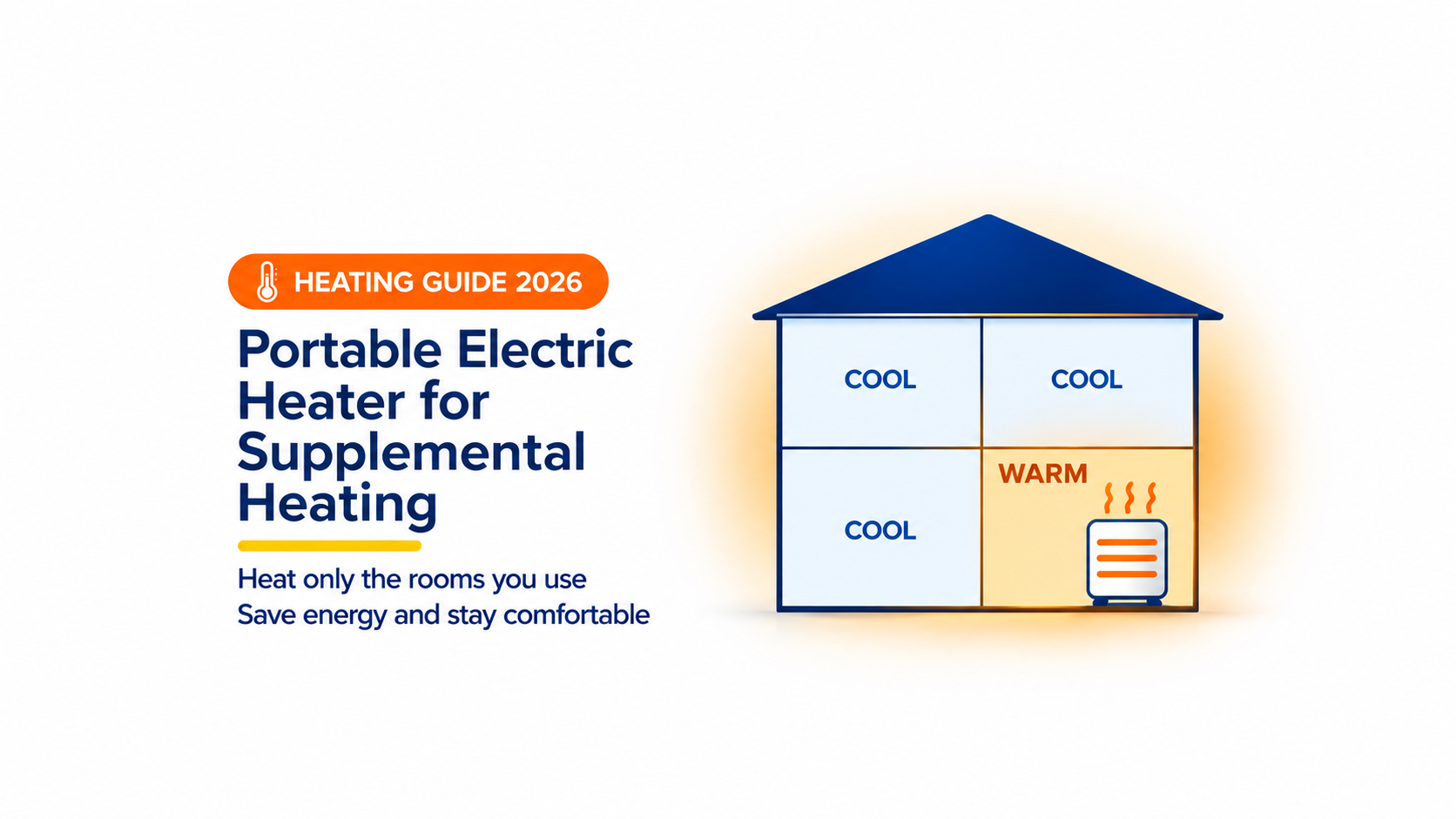
Zone heating means heating the rooms you use, when you use them, instead of heating every room to the same temperature. The idea is simple. Central heating warms the whole house, including empty rooms. If you turn the main thermostat down a few degrees and warm only the occupied room with a small heater, the central system works less.
Whether this saves money depends on your energy prices, your heating system and how you use the heater. Electric heaters turn almost all their electricity into heat, but electricity may cost more per unit of heat than gas or other fuels in many areas. That means a portable heater tends to save money only when it replaces a lot of central heating use, for example when only one person is in one room for hours while the rest of the house stays cooler.
A Simple Cost Example
Imagine you spend 5 hours each evening in a home office and you use a 1,000 W heater on a thermostat that lets it run about half the time. That is roughly 2.5 kWh per evening. If your electricity price is 15 cents per kWh, the heater costs about 38 cents per evening. Whether that is worthwhile depends on how much you can lower your main heating in the rest of the house during that time. Check your own energy rates and heating costs for a real comparison.
Best Types of Portable Heaters for Supplemental Heating
Ceramic Heaters
Ceramic heaters warm a small to medium room quickly and often include a thermostat, timer and oscillation. They suit bedrooms, offices and living rooms. Fan noise is the main downside.
Oil-Filled Radiators
These give gentle, steady heat and keep warming for a while after switching off. They are quiet, which makes them excellent for bedrooms and home offices. They take longer to warm up and are heavy.
Infrared (Radiant) Heaters
Infrared heaters warm people and objects directly. They are useful for spot heating at a desk, sofa or workbench and in drafty areas. They do not heat the air as well, so they suit targeted warmth.
Convector and Panel Heaters
Slim panels warm air gently and can be wall-mounted. They are good for steady background heat in small rooms, with less noise and a low profile.
Fan Heaters
Compact fan heaters are the cheapest and fastest option for short-term heat. They suit occasional use, such as warming a bathroom or a small room for a short period.
Micathermic Heaters
These combine convection and radiant heat in a slim, light body. They warm up faster than oil-filled radiators and are often quiet, which makes them a good middle option.
Quick Comparison Table
| Heater Type | Best Supplemental Use | Main Drawback |
|---|---|---|
| Ceramic | Small and medium rooms, daily use | Fan noise |
| Oil-filled radiator | Bedrooms and offices, long use | Slow warm-up, heavy |
| Infrared | Spot heating, drafty spaces | Warms only line of sight |
| Convector / panel | Quiet background heat | Slower heat-up |
| Fan heater | Quick, short bursts | Noise, dry air |
| Micathermic | Fast, quiet, slim | Usually costs more |
How to Size a Heater for Supplemental Use
Because the heater is only adding to your main system, you often need less power than if it were the main source. A general rule is about 10 watts per square foot (around 100 watts per square metre) to heat a room from cold. For supplemental use in a room that is already partly warmed by central heating, you can often use less.
| Room Size | Approx. Area | Typical Supplemental Wattage |
|---|---|---|
| Small (bathroom, nook) | Up to 80 sq ft | 500 to 800 W |
| Medium (bedroom, office) | 80 to 150 sq ft | 800 to 1,200 W |
| Large (living room, den) | 150 to 250 sq ft | 1,200 to 1,500 W |
| Very cold or poorly insulated room | Any | Use the higher end, and improve insulation |
Choose a heater with several power settings and a good thermostat so that it can adjust to the room instead of running at full power all the time. Also check that the circuit can carry the load, and avoid using the same circuit for other heavy appliances at the same time.
Features to Look For
- Adjustable thermostat: Holds the room at the temperature you choose and cycles the heater off when warm.
- Multiple heat settings: Lets you pick low power for steady warmth and high for a quick boost.
- Timer and programmable schedule: Warms the room before you arrive and turns off automatically.
- Eco mode: Adjusts power to keep the temperature with less energy.
- Tip-over protection: Switches off if the heater falls.
- Overheat protection: Switches off before the unit gets dangerously hot.
- Cool-touch housing and protective grille: Reduce burn and fire risk.
- Quiet operation: Important for bedrooms and offices.
- Remote control: Convenient for adjusting settings without getting up.
- Portability: A handle or wheels make it easy to move between rooms.
- Safety certification: Look for recognised testing marks.
Smart Ways to Get the Most From a Supplemental Heater
- Close the door: Keep heat in the room you are warming.
- Lower the main thermostat a little: Only do this if the rest of the house stays at a safe, comfortable level.
- Place the heater wisely: Put it on the side of the room where you sit, away from draughts, and let the warm air circulate.
- Use the thermostat and timer: Avoid running it at full power for hours.
- Seal draughts: Use weather stripping, draught excluders and heavy curtains to stop heat escaping.
- Use rugs on cold floors: They make a room feel warmer.
- Wear layers and use warm blankets: A small heater plus warm clothing is very effective.
- Pre-heat, do not overheat: Warm the room for a short time before you use it.
- Move the heater with you: Warm the bathroom in the morning, the office during the day and the living room in the evening.
- Keep vents and returns clear: Do not block your main heating outlets.
Safety Rules for Supplemental Heating
Because you will probably use the heater for hours at a time, safety should be a priority:
- Plug directly into a wall outlet: Avoid extension cords and power strips.
- Keep three feet (about one metre) clear: Stay away from curtains, bedding, furniture, clothes and paper.
- Use a flat, stable, hard surface: Never place a heater on a bed, soft furniture or thick rug.
- Do not leave it unattended: Turn it off when you leave the room or the house.
- Do not use it while sleeping: Warm the room beforehand and switch it off for the night, unless the maker explicitly allows safe overnight use and you take extra precautions.
- Never cover it: Do not drape clothes or towels over a heater.
- Keep children and pets away: Use a barrier if needed.
- Do not overload the circuit: Avoid running other high-power appliances on the same circuit.
- Check the cord and plug: Replace damaged parts, and stop using any heater whose plug or cord feels hot.
- Install and test smoke alarms: Make sure there is one in every room where a heater runs.
- Clean regularly: Remove dust from vents and grilles while the heater is unplugged and cool.
- Follow the manual: Every model has its own rules.
Improving the Room First
A heater can only do so much if heat is leaking out as fast as you pump it in. A few simple upgrades make a supplemental heater far more effective:
- Seal gaps: Door bottoms, window frames and outlet covers often leak air.
- Use thicker or lined curtains: They reduce heat loss through windows.
- Add window film: It adds a layer of insulation to single-pane glass.
- Insulate attic and walls: Over time, this is the biggest saver of all.
- Cover bare floors: Rugs and mats make rooms feel warmer.
- Check your ductwork: A room with weak airflow may need duct repairs or balancing rather than another heater.
Common Mistakes to Avoid
- Trying to heat the entire house with several portable heaters.
- Buying a heater that is too weak or too powerful for the room.
- Running the heater at full power all day without a thermostat.
- Leaving the door open so heat escapes to the rest of the house.
- Ignoring draughts and poor insulation.
- Using extension cords, power strips or overloaded outlets.
- Placing the heater near flammable items.
- Forgetting to turn it off when leaving the room.
- Assuming electric heat is always cheaper than central heating.
Frequently Asked Questions (FAQ)
What does supplemental heating mean?
It means using an extra heat source, such as a portable heater, to add warmth to a room or area in addition to your main heating system.
Will a portable heater lower my heating bill?
It can, but only if it lets you turn down your main heating while keeping the occupied room comfortable. If electricity is expensive compared with your main fuel, it may cost more. Compare your rates and usage.
Which type of heater is best for supplemental heating?
It depends on the use. Oil-filled radiators and panel heaters are great for quiet, steady warmth in bedrooms and offices. Ceramic and fan heaters give quick heat. Infrared heaters are ideal for spot heating.
How big a heater do I need?
As a rough guide, allow about 10 watts per square foot for a cold room. A supplemental heater in a partly heated room can often be smaller. Choose one with a thermostat and multiple settings.
Can I use a portable heater as my main heat source?
It is not recommended for whole-house heating. Portable heaters are designed for supplemental use, and relying on them for a full home can be costly and unsafe.
Is it safe to run a heater all day?
It is safer to use a thermostat and timer, stay in the room and follow the manual. Avoid leaving it on when you are away from the room or the home.
Should I close the door of the room I am heating?
Yes, closing the door helps keep the heat in the room so the heater works less. Make sure the room still has adequate ventilation.
Can a heater help a room that is over a garage?
It can help, but such rooms often lose heat through the floor. Insulating the floor and sealing gaps give a more lasting improvement.
Final Thoughts
A portable electric heater for supplemental heating can transform a cold room into a comfortable space without the cost of a new heating system. Choose a heater with the right type and wattage, add a thermostat and timer, seal draughts and heat only the rooms you use. Follow safe placement rules and keep your main heating system in place as the foundation.
Used as part of a smart zone heating plan, a portable heater gives you comfort exactly where and when you need it. Start with one room, learn what works and adjust from there.