
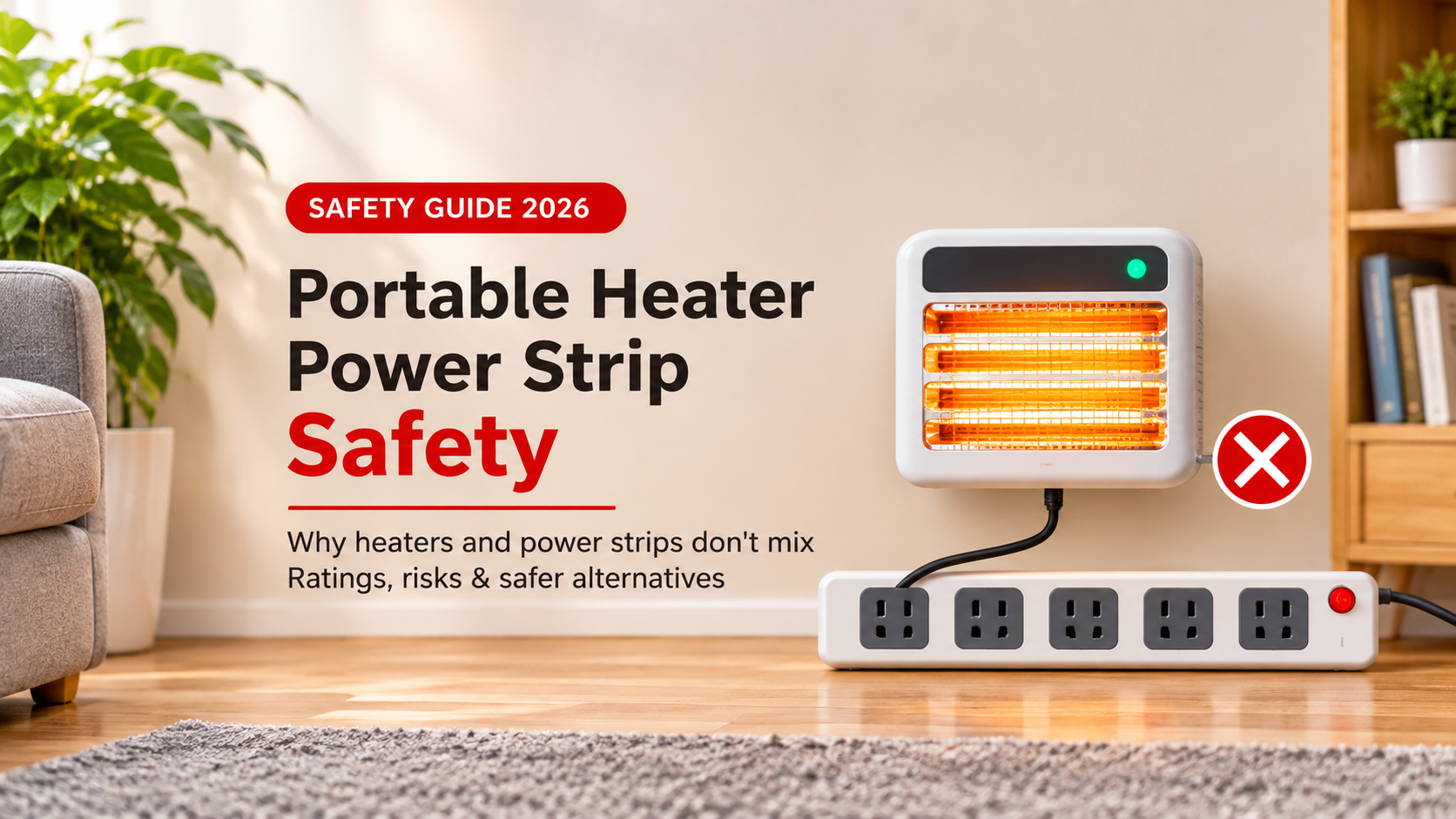
Power strips are everywhere. They sit behind the TV, under the desk and beside the bed, offering extra sockets in a tidy package. So when the wall outlet is full or too far away, plugging a heater into the strip seems like the obvious fix. Unfortunately, portable electric heater power strip safety is a serious issue: this common shortcut is one of the most frequent causes of overheated plugs, melted sockets and house fires linked to heaters.
In this guide you will learn why heaters and power strips are a bad match, how strip ratings really work, how a strip differs from an extension cord or surge protector, what to do if you have no other choice and which safer solutions you can use today.
Can You Plug a Portable Heater Into a Power Strip?
The short answer from heater manufacturers and fire safety experts is no, you should not. Most heater manuals clearly say to plug the unit directly into a wall outlet and to avoid power strips, surge protectors and multi-plug adapters. Following this advice is not just about being careful. It is often a condition of your warranty, and ignoring it can complicate an insurance claim if a fire occurs.
Power strips are built for low-power electronics such as lamps, routers, phone chargers and computers. A portable heater is a different kind of load. It can draw as much as 1,500 watts continuously, and it does so for hours at a time. That is a heavy, steady demand which many strips are simply not designed to handle.
Why a Heater and a Power Strip Are a Dangerous Match
1. Continuous High Current
Most electronics draw small and variable power. Heaters draw high and constant power. Even if a strip is technically rated for the load, running it near its limit for hours creates a lot of heat inside the strip.
2. Weak Internal Parts
Inside a power strip, thin metal bars and small contacts connect each socket. Under heavy load, these parts heat up. Low-quality strips often use thin copper and weak springs, and the sockets can loosen with time, increasing resistance and heat.
3. Thin Cord
Some strips have a light cord that is fine for a laptop but unsuited to a heater. A thin cord can overheat along its length, often hidden behind furniture.
4. Extra Connections Mean Extra Weak Points
The heater’s plug fits into the strip, and the strip’s plug fits into the wall. Each connection is a point where resistance can build. A loose or worn socket can create arcing, a small electrical spark that generates intense local heat.
5. Overloading With Other Devices
Because a strip has several sockets, people tend to plug other items in alongside the heater. The combined load can easily surpass the strip’s limit, even when each device seems modest.
6. Strips Do Not Always Protect Themselves
Not every strip includes a working overload breaker or fuse, and some protection devices only react to sudden spikes rather than a slow, sustained overload.
How Power Strip Ratings Work
Every legitimate power strip has a rating label, often on the back or near the cord. It shows the maximum voltage, current (amps) and sometimes watts. The key point is that this is the total the entire strip can handle, not each socket individually.
| Strip Rating (120V) | Max Power | Safe Continuous Load (about 80%) |
|---|---|---|
| 10 A | 1,200 W | About 960 W |
| 13 A | 1,560 W | About 1,250 W |
| 15 A | 1,800 W | About 1,440 W |
A common 1,500 W heater already sits at or above the safe continuous limit of a standard 15 A strip. Adding anything else makes it worse. On 230V systems, the same logic applies: compare the strip’s maximum rating in amps or watts with the heater’s rating and keep a healthy safety margin.
Power Strip vs Surge Protector vs Extension Cord
These three products look alike but serve different purposes. Mixing them up is a common source of danger.
| Product | Main Purpose | Heater Use |
|---|---|---|
| Basic power strip | Adds extra sockets | Not recommended |
| Surge protector | Shields electronics from voltage spikes | Not suitable |
| Heavy-duty extension cord | Extends reach to an outlet | Last resort if rated properly |
| Wall outlet | Direct connection to the circuit | Best option |
Why Surge Protectors Are Not for Heaters
A surge protector contains components that absorb voltage spikes. Heaters create no such spikes and need no such protection, but they do push a surge protector’s wiring and sockets hard. The protective parts may also wear out invisibly, leaving you with a strip that looks fine but offers no protection at all.
Can a Heavy-Duty Power Strip Handle a Heater?
Some strips are sold as heavy-duty or industrial. These use thicker wiring, stronger sockets and a built-in circuit breaker. In theory, a strip rated clearly above your heater’s current draw can handle the load more safely than a basic one. Even so, the best guidance remains to avoid using a strip. If your heater manual forbids it, treat that instruction as final. Do not assume a heavy-duty label means the strip is approved for your heater.
If You Have No Other Option: Minimum Precautions
Safety experts do not recommend this, but if you absolutely must, these steps reduce the risk:
- Check the heater manual first: If it prohibits strips, do not use one.
- Use only a heavy-duty strip with a clear rating: The rating must be well above the heater’s current draw, with a built-in breaker or fuse.
- Plug in only the heater: Nothing else should share that strip.
- Keep the strip uncovered and in the open: Do not place it under a rug, behind a sofa or inside a cabinet.
- Do not use a second strip or daisy-chain: Plugging one strip into another multiplies risk.
- Check for warmth: After 15 to 20 minutes, carefully feel the plug, strip and cord. Anything warm or hot means stop immediately.
- Inspect the strip often: Look for scorch marks, melted plastic, loose sockets or a cracked cord.
- Never leave it unattended: Switch the heater off when leaving the room or going to sleep.
- Replace old or damaged strips: A strip that has been used with heaters for years may be worn out inside.
Warning Signs of an Overloaded Power Strip
- The strip, plug or cord feels warm or hot.
- You smell burning plastic or a scorched odour.
- Plastic looks discoloured, brown or deformed.
- The heater plug feels loose in the socket.
- You hear crackling, buzzing or see sparks.
- The strip’s breaker trips again and again.
- Lights flicker or dim when the heater turns on.
If you notice any of these signs, switch the heater off at its own control, unplug it carefully and stop using the strip. Have it replaced and consider calling an electrician to check the outlet and circuit.
Safer Alternatives to Using a Power Strip
- Move the heater closer to the wall outlet: Warming the area where you sit is usually enough.
- Free up an outlet: Unplug a low-power device and move it to the strip instead, so the heater takes the wall socket.
- Pick a heater with a longer built-in cord: Some models are made with a heavy cord that reaches further.
- Use a wall-mounted heater: A fixed unit wired by an electrician removes the problem.
- Install a new outlet: A licensed electrician can add a socket exactly where you need it.
- Choose a lower-wattage heater: A 750 W or 1,000 W model is less demanding on the electrical system.
- Use a dedicated circuit for a high-power heater: Avoid sharing it with other large appliances.
Check the Wall Outlet Too
Even a direct connection is only as good as the outlet. Worn or loose outlets can overheat when a heater is plugged in. Signs include a plug that falls out easily, scorch marks, a warm faceplate or a buzzing sound. Replace damaged outlets through a qualified electrician. Also avoid using multi-plug adapters that fit into one wall socket and turn it into several.
Common Mistakes People Make
- Assuming a power strip with a switch and a light is safe for any appliance.
- Plugging a heater and other devices into the same strip.
- Using a surge protector as a heater extension.
- Chaining a strip to another strip or extension cord.
- Hiding a strip under carpet or behind furniture where heat cannot escape.
- Continuing to use a strip that feels warm.
- Buying the cheapest unmarked strip with no rating label.
Frequently Asked Questions (FAQ)
Is it safe to plug a space heater into a power strip?
It is not recommended. Most heater makers and fire safety organisations advise plugging directly into a wall outlet because strips are not designed for the continuous high load of a heater.
Can I use a surge protector with a portable heater?
No. A surge protector is meant for electronics and is not designed to carry the heavy, constant load a heater produces.
What if my power strip is rated 15 amps?
A 15 A rating is the maximum, not the safe continuous load. A 1,500 W heater already approaches or exceeds the recommended continuous limit, so it is still not advised.
Why does my power strip get hot with a heater?
The heater draws high current, which heats the strip’s internal wiring and contacts. If it feels warm, unplug the heater immediately and do not use that strip with it again.
Is an extension cord safer than a power strip for a heater?
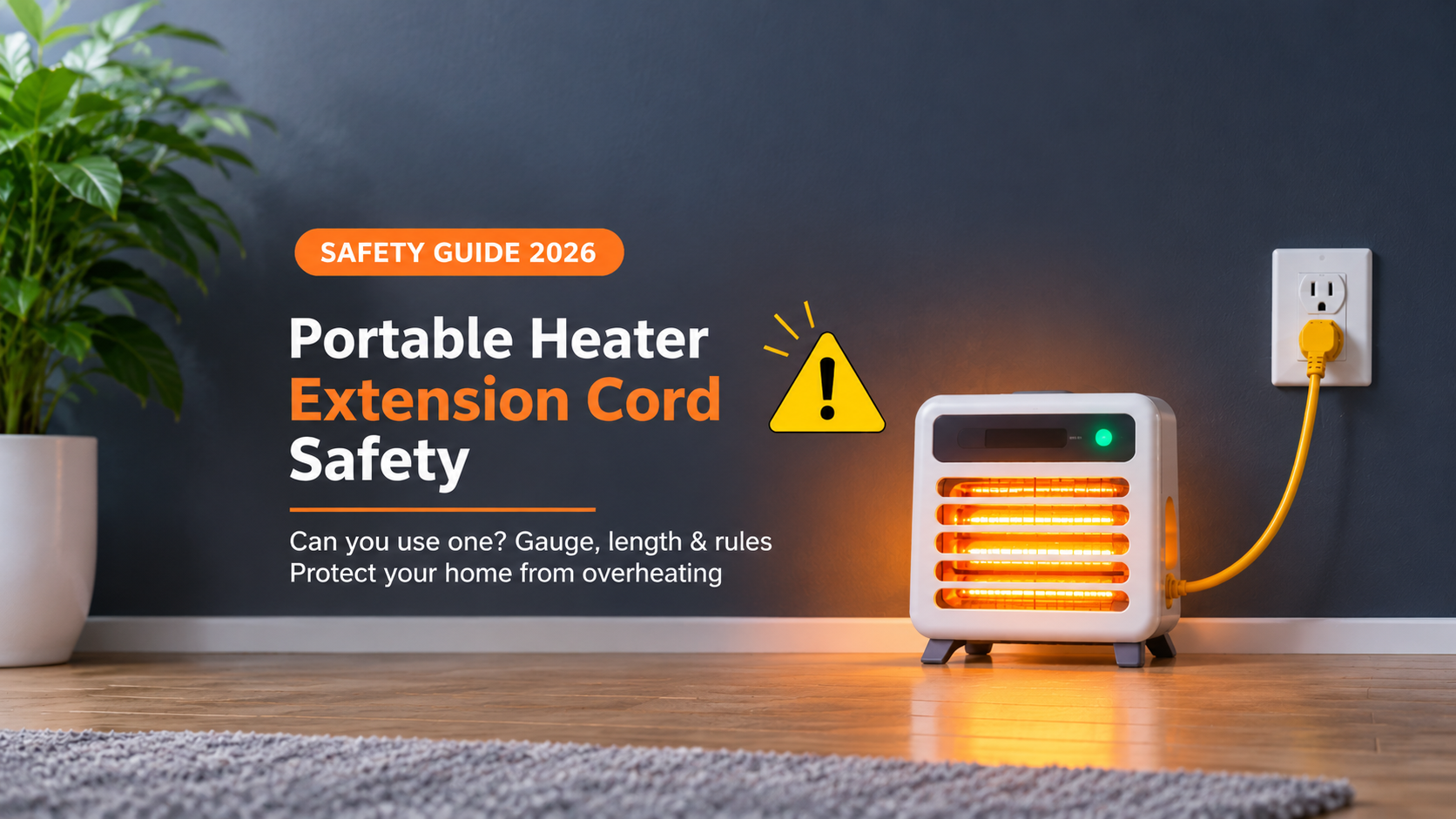
A short, heavy-duty extension cord with a proper rating is generally considered a lesser risk than a typical power strip, but a direct wall connection is still the best choice.
Can I plug a low-wattage heater into a power strip?
A small heater of a few hundred watts puts less strain on a strip, but the safest approach is still to follow the heater manual and plug into a wall outlet when you can.
What should I do if my strip melts or smells of burning?
Switch off the heater, unplug everything if it is safe to do so and replace the strip. If you see flames or smoke, leave the room and call your local emergency number.
Do heaters with plug-in thermostats need special sockets?
Some systems, such as heaters with a separate plug-in thermostat, still need a suitably rated outlet. Check the maker’s instructions for the correct connection.
Final Thoughts
When it comes to portable electric heater power strip safety, the rule is straightforward: plug the heater directly into a wall outlet. Power strips and surge protectors are built for light electronic loads, not for a hot, hungry heater running for hours. If you cannot reach an outlet, move the heater, choose a model with a longer cord, ask an electrician to add a socket or, at the very least, use a short, heavy-duty and properly rated cord.
A few seconds spent choosing the right connection can prevent overheating, damage and fire. Always read the heater’s manual, check plugs and cords for warmth and never leave a heater running unattended.