



500 Watt vs 1500 Watt Electric Heater: Which Wattage Is Right for You?

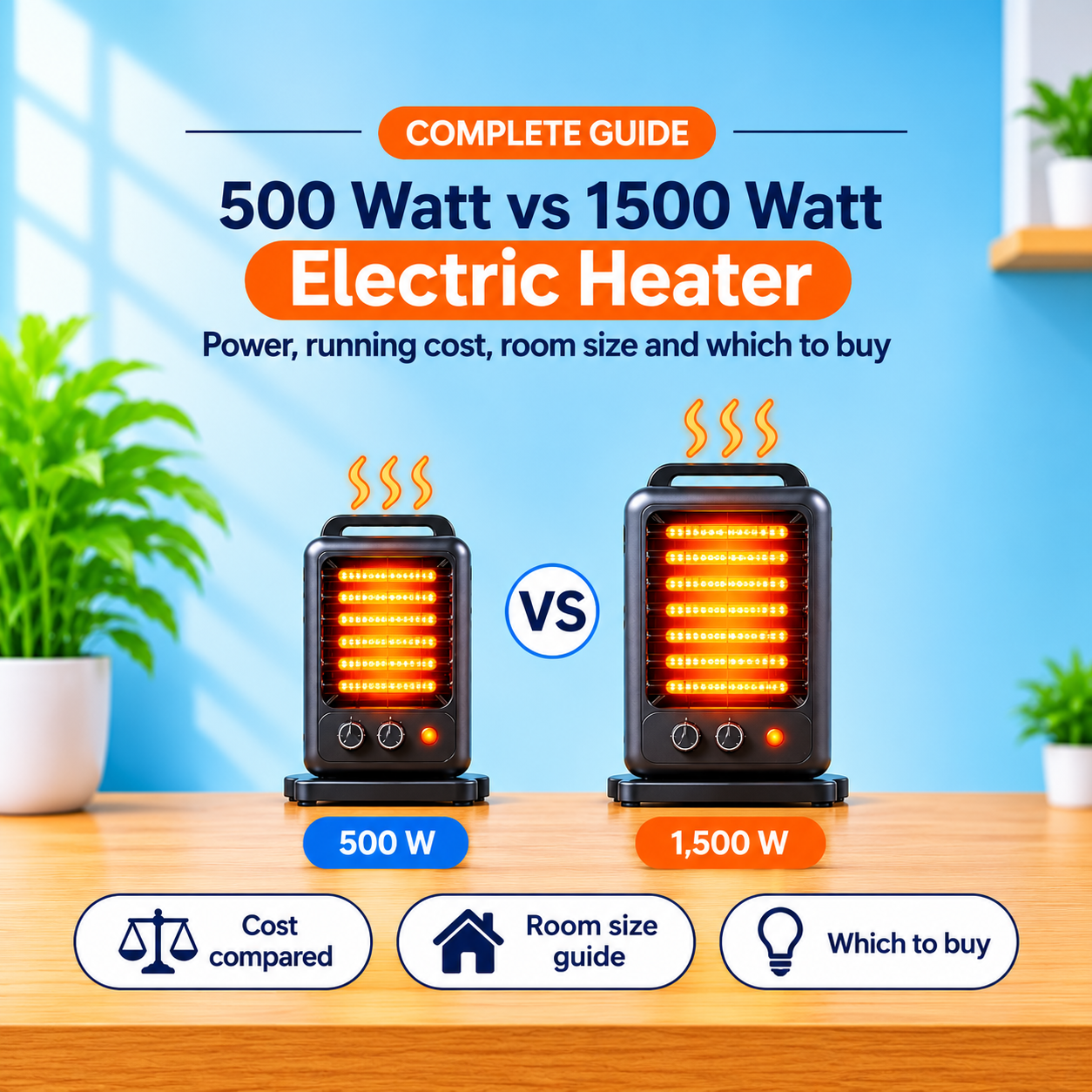
Shopping for a portable heater quickly leads to one question: should you buy a small 500 watt model or a full-size 1500 watt heater? The numbers look simple, because 1500 is exactly three times 500. But the right choice is not always the bigger one. Wattage affects how fast a room warms up, how much electricity you use, which rooms the heater can handle, how much load it puts on your wall circuit and even how long it can run from a generator or power station.
This guide compares a 500 watt vs 1500 watt electric heater in detail, with real running costs, room size recommendations, amp draw, heat output and a simple decision checklist, so you can pick the heater that fits your space and your budget.
Quick verdict
- Choose a 500 W heater for personal warmth at a desk or chair, for very small spaces of about 50 square feet, and when you need a low-power heater for a generator or power station.
- Choose a 1500 W heater for a bedroom, home office or other room of about 100 to 150 square feet, for faster warm-up, and for cold or drafty spaces.
- At full power, a 1500 W heater uses three times as much electricity: about 25.5 cents per hour versus 8.5 cents for 500 W at $0.17 per kWh.
- Both convert almost all their electricity into heat, so neither is “more efficient.” The real difference is how much heat per hour each delivers.
500 Watt vs 1500 Watt Heater: Head-to-Head Comparison
The table below summarizes the most important differences. Running costs use an example electricity rate of $0.17 per kWh, so replace it with your own rate for an accurate estimate.

| Feature | 500 W heater | 1500 W heater |
|---|---|---|
| Typical type | Personal or mini heater | Full-size room heater |
| Energy per hour (full power) | 0.5 kWh | 1.5 kWh |
| Cost per hour at $0.17 per kWh | 8.5 cents | 25.5 cents |
| Heat output | about 1,700 BTU per hour | about 5,100 BTU per hour |
| Current on 120 V | about 4.2 A | about 12.5 A |
| Current on 230 V | about 2.2 A | about 6.5 A |
| Room size guide | up to about 50 sq ft (5 m²) | up to about 150 sq ft (14 m²) |
| Best for | Desk, chair, small zone, off-grid use | Bedrooms, home offices, small living spaces |
What Do 500 Watts and 1500 Watts Actually Mean?
Watts measure how fast a heater converts electricity into heat. A 1500 W heater produces three times as much heat every hour as a 500 W heater. In heating terms, 1 watt equals about 3.412 BTU per hour, so:
- 500 W is about 1,706 BTU per hour.
- 1500 W is about 5,118 BTU per hour.
A useful way to think about it is that heat output is the amount of “heating effort” you can apply to a room. A 500 W heater applies a small amount of effort, enough for a tiny space or for warming one person. A 1500 W heater applies three times as much, enough to raise the temperature of an average bedroom.
Another important point is that wattage does not change efficiency. Electric resistance heaters of any wattage turn virtually all the power they use into heat. Neither size is “greener” or “wasteful” by design. What matters is whether the heater’s output suits the room it is heating.
Running Cost: 500 Watt vs 1500 Watt Heater
At full power, the cost difference is exactly three to one, because cost depends directly on wattage: cost per hour = watts ÷ 1,000 × price per kWh.
| Usage | 500 W heater | 1500 W heater | Difference |
|---|---|---|---|
| 1 hour | 8.5 cents | 25.5 cents | 17 cents |
| 8 hours (one night) | $0.68 | $2.04 | $1.36 |
| 1 month at 6 hours a day | $15.30 | $45.90 | $30.60 |
| Heating season (120 days at 6 hours a day) | $61.20 | $183.60 | $122.40 |

These are worst-case figures that assume the heating element never switches off. In real life, a thermostat cuts the power once the room reaches your target temperature, so you only pay for the time the element is actually on. That brings us to one of the biggest misconceptions in this comparison.
Does a 1500 Watt Heater Always Use More Electricity?
Not necessarily. Electricity use depends on how much heat the room needs, not on the label of the heater alone. Imagine a small, well-sealed room that needs about 500 W of heat to stay comfortable. A 500 W heater has to run the entire hour to supply that. A 1500 W heater supplies the same heat in about 20 minutes of running time and then switches off. Both use roughly 0.5 kWh in that hour and cost about 8.5 cents.

This is why a 1500 W heater is not automatically “three times more expensive” to run. Where the 1500 W heater does cost more is when:
- the room is large or drafty and the heater runs continuously;
- you run it on the high setting with no thermostat control; or
- you leave it on for long periods after the room is already warm.
On the other hand, if you choose a 500 W heater for a room that is too big, the heater will run constantly and never reach a comfortable temperature, so you pay for electricity without getting comfort. The cheapest heater is the one that is sized correctly, not the one with the lowest wattage.
Room Size: Which Rooms Can Each Heater Warm?
A common rule of thumb is 10 watts per square foot of floor area for rooms with standard 8 ft ceilings and average insulation. Using that guideline, a 500 W heater suits roughly 50 square feet, and a 1500 W heater suits roughly 150 square feet.

| Space | Approx. area | Wattage needed | Better choice |
|---|---|---|---|
| Closet-sized room or booth | 50 sq ft (5 m²) | 500 W | 500 W |
| Small office | 80 sq ft (7 m²) | 800 W | 1500 W on a lower setting |
| Small bedroom | 100 sq ft (9 m²) | 1,000 W | 1500 W |
| Average bedroom | 150 sq ft (14 m²) | 1,500 W | 1500 W |
| Large bedroom | 200 sq ft (19 m²) | 2,000 W | 1500 W plus a second heater, or a higher-wattage 230 V model |
| Living room | 300 sq ft (28 m²) | 3,000 W | Multiple heaters or other heating system |
Remember that a 500 W heater is rarely meant to heat an entire room. It is better at personal or zone heating: keeping your feet, legs or upper body warm in a space that is otherwise cool. That can be a very efficient use of energy, because you are only warming the area where a person actually sits.
Heating Speed and Comfort
Because a 1500 W heater produces three times the heat per hour, it can raise the temperature of the same room roughly three times faster than a 500 W heater, all else being equal. That matters on a cold morning when you want the room warm in 10 or 15 minutes rather than an hour.
A 500 W heater is slower, but it comes with some advantages:
- It is typically smaller, lighter and easier to carry from room to room.
- It tends to run quieter because fan heaters at lower wattage can use smaller fans.
- Its gentle output suits a close-range warmth, such as under a desk, without blasting hot air.
Many 1500 W heaters include a lower setting such as 750 W or 900 W. If you buy one of those, you get a heater that can act like a mid-size model on the low setting and a full-size model on high. That flexibility is one reason 1500 W heaters are the most popular choice.
Electrical Load: How Many Amps Do They Draw?
The current a heater draws equals watts divided by volts. On a 120 V supply, a 500 W heater pulls about 4.2 amps and a 1500 W heater pulls about 12.5 amps. On a 230 V supply, the figures are about 2.2 amps and 6.5 amps.
On a standard 120 V, 15 A circuit, that difference is significant:
- A 500 W heater leaves plenty of capacity on the circuit, so it can usually share the line with a lamp or laptop charger.
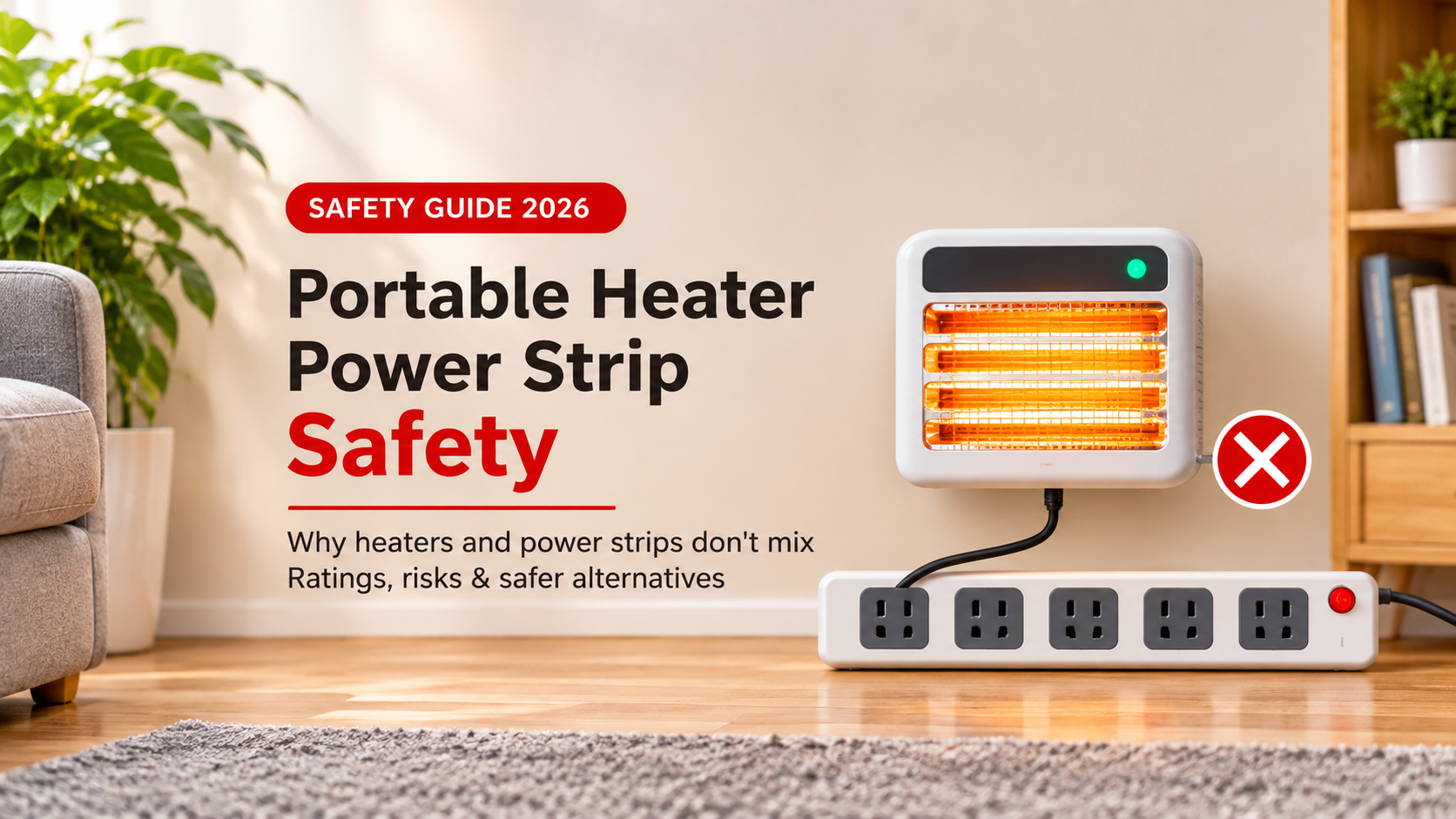
- A 1500 W heater uses most of the circuit’s safe continuous capacity. It should be the only large load on that circuit, and it should be plugged directly into a wall socket instead of an extension cord or power strip.
If a room already has several devices on the same circuit, or if your breaker trips often, a 500 W heater (or two) may be the safer and more practical choice.
Running a Heater From a Generator, Inverter or Power Station
This is where the wattage gap matters most. Battery power stations and small generators have strict output limits, and a heater consumes energy very quickly. Divide the battery capacity in watt-hours by the heater’s wattage to estimate runtime.

A 1,000 Wh power station could in theory run a 500 W heater for 2 hours but a 1500 W heater for only 40 minutes. Many small power stations also cannot deliver 1500 W continuously at all, so always check the unit’s continuous output rating, not just its battery size. A 500 W heater is usually the realistic choice for off-grid cabins, RVs and emergency backup, while 1500 W heaters generally need a large generator or a high-capacity power station.
Pros and Cons of Each Wattage
500 watt electric heater
Pros
- Lowest cost for every hour of use
- Draws little current and is easy on household circuits
- Compact, light and portable
- Works with generators, inverters and small power stations
- Great for personal, close-range warmth
Cons
- Cannot heat a standard bedroom or living room on its own
- Slow to raise room temperature
- May run constantly in cold or drafty spaces without ever feeling warm
1500 watt electric heater
Pros
- Heats an average room quickly
- Often has multiple settings, so it can also run at lower power
- Better for cold, large or drafty spaces
- Widest choice of designs, including oil-filled, ceramic, infrared and panel models
Cons
- Three times the cost per hour at full power
- Uses most of a standard 15 A circuit, so it needs to be the only major load
- Drains small power stations quickly
- Can be more than you need in a very small space
Best Heater Wattage for Different Uses
| Use case | Recommended wattage | Why |
|---|---|---|
| Under a desk or at a workstation | 500 W | Warms you, not the whole room, at the lowest cost. |
| Small home office (up to 100 sq ft) | 1500 W with a low setting | Warms up quickly, then holds temperature on a lower setting. |
| Average bedroom | 1500 W | A 500 W unit is too small for the whole room. |
| Dorm room | 500 W to 1500 W | Depends on room size and any building power limits. |
| RV, cabin or off-grid use | 500 W | Matches inverter and battery limits. |
| Garage or workshop | 1500 W (radiant for spot heating) | Cold, drafty spaces need more power. |
| Living room | 1500 W (as supplementary heating) | Larger rooms need more output than a single portable heater provides. |
Can You Use Two 500 Watt Heaters Instead of One 1500 Watt Heater?
Three 500 W heaters give the same total output as one 1500 W heater, but the practical benefits are different. Two or three small heaters let you warm several spots, such as a desk, a bed and a seating area, and you can switch off the ones you do not need. They also spread the load across several sockets or circuits, which helps if your wiring is limited. The downside is that you have to manage multiple devices, and the combined cost per hour is the same as a single 1500 W unit when all are on.
A single 1500 W heater is simpler and usually cheaper to buy, while multiple smaller heaters give you more flexible, targeted heating. If you mostly want personal warmth, go small. If you need an entire room comfortable, one properly sized heater is more convenient.
Which One Should You Choose?

If you are still undecided, ask yourself three questions:
- How big is the space? Under about 50 square feet, or if you only need to warm yourself, a 500 W heater is enough. Between 100 and 150 square feet, choose 1500 W.
- What power do you have? On a shared circuit, a generator or a small power station, a 500 W heater is far easier to run. With a dedicated circuit and normal mains power, 1500 W is no problem.
- How cold does it get? In freezing weather or poorly insulated rooms, 1500 W gives you the power you need. In mild weather and small rooms, 500 W may be all you need.
Features to Look For in Either Heater
Whatever wattage you choose, the features below make a heater safer and cheaper to use.
- Adjustable thermostat: keeps the heater from running when the room is warm enough.
- Multiple heat settings: lets you reduce power once the room is warm.
- Tip-over and overheat protection: automatic shut-off if the heater falls or gets too hot.
- Timer and auto shut-off: prevents wasted hours at full power.
- Safety certification: look for a mark from a recognized testing laboratory, such as UL or ETL in the United States.
- Cool-touch housing: especially important if you have children or pets.
- Noise level: check this if you plan to use the heater in a bedroom or office.
- Portability: a carry handle and lightweight body help if you move the heater around.
- Heater type: ceramic for quick heat, oil-filled for steady heat, infrared for spot heating and panel for quiet background warmth.
Safety Tips for Any Portable Heater
- Plug the heater straight into a wall outlet. Avoid extension cords and power strips, especially with a 1500 W model.
- Keep at least three feet (about one meter) of clear space around the heater.
- Place it on a flat, hard surface and never on a bed or soft carpet.
- Never cover the heater or use it to dry clothes.
- Do not use a heater in a wet bathroom unless it is designed for that purpose.
- Switch it off when leaving the room, and follow the manufacturer’s instructions for overnight use.
- Check the cord and plug regularly. Stop using the heater if either feels hot or looks damaged.
Frequently Asked Questions
Is a 500 watt heater enough to heat a bedroom?
Usually not. A 500 W heater suits about 50 square feet, while an average bedroom is closer to 150 square feet. A 500 W heater can still help as a supplementary heater near the bed or a chair, but a 1500 W heater is the better choice for the whole room.
Does a 1500 watt heater use three times more electricity than a 500 watt heater?
At full power, yes: 1.5 kWh per hour versus 0.5 kWh per hour. In real use the difference depends on how long each heater’s element is actually on. A thermostat can reduce the gap, especially when the larger heater cycles off after quickly warming the room.
How much does it cost to run a 500 watt heater?
At $0.17 per kWh, a 500 W heater costs about 8.5 cents per hour, 68 cents for 8 hours and about $15.30 for a month at 6 hours a day, assuming it runs at full power the entire time.
How much does it cost to run a 1500 watt heater?
At $0.17 per kWh, a 1500 W heater costs about 25.5 cents per hour, $2.04 for 8 hours and about $45.90 for a month at 6 hours a day at full power. A working thermostat often reduces this.
How many 500 watt heaters equal one 1500 watt heater?
Three. Three 500 W heaters produce the same total heat as one 1500 W heater and draw the same total current.
Can a 500 watt heater run on an inverter or power station?
Often yes, as long as the inverter’s continuous output rating is higher than 500 W with some headroom. A 1500 W heater generally needs an inverter or power station rated well above 1,500 W, and it will drain a battery much faster.
Is a 500 watt heater safe to leave on overnight?
Safety depends on the heater’s design and features, not only its wattage. A model with a thermostat, tip-over protection, overheat protection and a recognized safety certification is far safer than one without them. Always follow the manufacturer’s instructions.
Which is better for a small room, 500 W or 1500 W?
For a room of about 50 square feet or less, 500 W is enough. For a small room of 80 to 100 square feet, a 1500 W heater with a lower setting and a thermostat is usually more comfortable.
Final Verdict: 500 Watt vs 1500 Watt Electric Heater
The choice comes down to how much space you need to heat and what power supply you have. A 500 watt electric heater is a low-cost, low-load option for personal warmth, tiny spaces and off-grid situations. A 1500 watt electric heater is the all-round choice for bedrooms, offices and cold or drafty spaces, with the speed and power to keep an average room comfortable.
If you are heating a whole room, choose 1500 W and use the thermostat and lower settings to control the cost. If you only need to keep yourself warm, choose 500 W and enjoy lower running costs, less load on your wiring and easier use with portable power. Matching the wattage to the space gives you the best comfort for the least money.
Note: All prices in this article are examples based on a rate of $0.17 per kWh. Replace it with the rate on your own electricity bill for an accurate estimate. Room size, BTU and runtime figures are guidelines and vary by model and conditions.