






Portable Electric Heater Cost Per Hour: What You Really Pay by Wattage and Electricity Rate

Few questions come up more often in cold weather than this one: how much does it cost to run a portable heater for an hour? The honest answer is that it depends on two things you can look up in a minute: the heater’s wattage and the price you pay for each kilowatt-hour of electricity. Once you know both, the cost per hour is a one-line calculation.
In this guide you will find the portable electric heater cost per hour for every common wattage at low, average and high electricity rates, a simple formula you can use with any currency, the cost of running a heater for a night or a month, and the reasons your real bill is usually lower than the maximum figures you see online.
Quick answer
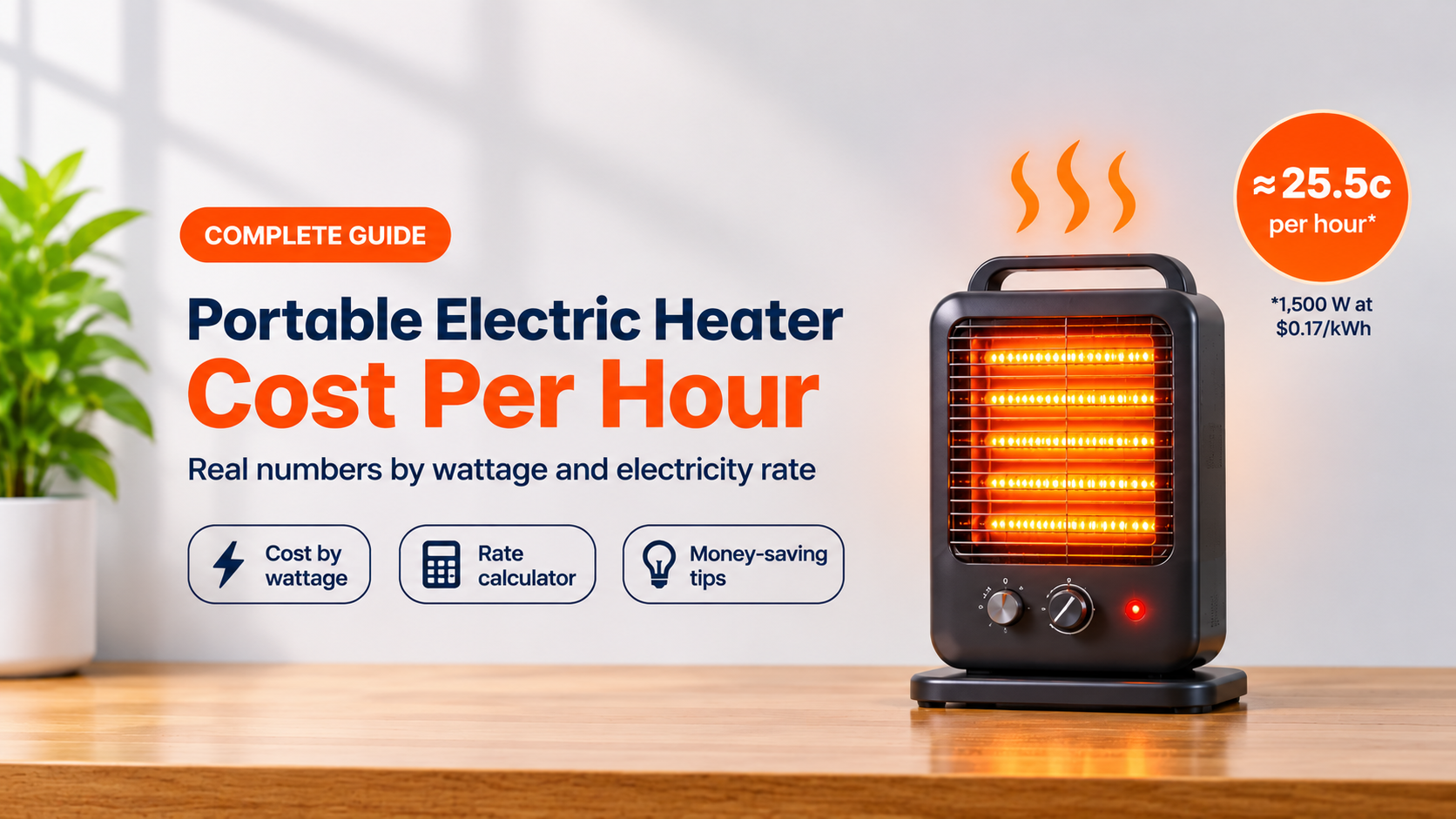
- A 1,500 W portable heater costs about 25.5 cents per hour at $0.17 per kWh when it runs at full power.
- Smaller heaters cost less: 500 W is about 8.5 cents per hour and 750 W is about 12.8 cents.
- A 2,000 W heater costs about 34 cents per hour at the same rate.
- Formula: watts × rate per kWh ÷ 1,000 = cost per hour.
- With a thermostat that switches the heater off half the time, the effective cost per hour is roughly half of the maximum.
What “Cost Per Hour” Really Means for a Heater
Electric heaters are rated in watts, which measure how quickly the heater uses energy. Your electricity company bills you in kilowatt-hours (kWh), which measure how much energy you used over time. One kilowatt-hour is one thousand watts used for one hour.
That means a 1,000 W heater uses exactly 1 kWh in an hour of continuous running, and a 1,500 W heater uses 1.5 kWh. Multiply by the price you pay per kWh and you have the cost per hour. The numbers in this article describe full-power running, which is the maximum you can pay. Later, we will look at why the actual cost is often lower.
Portable Heater Cost Per Hour by Wattage
The chart below shows the hourly cost of the most common heater sizes at three example electricity rates: $0.10 (a low rate), $0.17 (close to an average household rate) and $0.25 (a high rate).

| Heater wattage | Energy per hour | At $0.10 per kWh | At $0.17 per kWh | At $0.25 per kWh |
|---|---|---|---|---|
| 500 W | 0.5 kWh | 5.0 cents | 8.5 cents | 12.5 cents |
| 750 W | 0.75 kWh | 7.5 cents | 12.75 cents | 18.75 cents |
| 1,000 W | 1.0 kWh | 10.0 cents | 17.0 cents | 25.0 cents |
| 1,200 W | 1.2 kWh | 12.0 cents | 20.4 cents | 30.0 cents |
| 1,500 W | 1.5 kWh | 15.0 cents | 25.5 cents | 37.5 cents |
| 2,000 W | 2.0 kWh | 20.0 cents | 34.0 cents | 50.0 cents |
Most portable heaters sold for 120 V outlets top out at 1,500 W. Heaters of 2,000 W are common where the mains supply is 220 to 240 V. If your heater has several settings, such as 750 W and 1,500 W, use the figure for the setting you actually run.
How to Calculate Your Heater’s Cost Per Hour
You can check any heater in under a minute. You need two numbers: the heater’s wattage and your electricity rate.

Step 1: Find the wattage
Look at the rating label on the back or base of the heater, or in the manual. You are looking for a number followed by “W”, for example 1500 W. If the label lists only amps and volts, multiply them together: 12.5 A × 120 V = 1,500 W.
Step 2: Find your electricity rate
Your bill shows the total you paid and the kWh you used. Divide the total by the kWh to get your real average rate, which includes delivery and other charges. Some plans use tiered or time-of-use prices, so your heating hours may cost more or less than the average.
Step 3: Apply the formula
Multiply the wattage by your rate and divide by 1,000. For a 1,500 W heater at $0.17 per kWh: 1,500 × 0.17 ÷ 1,000 = $0.255, or 25.5 cents per hour.
Quick table for any currency
Not paying in dollars? The table below works with any currency. Find your rate per kWh in the first column and read across for the cost of one hour at full power, in the same currency.
| Your rate per kWh | 750 W heater | 1,000 W heater | 1,500 W heater | 2,000 W heater |
|---|---|---|---|---|
| 5 | 3.75 | 5 | 7.5 | 10 |
| 10 | 7.5 | 10 | 15 | 20 |
| 15 | 11.25 | 15 | 22.5 | 30 |
| 20 | 15 | 20 | 30 | 40 |
| 30 | 22.5 | 30 | 45 | 60 |
| 40 | 30 | 40 | 60 | 80 |
From One Hour to One Month: What a Heater Costs Over Time
Hourly figures are easy to compare, but most people want to know what a whole evening, a night or a month will cost. Using the 1,500 W example at $0.17 per kWh, the numbers stack up like this.

Overnight cost: 8 hours of use
| Heater wattage | Energy for 8 hours | Cost at full power | Cost if it runs half the time |
|---|---|---|---|
| 500 W | 4 kWh | $0.68 | $0.34 |
| 750 W | 6 kWh | $1.02 | $0.51 |
| 1,000 W | 8 kWh | $1.36 | $0.68 |
| 1,500 W | 12 kWh | $2.04 | $1.02 |
| 2,000 W | 16 kWh | $2.72 | $1.36 |
Running a 1,500 W heater non-stop for 6 hours a day over 30 days adds up to 270 kWh, or $45.90 at $0.17 per kWh. That is a real chunk of a monthly bill, which is why the next section matters so much.
Why Your Real Cost Per Hour Is Usually Lower
The figures above assume the heating element stays on for every minute of the hour. Most portable heaters do not work that way. A thermostat measures the room temperature, switches the heating element off when it reaches your setting and turns it back on when the room cools down. While the element is off, the heater uses almost no electricity.

If your heater is on for 30 minutes out of every hour, you are billed for 0.75 kWh, which is about 12.8 cents. If it only runs 15 minutes, you pay about 6.4 cents. How much a thermostat helps depends on your room’s size, insulation and the outside temperature. In a small, well-sealed room, the thermostat may cut the heater off most of the time. In a large, drafty space, the heater may run non-stop and you will pay close to the full figure.
One important note: the thermostat does not reduce the wattage while the heater is running. It only controls how often the element is on. A heater without a thermostat, or with a faulty one, runs continuously and costs the maximum every hour.
Does Heater Type Change the Cost Per Hour?
Watt for watt, no. Ceramic, oil-filled, infrared, panel and fan heaters all turn practically 100 percent of the electricity they use into heat. A 1,500 W ceramic heater and a 1,500 W oil-filled radiator both cost 25.5 cents per hour at full power at the example rate. The differences are in how that heat is delivered, and that can affect how long the heater needs to run:
- Ceramic fan heaters warm the air quickly, so a small room reaches temperature fast, but the heat disappears soon after the heater stops.
- Oil-filled radiators take longer to warm up but keep radiating after the element switches off, which often means the heater cycles off for longer periods.
- Infrared heaters warm people and objects directly, which can feel comfortable at a lower air temperature in open or drafty spaces.
- Panel heaters provide gentle, steady warmth and suit rooms used for long periods.
- Personal heaters use little power and are ideal when you only need to warm yourself, not the whole room.
How a Heater Compares With Everyday Appliances
A portable heater is one of the most power-hungry devices you plug in. Seeing it next to ordinary household items puts its running cost in perspective.

A light bulb or a laptop costs pennies to run all day. A heater is closer to a hair dryer or microwave, except that you may leave it on for hours instead of minutes. That is why heaters can have a noticeable effect on your bill even though the hourly figure looks small.
What Changes the Cost Per Hour in Real Life

Wattage and electricity rate are the only two numbers that set the maximum cost per hour. The remaining four factors decide how much of that maximum you actually pay. They also explain why two households with identical heaters can see very different bills: a small, insulated bedroom may need the heater for 15 minutes an hour, while a drafty garage may need it for the whole hour.
Electric Heater Cost Compared With Other Ways to Heat
An electric resistance heater gives you exactly one unit of heat for every unit of electricity. At $0.17 per kWh, that is 17 cents for each kWh of heat. A heat pump or an inverter air conditioner in heating mode moves heat instead of creating it, and typically delivers about two to four units of heat per unit of electricity. At the same electricity price, that works out to roughly 4 to 9 cents per kWh of heat, which is a fraction of the cost.
Gas or oil heating can be cheaper or more expensive than electricity, depending entirely on local fuel prices. To compare, convert each option to a cost per kWh of heat, then divide by that system’s efficiency.
That does not make portable heaters a poor choice. They are most cost-effective as zone heaters: when you lower the central heating and warm only the room you are sitting in, or when you have no central heating at all. They are least cost-effective when used to heat several rooms or a whole home.
8 Ways to Reduce Your Heater’s Cost Per Hour
- Choose the right wattage. A heater matched to your room reaches the set temperature and then cycles off, while an undersized one runs endlessly.
- Use a thermostat and keep it modest. Setting 20 to 22 °C (68 to 72 °F) is comfortable for most people. Every extra degree increases running time.
- Heat the room you are in. Shut doors and windows and move the heater to the space you actually use.
- Stop the drafts. Door seals, draft stoppers and thick curtains keep heat in the room.
- Use a timer or smart plug. Pre-heat the room before you arrive or go to bed instead of leaving the heater on all day.
- Drop to a lower setting once warm. Holding a temperature needs less power than raising it.
- Take advantage of off-peak pricing. If your plan has cheaper hours, pre-heat during those periods.
- Layer up. A sweater, blanket or warm slippers let you lower the thermostat by a degree or two without noticing.
Features to Look For in a Heater That Costs Less to Run
All heaters of the same wattage cost the same at full power, but the right features help you pay for fewer of those hours.
- Accurate adjustable thermostat: the most important feature for controlling the running cost.
- Multiple power settings: being able to run at 750 W instead of 1,500 W halves the hourly cost when the room is already warm.
- Eco mode: adjusts output automatically to maintain a set temperature.
- Programmable timer: prevents wasted hours at full power.
- Digital display and remote control: makes it easier to keep the setting where you want it.
- Tip-over and overheat protection: essential safety features that also protect your investment.
- Recognized safety certification: look for a mark from an independent test laboratory, such as UL or ETL in the United States.
- Right size and form: a quiet oil-filled or panel heater for a bedroom, a compact ceramic heater for a desk, and a more powerful radiant model for a garage.
How to Measure Your Heater’s Actual Running Cost
The most accurate method is a plug-in energy monitor, a small adapter that sits between the heater and the wall socket. It shows live wattage and the total kWh used. Run your heater as you normally would for a day or an evening, note the kWh on the display and multiply by your electricity rate. That gives you the real cost for your room, including every thermostat cycle.
If you do not have a monitor, you can still estimate. Note how many hours the heater is switched on, observe roughly how often the heating indicator light is on, and apply that fraction to the full-power cost.
Safety Tips When Running a Heater for Long Periods
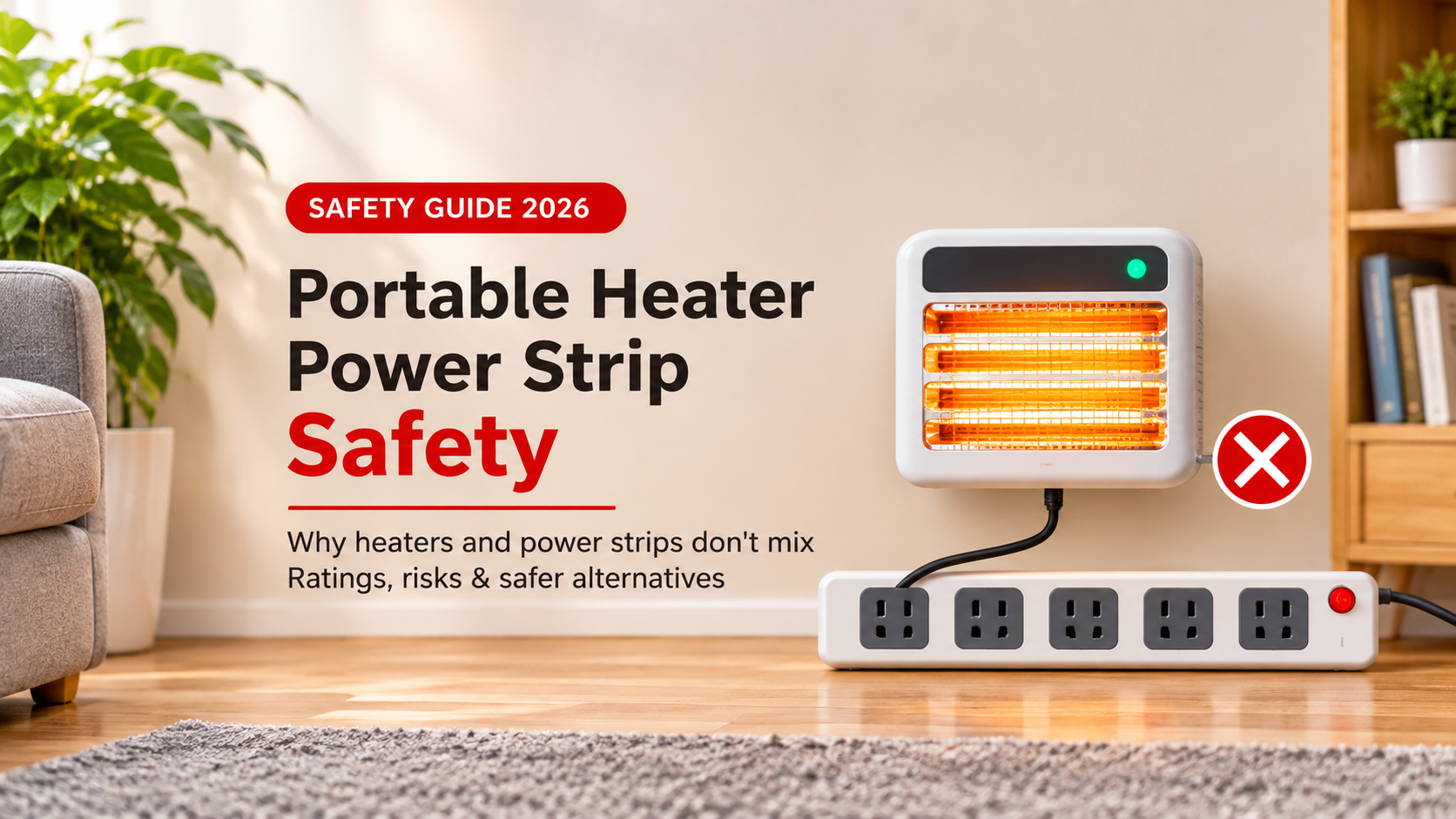
- Plug the heater directly into a wall socket. Avoid extension cords and power strips.
- Keep at least three feet (about one meter) of clear space around the heater.
- Place it on a flat, hard surface, never on a bed or soft carpet.
- Never cover the heater or use it to dry clothes.
- Do not use a standard heater in a wet bathroom unless it is made for that environment.
- Switch the heater off when you leave the room, unless it is designed for unattended use and you follow the manufacturer’s instructions.
Frequently Asked Questions
How much does a portable electric heater cost per hour?
At a rate of $0.17 per kWh, a 500 W heater costs about 8.5 cents per hour, a 1,000 W heater costs about 17 cents, a 1,500 W heater costs about 25.5 cents and a 2,000 W heater costs about 34 cents, all at full power.
How much does it cost to run a 1,500 W heater for 8 hours?
A 1,500 W heater uses 12 kWh in 8 hours of full-power running, which costs about $2.04 at $0.17 per kWh. With a thermostat switching the heater off for part of the time, the cost is usually lower.
Is it cheaper to run a heater on low?
The low setting uses less power every hour. Whether it costs less overall depends on whether it can keep the room comfortable. A low setting is ideal once the room is warm, but may never reach your target in a large or cold space.
Does a bigger heater cost more to run?
Per hour at full power, yes. However, a larger heater warms a room faster and may then cycle off, while a smaller heater might run constantly. The best heater is one that suits your room size.
Are oil-filled heaters cheaper to run than ceramic heaters?
At the same wattage, they cost the same per hour of running. Oil-filled heaters may use less energy in practice because they retain and radiate heat after the element switches off.
How can I calculate the cost if I only know the amps?
Multiply the amps by the supply voltage to get watts, then use the formula. For example, a heater rated at 12.5 A on a 120 V supply draws 1,500 W, which is 25.5 cents per hour at $0.17 per kWh.
Do portable heaters use electricity when they are turned off?
A heater that is switched off uses almost nothing. Models with displays or remote controls may use a watt or two on standby, which is negligible.
Is a portable heater cheaper than central heating?
It depends on your energy prices and system. A portable heater is usually more expensive per unit of heat than a gas furnace or heat pump, but it can save money when it heats only the room you are using while the rest of the home stays cooler.
Final Thoughts
The portable electric heater cost per hour is easy to work out: multiply the heater’s watts by your price per kWh and divide by 1,000. A typical 1,500 W heater costs about 25.5 cents per hour at $0.17 per kWh when it runs flat out, and less when a thermostat switches it off for part of the time.
The best way to keep that cost down is to choose a heater that matches your room, use its thermostat and timer, stop drafts, and heat only the space you are in. Do that, and you can enjoy a warm room all winter without a shock on your electricity bill.
Note: All prices in this article are examples based on rates of $0.10, $0.17 and $0.25 per kWh. Replace them with the rate on your own bill for an accurate estimate. Appliance wattages and thermostat run times are typical or illustrative values and vary by model and conditions.