







Why Does My Home Decor Look Unbalanced? 10 Causes and Simple Fixes
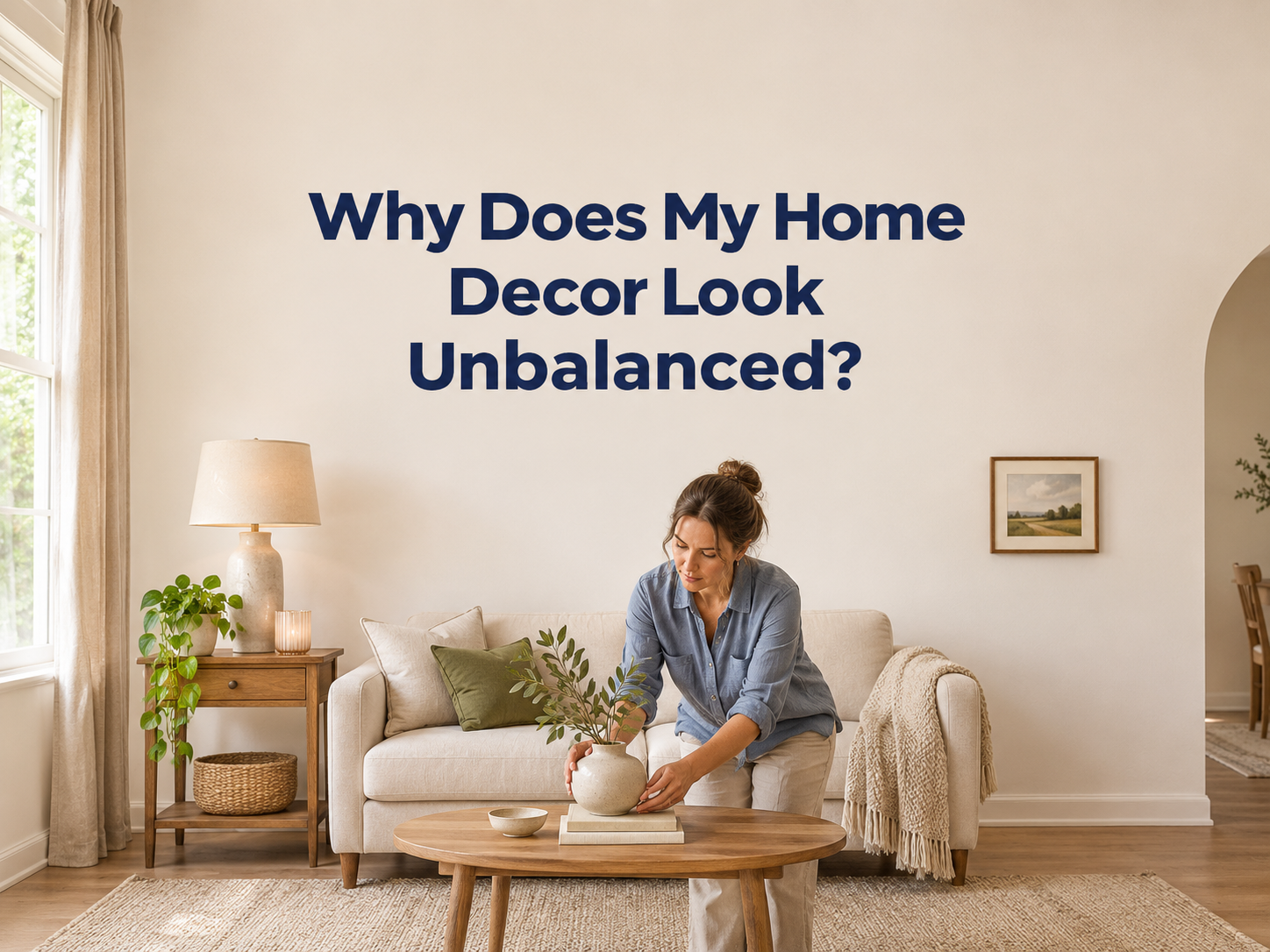
You bought good pieces, picked colors you love and followed the trends, yet the room still feels slightly wrong. Nothing looks broken, but your eye keeps landing in the same corner, or the whole space feels lopsided, crowded or unfinished. If you have ever asked yourself why your home decor looks unbalanced, you are not alone, and the good news is that the cause is usually easy to find.
In this guide you will learn what balance really means in interior design, how to spot the problem with five quick tests, ten common causes of unbalanced decor, and practical fixes you can try today without buying a whole new room full of furniture.
Quick answer
Home decor looks unbalanced when visual weight is concentrated on one side, when pieces are the wrong scale, or when color, height and texture are not spread evenly through the room. Move heavy or dark items to the opposite side, repeat colors in at least three places, group accessories in odd numbers, vary heights, and leave some open space so the eye can rest.
What you will learn
- What visual balance means and the three types of balance
- Five quick tests to see what is wrong with your room
- Ten common causes of unbalanced decor, each with a simple fix
- How to use the triangle rule and the 60-30-10 color rule
- Which decor pieces help restore balance
- Answers to the most common balance questions
What Does “Balanced” Decor Actually Mean?
Balance in interior design is about visual weight. Every object in a room attracts a certain amount of attention, and a balanced room spreads that attention so that no single area dominates and no area is left empty and forgotten. It is not about having the same number of objects on each side. One large painting can balance three small frames, and one tall plant can balance a wide sofa.
Designers describe three main types of balance. Knowing which one you are working with makes it much easier to fix a room.
- Symmetrical balance mirrors pieces on each side of a center line, like matching lamps on either side of a bed. It feels calm, formal and traditional.
- Asymmetrical balance uses different pieces with similar weight, such as a large mirror on one side and a tall plant and small table on the other. It feels relaxed and modern.
- Radial balance arranges items around a central point, like chairs around a round table or objects around a round mirror. It draws the eye to the middle.
What Gives an Object Visual Weight?
Two objects of the same physical size can feel very different. Understanding what adds weight helps you move pieces around with intention.
Large, dark, textured, boldly patterned and tall objects feel heavier. Small, pale, smooth, plain and low objects feel lighter. A balanced room places heavy items so they offset each other and uses light items to fill the gaps.
5 Quick Tests to Find What Is Wrong With Your Room
- The photo test. Take a photo from the doorway. A photo shows lopsided areas that your eyes have gotten used to.
- The black and white test. Switch the photo to black and white. Dark masses that sit on one side show up instantly.
- The squint test. Squint at the room, or step back to the far wall. The biggest blobs you see are your heaviest elements. Are they spread out?
- The eye path test. Stand at the entrance and notice where your eye goes first, second and third. If it jumps from one corner to another, or gets stuck in one area, the layout needs adjusting.
- The cover test. Cover half of the photo with your hand. If the visible half looks very different from the hidden half, the room is unbalanced.
Once you know where the problem is, check the ten causes below. Most unbalanced rooms have two or three of them at once.
10 Reasons Your Home Decor Looks Unbalanced
1. All the Visual Weight Sits on One Side
This is the most common reason a room feels off. A tall bookcase, a large plant, a floor lamp and a gallery wall all gather in one half of the room, while the other half holds only a small frame. The eye is pulled to one side and the room feels like it is tipping.
The fix: Move or add items on the opposite side so that both sides carry similar weight. You do not need identical pieces. A floor lamp, a medium plant or a reading chair can offset a bookcase.
2. Decor and Furniture Are the Wrong Scale
Tiny art above a big sofa, a small rug under a large seating group, or a short lamp on a tall table all create a disconnect. Pieces that are too small look lost, and pieces that are too large overwhelm everything near them.
- Art above furniture should be about two thirds to three quarters of the furniture’s width and hang about 6 to 10 inches (15 to 25 cm) above it.
- Art on an open wall should have its center at roughly 57 inches (145 cm) from the floor.
- Rugs should be large enough that at least the front legs of all main furniture rest on them.
- Table lamps should be tall enough that the bottom of the shade sits near eye level when you are seated.
- Coffee tables should be about the same height as the sofa seat or slightly lower.
The fix: Replace the one piece that is clearly out of scale first. Often a single larger piece of art or a bigger rug transforms the whole room.
3. There Is No Clear Focal Point, or Too Many
A room without a focal point feels flat, because the eye has nowhere to land. A room with five equal focal points feels chaotic because every item competes for attention. Both look unbalanced.
The fix: Choose one main focal point in each room, such as a fireplace, a large piece of art, a bold sofa or a window with a view, then let other pieces support it. Keep the rest quieter in color and scale.
4. Colors Are Unevenly Spread
If all the bright or dark colors sit in one area, the room looks heavy there and empty elsewhere. A single red cushion with no other red in the room also looks like a mistake instead of an accent.
The fix: Follow the 60-30-10 rule: about 60 percent of the room in a main color, 30 percent in a secondary color and 10 percent in an accent. Then repeat each accent color in at least three places, ideally at different heights and on different sides of the room, like a cushion, a vase and a piece of art.
5. Everything Is the Same Height
When every item on a shelf, mantel or console sits at the same height, the arrangement looks flat and static. On the other hand, one very tall item on one end and nothing tall elsewhere can look lopsided.
The fix: Use the triangle rule. Place the tallest piece near the center or to one side, a medium piece next to it, and a smaller piece lower and in front. The eye moves up and down along the triangle and the group feels complete.
Group items in odd numbers, such as three or five. Odd groups feel more natural than pairs, which can look stiff unless you are intentionally going for symmetry.
6. The Room Is Too Cluttered or Too Empty
Too many items make a room feel crowded and heavy, while too few make it feel cold and unfinished. Balance also depends on negative space, the empty areas that let the eye rest between objects.
The fix: If a surface feels crowded, remove one third of the items and see how it feels. If a wall feels empty, add one large piece instead of many tiny ones. Leave at least a hand’s width of open space around each group of accessories.
7. Textures and Materials Are Not Mixed
A room made entirely of smooth, shiny materials feels cold and flat, while a room full of rough, heavy textures feels dense. Without a mix, the room lacks depth, and the visual weight cannot be spread across different materials.
The fix: Combine at least three textures in every room, such as wood, linen, metal, glass, ceramic, wool or rattan. Place rough textures in several areas and not only in one corner.
8. Lighting Is Unevenly Placed
Light has visual weight too. If one half of the room is bright and the other half is dim, the bright area will draw all the attention, and the dark area will feel heavy and empty.
The fix: Use three layers of light: ambient light from the ceiling or large lamps, task light for reading or working, and accent light for art or shelves. Place lamps at different heights on both sides of the room so the light is evenly distributed.
9. Furniture Layout Pulls in Different Directions
A sofa facing the window, a chair facing the TV and a table facing the door can leave the room without a center. Furniture pushed against every wall also leaves a dead zone in the middle.
The fix: Arrange seating so that pieces face or angle toward each other, and anchor the group with a rug. Pull furniture a few inches from the wall when space allows, and keep walkways of 30 to 36 inches (76 to 91 cm) open.
10. Too Many Styles With No Common Thread
Mixing styles can look beautiful, but only when something repeats. A farmhouse table, a glam chandelier, a modern sofa and a boho rug can feel disconnected if they share no color, shape or material.
The fix: Choose one or two things to repeat throughout the room, such as a color, a metal finish, a shape (like round forms) or a material (like natural wood). Repetition is the glue that makes mixed decor feel intentional.
Room-by-Room Balance Fixes
Living Room
- Balance a large sofa with a floor lamp or tall plant on the opposite side
- Treat the TV as a heavy dark block and surround it with shelves or art
- Mix cushion sizes and use odd numbers per sofa
Bedroom
- Use two bedside tables and lamps of similar height, or one table balanced by a bench or a plant on the other side
- Center art or a mirror above the headboard and scale it to about two thirds the bed’s width
- Place a chair or a dresser opposite the bed to anchor the other half of the room
Dining Room
- Hang the chandelier or pendant about 30 to 36 inches (76 to 91 cm) above the table
- Use a sideboard with a mirror or art above it to offset the table
- Keep the centerpiece low enough to see across the table
Entryway and Hallway
- Use a narrow console with a mirror above it and a lamp, tray or vase on top
- Balance one tall item, like a plant, with wall art or a coat rack on the other side
- Add a runner or rug to anchor the space
Shelves, Mantels and Consoles
- Group items in threes or fives and vary height and texture
- Mix books stacked flat with books standing upright
- Repeat a color or material at least three times across the shelf
A Simple Step-by-Step Plan to Rebalance Any Room
- Take a photo of the room and use the black and white and squint tests.
- Find the heaviest area and the lightest area.
- Remove a few items from the heavy area, or move them to the light side.
- Check the scale of art, lamps and rugs, and replace the one that is clearly too small or too large.
- Repeat each accent color in at least three places.
- Rearrange shelves and tabletops into triangles using odd numbers.
- Add a layer of lighting on the weaker side.
- Step back, take a new photo, and compare.
Decor Pieces That Help Restore Balance
You may not need to buy anything, but when you do need a balancing piece, these are the most useful and what to look for.
Statement Mirrors and Large Wall Art
- Size that is about two thirds of the furniture below
- Frames in a finish that repeats elsewhere in the room
- A mirror placed opposite a window to bounce light into dim areas
Matching or Coordinated Table Lamps
- Similar height and shade size for pairs
- Bases in a finish that repeats elsewhere in the room
- Warm light bulbs for a soft, even glow
Tall Floor Plants and Planters
- Planters with a heavy base to give strong visual weight
- Natural-looking faux plants if light is limited
- Height of 4 to 6 feet (120 to 180 cm) for corners
Area Rugs
- Large enough for front legs of all main furniture to rest on it
- Low-contrast patterns that unify the seating group
- Non-slip pads for safety and a neat look
Decorative Trays, Bookends and Baskets
- Trays that corral small items into a single group
- Bookends that give shelves structure and weight
- Baskets that hide clutter and add texture
Accent Pillows and Throws
- Colors that repeat elsewhere in the room
- A mix of sizes and textures
- Removable covers that wash easily
Wall Sconces and Floating Shelves
- Sconces to add light on a dim side without taking floor space
- Shelves that add weight and display space to an empty wall
- Finishes that match your other metals and woods
Common Balance Mistakes to Avoid
- Matching everything. A room full of identical pieces looks like a showroom, not a home.
- Hanging art too high. Art should relate to furniture and eye level, not float near the ceiling.
- Using only small accessories. Many tiny items add clutter without adding weight. Include a few larger pieces.
- Pushing everything against the walls. A floating arrangement can bring the room together.
- Ignoring the ceiling and floor. Rugs, curtains and lighting set the base and top of the room.
- Changing everything at once. Make one change at a time, then take a new photo to see the effect.
Frequently Asked Questions
Why does my room look off even though everything matches?
Matching colors and styles do not guarantee balance. A room can still feel off if the pieces are the wrong size, if the visual weight sits on one side, or if everything is the same height. Check scale, spacing and placement, not only color.
Does home decor have to be symmetrical to look balanced?
No. Symmetry is only one way to create balance. Asymmetrical balance, where different pieces carry similar visual weight, often feels more relaxed and modern. The goal is that no single side of a wall or room feels heavier than the other.
How many decor items should I put on a surface?
Groups of three or five items usually look best. Mix heights, shapes and textures, and leave some empty space around the group so the pieces can be seen clearly.
How do I balance a room with a large TV?
Treat the TV as a heavy dark block. Flank it with shelves, art or plants of similar combined weight, or frame it with a gallery wall or a bold console below it. Using a darker wall color behind the TV also helps it blend in.
How do I balance a room with one big sofa?
Add weight on the opposite side with a tall plant, an accent chair, a bookcase or a floor lamp. Hang a piece of art or mirror above the sofa that is about two thirds to three quarters of the sofa’s width.
Can too many throw pillows make a sofa look unbalanced?
Yes. Too many pillows can make one end heavy. Use an odd number, or arrange pairs on each side in different sizes, and repeat colors from the rest of the room.
What is the fastest way to test whether my decor is balanced?
Take a photo of the room, turn it to black and white, and squint at it. Large dark or heavy areas on only one side will stand out right away.
Final Thoughts
When home decor looks unbalanced, the cause is almost always a mix of uneven visual weight, wrong scale and repeated elements that are missing. You do not need a complete redesign. Take a photo, find the heavy and light areas, and make small moves: shift a plant, repeat a color, resize a piece of art, group accessories in a triangle and add a lamp where the room is dim.
Balance is not about perfection. It is about creating a room where the eye can travel comfortably and every piece has a reason to be where it is. Start with one wall or one shelf today, and let the result guide your next change.