

Portable Electric Heater Power Consumption: How Many Watts, Amps and kWh Do They Really Use?

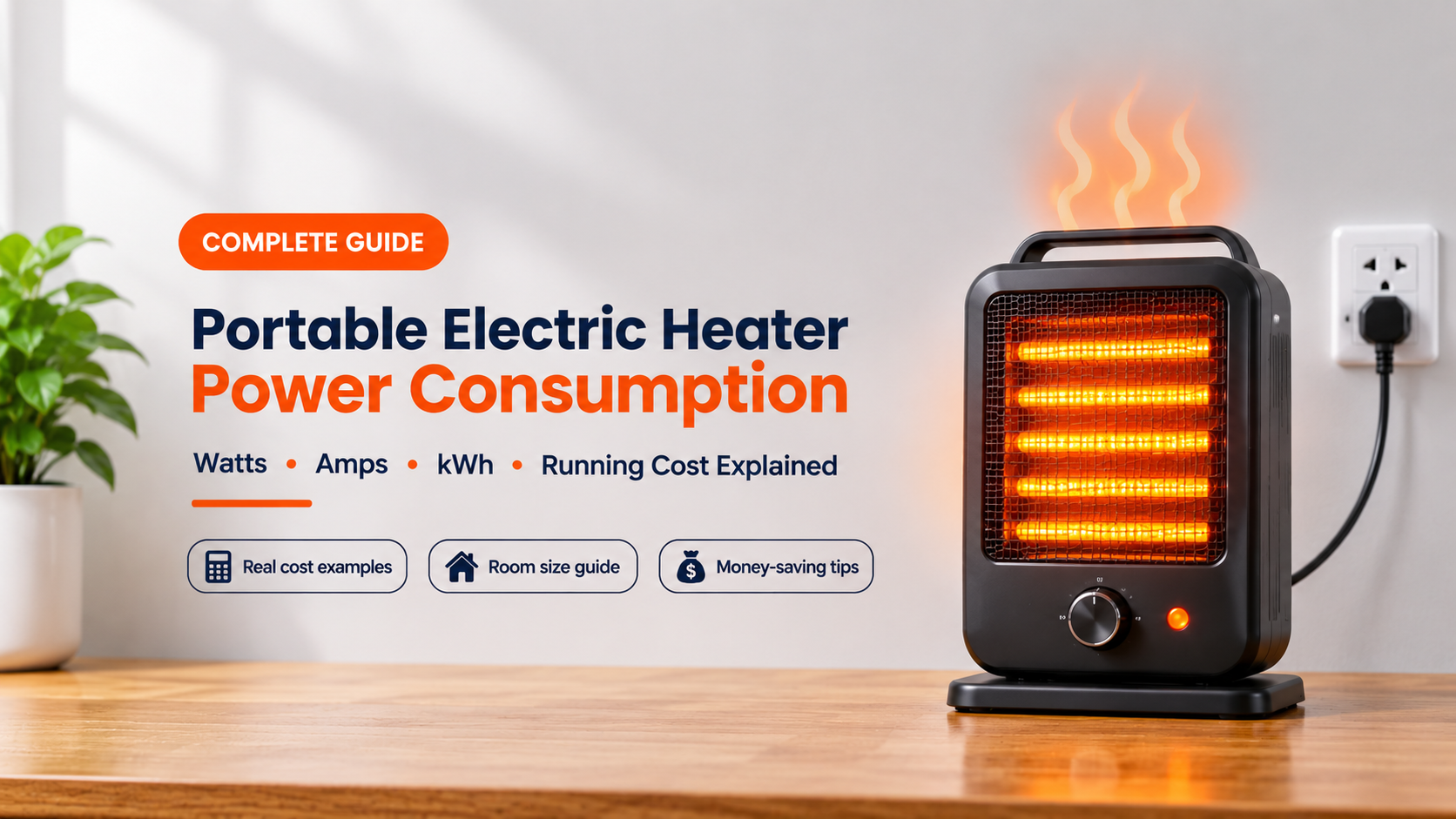
When the temperature drops, a portable electric heater is the quickest way to take the chill off a bedroom, home office or garage. It is also one of the easiest ways to get a nasty surprise on your next electricity bill. Before you plug one in, it helps to know exactly how much power it draws and what that costs you each hour, each day and each month.
This guide explains portable electric heater power consumption in plain language. You will learn typical wattage for every heater type, how to convert watts into kilowatt-hours, how many amps a heater pulls, how to estimate your real running cost, and which habits and features keep that cost under control.
Quick answer
- Most portable electric heaters use 500 to 1,500 watts. In 220-240 V countries, models of 2,000 W are common.
- A 1,500 W heater uses 1.5 kWh per hour when it runs at full power.
- At an example rate of $0.17 per kWh, that is about 25.5 cents per hour or $2.04 for 8 hours.
- Running one non-stop for 6 hours a day for a month would cost roughly $45.90. With a thermostat cycling the heater on and off, the real figure is often much lower.
- Almost all the electricity a heater uses becomes heat, so wattage, not heater type, decides how much energy it consumes.
Understanding Watts, Volts, Amps and kWh
Four electrical terms show up on every heater label and every electricity bill. Once you understand them, every other calculation in this article becomes simple.
| Term | What it means | Example |
|---|---|---|
| Watt (W) | The rate at which the heater uses electricity at any moment. | 1,500 W |
| Kilowatt (kW) | 1,000 watts. | 1,500 W = 1.5 kW |
| Kilowatt-hour (kWh) | The unit your electricity company bills you for: one kilowatt used for one hour. | 1.5 kW for 2 hours = 3 kWh |
| Volt (V) and Amp (A) | Volts are the electrical pressure of your supply; amps are the current the heater pulls. Amps = watts ÷ volts. | 1,500 W ÷ 120 V = 12.5 A |
The key point: watts tell you how fast a heater uses power, and kilowatt-hours tell you how much it used over time. Your bill depends on kilowatt-hours.
Typical Wattage of Portable Electric Heaters by Type
Portable heaters differ in how they deliver warmth, but they all convert electricity into heat very efficiently. What really separates them is their wattage range, how quickly they warm a room and how well they hold that warmth.

| Heater type | Typical wattage | How it heats | Best for |
|---|---|---|---|
| Ceramic fan heater | 750-1,500 W | A ceramic element heats air that a fan blows into the room. | Quick warm-up in small and medium rooms. |
| Oil-filled radiator | 600-1,500 W | Sealed oil is heated and radiates warmth, even after the element switches off. | Bedrooms and long, quiet, steady heating. |
| Infrared / quartz heater | 400-1,500 W | Radiant heat warms people and objects directly instead of the air. | Spot heating, garages and workshops. |
| Panel / convection heater | 400-1,500 W | Air circulates naturally across a heated panel. | Silent, steady background heat. |
| Personal / mini heater | 200-750 W | A small ceramic or fan unit that warms one person. | Under a desk or beside a chair. |
Ceramic fan heaters
Ceramic heaters are the most popular portable option because they heat up in seconds, cost little and are easy to carry. Many have two or three power settings, for example 750 W and 1,500 W. The fan adds some noise and can make the air feel dry, but the speed of heating makes them a favorite for hallways, offices and small bedrooms.
Oil-filled radiators
An oil-filled radiator takes longer to warm up, yet it keeps radiating heat after the thermostat switches the element off. That is why it is often the most comfortable choice for overnight use. A typical unit offers settings around 600 W, 900 W and 1,500 W.
Infrared and quartz heaters
Infrared heaters warm you and the objects around you rather than the air. They feel warm instantly, which makes them useful in drafty garages or at a workbench, although they do not heat a whole room evenly.
Panel and convection heaters
Panel heaters are slim, quiet and often wall-mountable. They provide gentle, even warmth and suit people who dislike fan noise, though they need more time to lift the temperature of a large room.
Personal and mini heaters
With 200 to 750 watts, mini heaters have the lowest hourly cost. They only warm a small zone close to the unit, so they are best as a supplement, not as the main heat for a room.
How to Calculate Your Heater’s Electricity Cost
You do not need a smart meter to estimate what a heater costs. You only need the wattage printed on its label, the number of hours you use it, and the price per kWh on your electricity bill.

- Convert watts to kilowatts: divide the wattage by 1,000. A 1,500 W heater is 1.5 kW.
- Find the kilowatt-hours: multiply kilowatts by the hours of use. 1.5 kW × 8 hours = 12 kWh.
- Multiply by your rate: 12 kWh × $0.17 = $2.04.
Electricity prices vary widely between countries, states and even time-of-use plans, so check your latest bill. The table below shows how much the same 1,500 W heater costs at three different rates.
| Electricity rate | Cost per hour | Cost for 8 hours |
|---|---|---|
| $0.10 per kWh | 15.0 cents | $1.20 |
| $0.17 per kWh | 25.5 cents | $2.04 |
| $0.25 per kWh | 37.5 cents | $3.00 |
Using another currency? The method is identical. If your rate is 10 per kWh in your local currency, a 1,500 W heater costs 15 per hour (1.5 kWh × 10).
Running Cost Per Hour by Wattage
Because cost rises in a straight line with wattage, doubling the wattage doubles the hourly cost. That makes a quick comparison easy.

How Much Does a Portable Heater Cost Per Month?
Monthly cost depends on how many hours you run the heater and how often its thermostat switches it off. The chart and table below assume 6 hours of use per day for 30 days (180 hours). The orange bars show the same heater when the thermostat keeps it running only about half the time, which is a common situation once a room has warmed up. Treat that 50 percent figure as an illustration, not a guarantee, because insulation, outdoor temperature and room size all change it.

| Heater wattage | kWh per hour | Cost per hour | kWh per month (180 h) | Cost per month (non-stop) |
|---|---|---|---|---|
| 500 W | 0.5 | 8.5 cents | 90 | $15.30 |
| 750 W | 0.75 | 12.8 cents | 135 | $22.95 |
| 1,000 W | 1.0 | 17.0 cents | 180 | $30.60 |
| 1,200 W | 1.2 | 20.4 cents | 216 | $36.72 |
| 1,500 W | 1.5 | 25.5 cents | 270 | $45.90 |
| 2,000 W | 2.0 | 34.0 cents | 360 | $61.20 |
Do Heater Settings and Thermostats Change Power Consumption?
Yes, but not in the way many people expect. A heating element does not use “a little less” power when you turn the dial down. Instead, one of two things happens:
- Fixed power stages: a heater with low, medium and high settings simply switches between set wattages, such as 750 W and 1,500 W. Choosing the low setting really does halve the power draw while the heater is running.
- Thermostat cycling: once the room reaches your target temperature, the thermostat cuts power to the element and turns it back on when the room cools. During the “off” periods the heater uses almost nothing.
This is why a heater with a good thermostat is often cheaper to run than a simpler model of the same wattage. It is also why a 1,500 W heater in a tiny, well-sealed room can consume much less energy over an evening than the label suggests, while the same heater in a large, drafty room may run almost continuously.
How Many Amps Does a Portable Heater Draw?
Amps matter because they decide whether a heater is safe on your wall circuit. Use the formula amps = watts ÷ volts. A 1,500 W heater on a 120 V supply draws 12.5 amps. On a 230 V supply, the same wattage draws only about 6.5 amps.

A standard 15 A household circuit is commonly treated as safe for about 12 A of continuous load, which is the 80 percent guideline shown in the chart. A 1,500 W heater sits right at that edge, which is why 1,500 W is effectively the ceiling for plug-in heaters in 120 V countries. It also explains the most important safety rules:
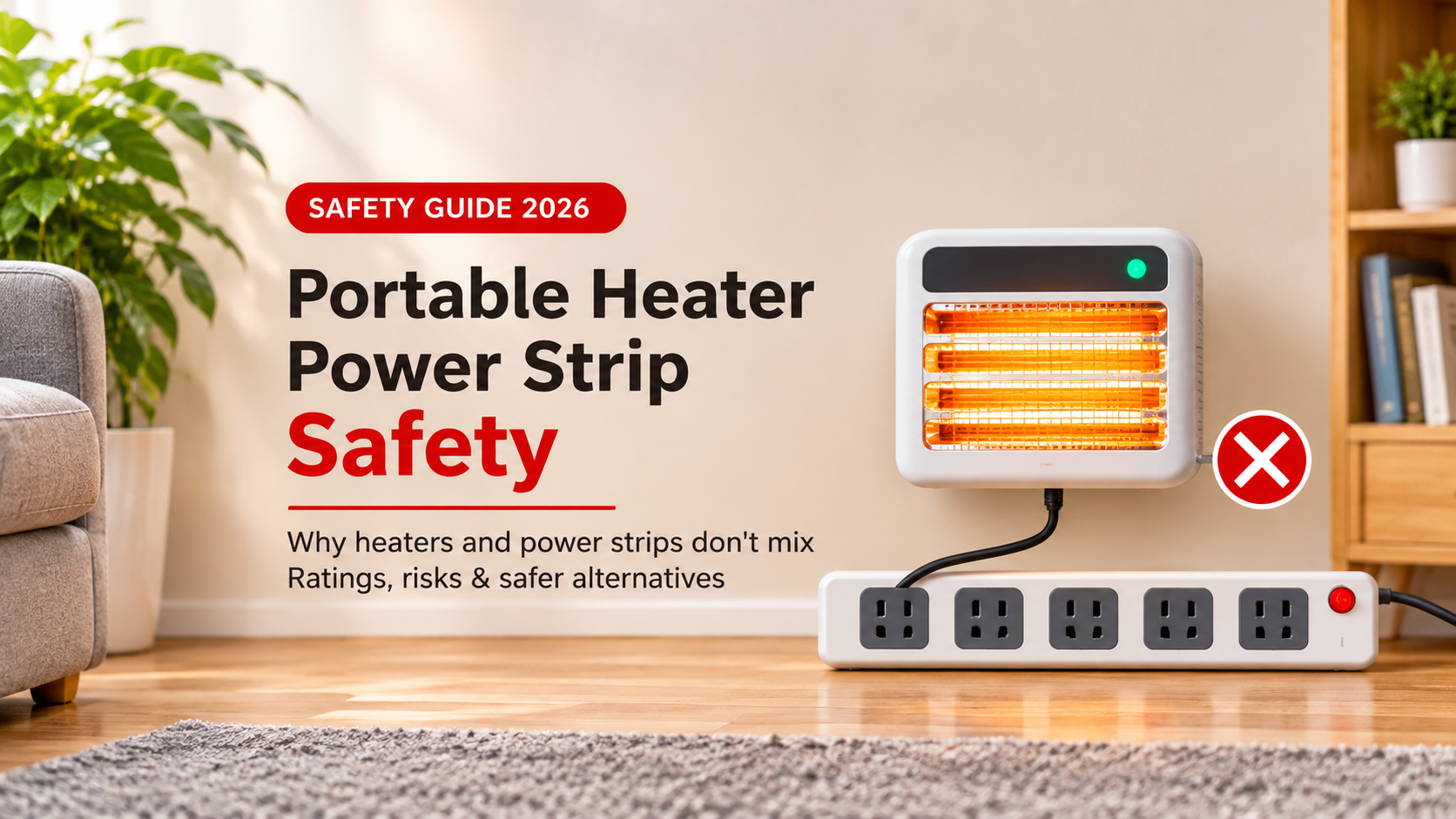
- Plug the heater directly into a wall outlet. Avoid extension cords and power strips, which can overheat under such a heavy load.
- Do not share the circuit with other high-power devices such as a kettle, hair dryer or microwave.
- Check the cord and plug. If either feels hot or smells of burning plastic, stop using the heater.
Are Portable Electric Heaters Energy Efficient?
This question has two honest answers. First, an electric resistance heater is essentially 100 percent efficient at turning electricity into heat. Every watt it draws ends up as warmth in your room, and no heater type produces more heat per kWh than another. A 1,500 W ceramic heater and a 1,500 W oil-filled radiator release the same amount of heat: about 5,118 BTU per hour.
Second, efficient at making heat does not mean cheap to run. Compared with a heat pump or an inverter air conditioner in heating mode, which can deliver roughly two to four units of heat for every unit of electricity, a resistance heater is the more expensive way to heat an entire home. Where portable heaters shine is zone heating: warming the one small room you are actually using, instead of heating the whole house.
How Many Watts Do You Need for Your Room?
Buying a heater that is too weak means it runs endlessly without ever reaching a comfortable temperature. Buying one that is far too strong wastes money and can cycle uncomfortably on and off. A well-known rule of thumb is 10 watts for every square foot of floor space, or roughly 100 watts per square meter.

| Room size | Approx. area | Suggested wattage | Equivalent BTU per hour |
|---|---|---|---|
| Small office or box room | 100 sq ft (9 m²) | 1,000 W | about 3,400 |
| Average bedroom | 150 sq ft (14 m²) | 1,500 W | about 5,100 |
| Large bedroom or small living room | 200 sq ft (19 m²) | 2,000 W | about 6,800 |
| Living room | 300 sq ft (28 m²) | 3,000 W | about 10,200 |
This guideline assumes standard 8 ft ceilings and average insulation. Increase the wattage for high ceilings, big windows, uninsulated garages or very cold climates. If the room needs more than 1,500 W and you live in a 120 V country, use two heaters on separate circuits instead of overloading one outlet, or choose a higher-wattage model designed for a 230 V supply.
6 Ways to Reduce Portable Heater Electricity Use

- Use the thermostat. Set a comfortable target, around 20 to 22 °C (68 to 72 °F), and let the heater switch itself off. Every extra degree you add costs more energy.
- Heat only the room you are using. Close doors and keep the heater in the space where you actually sit or sleep.
- Match the wattage to the room. An oversized unit wastes energy on short, frequent cycles, and an undersized one never stops running.
- Seal drafts. Weather stripping, door snakes and thick curtains keep the warm air you paid for inside the room.
- Use a timer. Pre-heat the room for 20 to 30 minutes, then switch off or drop to a lower setting. Many models have built-in timers.
- Choose the lower setting once the room is warm. Holding a temperature takes far less power than raising it, so 700 to 800 W is often enough after the initial warm-up.
A few extra tricks also help: layer clothing, use a blanket or a heated throw for personal warmth, place a rug on cold floors, and keep furniture and curtains away from the heater so warmth can spread freely.
How to Choose the Right Portable Electric Heater: Buyer’s Checklist
If you are shopping for a new heater, the features below matter more than brand names or flashy styling. They affect both safety and how much electricity the heater wastes.
- Adjustable thermostat: the most important feature for controlling energy use.
- Multiple power settings: having 750 W and 1,500 W options lets you match output to the room.
- Eco or energy-saving mode: adjusts output automatically to hold a set temperature.
- Timer and auto shut-off: prevents the heater running all night or while you are away.
- Tip-over and overheat protection: essential safety cut-offs that switch the heater off if it falls or gets too hot.
- Safety certification: look for a mark from a recognized testing laboratory, such as UL or ETL in the United States.
- Cool-touch housing: important if you have children or pets.
- Noise level: fan heaters are louder than oil-filled or panel heaters, so consider this for bedrooms and offices.
- Size and weight: check that it is easy to move and fits where you plan to use it.
- Warranty: a longer warranty is a good sign of build quality.
Which heater type suits which space?
| Where you will use it | Good choice | Typical wattage |
|---|---|---|
| Bedroom (overnight) | Oil-filled radiator or quiet panel heater | 600-1,500 W |
| Home office or under a desk | Personal ceramic heater | 200-750 W |
| Living room | Ceramic fan heater or oil-filled radiator | 1,000-1,500 W (or two units) |
| Garage or workshop | Infrared / radiant heater | 1,000-1,500 W |
| Bathroom | Only a heater specifically rated for bathroom use | As rated |
Common Myths About Heater Power Consumption
Myth 1: A low-wattage heater is always cheaper.
Not necessarily. A 500 W heater uses less power per hour, yet if it is too small for the room it will run constantly and still not feel warm. Energy used equals watts multiplied by hours, so the best heater is one that matches the room.
Myth 2: Turning the heater to maximum heats the room faster per unit of energy.
A higher setting reaches the target temperature sooner, but it uses power at a higher rate. Once the room is warm, the thermostat should do the work.
Myth 3: Some heater types are more efficient than others.
All electric resistance heaters convert virtually all their power into heat. The difference is comfort, speed, noise and how the warmth is delivered, not the amount of heat per kWh.
Myth 4: A heater uses power even when switched off.
A heater that is off uses almost nothing. Models with digital displays or remote controls may draw a watt or two in standby, which is negligible compared with the running wattage. For simple, mechanical heaters, unplugging is still a good habit.
Portable Heater Safety Essentials
Portable heaters are involved in a significant share of home heating fires, almost always because of misuse. Following a few rules removes most of the risk:
- Keep at least three feet (about one meter) of clear space around the heater, away from curtains, bedding, sofas and paper.
- Place it on a flat, hard surface, never on a bed, carpet pile or unstable furniture.
- Never cover a heater or use it to dry clothes.
- Do not leave it running while you are asleep unless it has reliable thermostat, timer and tip-over protection, and always follow the manufacturer’s instructions.
- Never use a heater near water unless it is designed for that purpose.
- Test your smoke alarms regularly.
Frequently Asked Questions
How much electricity does a 1,500 W portable heater use per hour?
A 1,500 W heater uses 1.5 kWh for every hour it runs at full power. At $0.17 per kWh, that costs about 25.5 cents an hour.
Is it expensive to run a portable electric heater all night?
If a 1,500 W heater ran at full power for 8 hours it would use 12 kWh, costing about $2.04 at $0.17 per kWh. In practice a thermostat usually shuts the heater off for part of that time, so the real cost is often lower.
How many watts does a small space heater use?
Small personal heaters generally use 200 to 750 watts, while most room-sized portable heaters use 750 to 1,500 watts.
Does a 1,000 W heater use less electricity than a 1,500 W heater?
Per hour, yes: it draws one-third less power. Over a whole evening the difference depends on whether the smaller heater can keep the room warm without running constantly.
How many amps does a portable electric heater use?
Divide the wattage by the supply voltage. A 1,500 W heater uses 12.5 A on 120 V and about 6.5 A on 230 V.
Is a portable heater cheaper than central heating?
It depends on your energy prices and how your home is heated. Electric heaters are generally more expensive per unit of heat than gas or heat pump systems, but they can save money when you heat only one occupied room and turn the central system down.
Can I plug a portable heater into an extension cord?
It is best to avoid this. High-wattage heaters draw a lot of current, and ordinary extension cords and power strips can overheat. Always plug the heater directly into a wall socket.
How can I measure the actual power consumption of my heater?
A plug-in energy monitor placed between the heater and the wall socket shows real-time watts and total kWh used, so you can see exactly how often the thermostat cycles your heater on and off.
Final Thoughts
Portable electric heater power consumption comes down to one simple relationship: watts × hours × price per kWh. A typical 1,500 W heater uses 1.5 kWh each hour at full power, which is about 25.5 cents at an example rate of $0.17 per kWh. The heater’s thermostat, the size of the room and how well your home keeps in warmth then decide how much of that maximum you actually pay for.
To keep costs down, choose a heater with a reliable thermostat and more than one power setting, match its wattage to your room, seal drafts, and heat only the space you are using. Do that, and a portable heater can keep you comfortable all winter without an unpleasant surprise on your electricity bill.
Note: All prices in this article are examples based on a rate of $0.17 per kWh. Replace it with the rate on your own electricity bill for an accurate estimate. Wattage ranges are typical values and vary by model, so always check the label on your heater.