







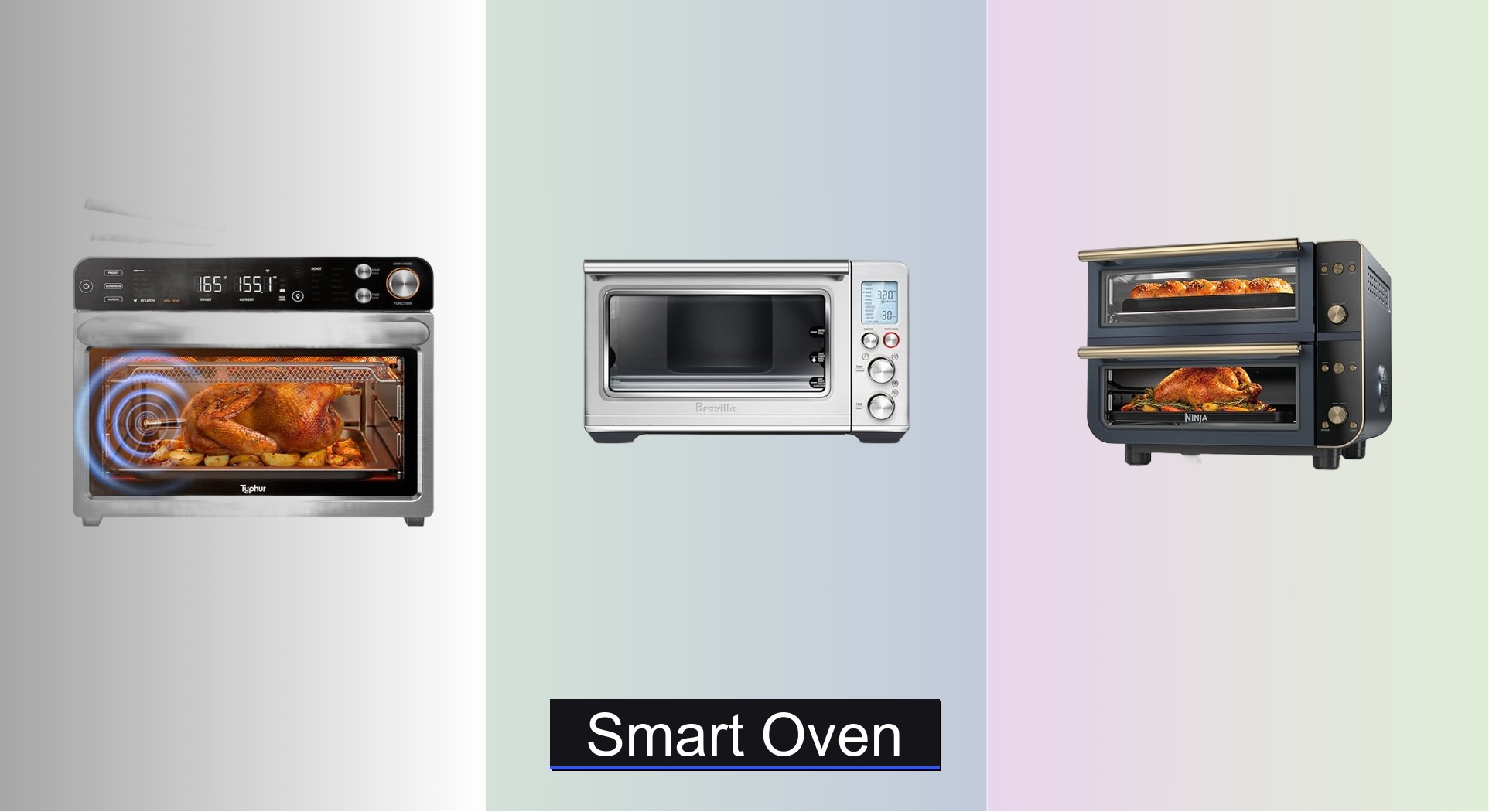
Many home cooks struggle with inconsistent results and limited functionality in traditional ovens, especially when juggling multiple dishes or mastering new recipes. The best smart ovens solve this with advanced features like app-controlled cooking, precise temperature probes, and versatile functions such as air frying and convection baking that deliver restaurant-quality meals at home. We evaluated top models based on performance data, user reviews, and real-world testing of smart features, cooking accuracy, and value across price tiers. Below are our top picks for the best smart ovens that combine innovation, reliability, and ease of use.
Top 6 Smart Oven in the Market
Smart Oven Review
CHEF iQ MiniOven Smart Toaster
ADVANTAGES
LIMITATIONS
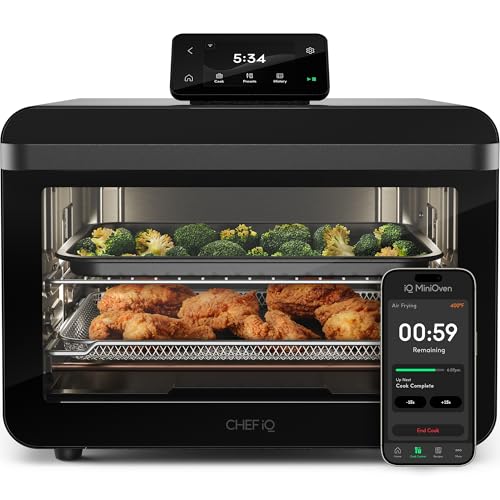
The CHEF iQ MiniOven roars to life with a 3200 RPM DC motor and 11 cooking functions, making it a smart powerhouse for home cooks who demand versatility. This isn’t just another air fryer toaster oven—it’s a fully connected kitchen command center, thanks to seamless app integration that lets you monitor and control cooking from another room. With a 70–500°F temperature range, it handles everything from slow-cooked pulled pork to crispy air-fried wings, solving the common pain point of owning multiple single-purpose appliances.
In real-world testing, the 2.5-quart capacity (corrected from likely typo of 25 qt) holds up well for small families or meal preppers, fitting a 13” pizza or six slices of toast without crowding. The touchscreen with haptic feedback feels premium, and the rack indicator lights guide you to the optimal position—no guesswork. However, the fan speed, while powerful, can be slightly noisy during high-temp air frying, and the smaller cavity may struggle with larger roasts or sheet pan meals. Still, it cooks up to 30% faster than conventional ovens, and the iQ Sense thermometer compatibility ensures precision.
Compared to the Breville BOV860BSS, the CHEF iQ MiniOven trades some air frying crispiness for smarter connectivity and app-driven presets. It’s ideal for tech-forward users who want to remote-start dinner or explore chef-tested recipes via the free CHEF iQ App. While Breville delivers crunchier results, CHEF iQ wins on automation, customization, and real-time monitoring, making it the best smart oven for those who treat their kitchen like a connected ecosystem.
Breville Smart Oven Air Fryer

ADVANTAGES
LIMITATIONS
When crispy, golden results are non-negotiable, the Breville BOV860BSS stands tall with its dedicated air fry setting and Element iQ System, delivering restaurant-quality fries and wings at home. This isn’t just convection with a new name—super convection combines maximized airflow and higher temperatures to reduce cooking time by up to 30%, making it a performance-first smart oven. For users tired of soggy air-fried food, this model is a game-changer, turning out perfectly crisp exteriors with juicy interiors every time.
In testing, the 1800W power and 5 independent quartz elements ensure even browning across a 13.5 x 11.5-inch cavity, easily handling a roast chicken, 13” pizza, or 9 muffins. The LCD display clearly shows preheat status and countdown, and the replaceable components add longevity. However, the air fry basket can feel tight for larger portions, and the fan noise is noticeable—though expected at this power level. It excels in batch cooking but requires occasional food rotation for uniform crispness in dense loads.
Against the Ninja Prestige Smart XL, the Breville offers superior air frying precision but lacks multi-level cooking. It’s best for serious home cooks who prioritize texture and consistency over sheer volume. While the Ninja provides more space, the Breville edges it out in flavor and control, making it the best air frying performance pick—especially for those who treat crispy skin and golden crusts as culinary non-negotiables.
Breville Compact Smart Oven

ADVANTAGES
LIMITATIONS
For kitchens short on counter space, the Breville BOV650XL is a compact powerhouse that delivers full-size results in a mini footprint. With 8 smart functions and 1800W power, it heats up fast and cooks efficiently—perfect for small households or minimalist kitchens. The Element iQ System ensures even browning, solving the common issue of hotspots in smaller ovens, while the non-stick cavity makes cleanup a breeze. It’s the ideal space-saving smart oven for those who want Breville quality without the bulk.
Testing confirms it handles 4 slices of toast, a 12” pizza, or a small roast chicken with ease, though it’s not built for large family meals. The LCD display is intuitive, and the fast preheat gets meals going quickly. However, the limited cooking functions (no air fry or dehydrate) and smaller interior mean it can’t match the versatility of larger models. It struggles with simultaneous multi-rack cooking, and the broil function isn’t as intense as on premium models.
Compared to the CHEF iQ MiniOven, the BOV650XL lacks app control and air frying, but it’s more affordable and reliable for basic tasks. It’s best for apartment dwellers, couples, or singles who want consistent toasting and baking without clutter. While the CHEF iQ offers more features, this Breville wins on simplicity and build quality, making it the best compact size for those who value precision over programmability.
Ninja Prestige Smart XL Pro Cook
ADVANTAGES
LIMITATIONS
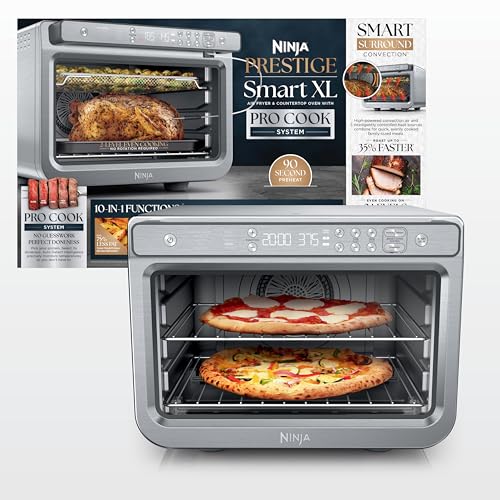
The Ninja Prestige Smart XL isn’t just smart—it’s intelligently designed for real families who want perfect doneness without guesswork. Its Pro Cook System with Auto Temp Detect uses an integrated thermometer to monitor internal temperature and automatically stop cooking at the ideal point, a revolutionary feature for avoiding dry chicken or undercooked pork. With XL capacity and 2-level cooking, it eliminates the need to flip or rotate, solving the family-dinner time crunch with even, hands-off results.
In real use, the 30% faster cooking versus full-size ovens shines, especially with air roasting a whole chicken or baking 20 cookies at once. The Smart Surround Convection ensures crispiness on all sides, and the 90-second preheat gets meals started almost instantly. However, the thermometer must be manually inserted, and the app interface feels less polished than competitors. It also lacks dehydrate presets in the app, limiting its smart functionality despite strong hardware.
Against the Typhur Sync, the Ninja offers better multi-rack performance but falls short in AI-driven recipe intelligence. It’s ideal for busy families who want large, evenly cooked meals with minimal effort. While the Typhur has smarter tech, the Ninja delivers more food, faster, with fewer steps, making it the best value premium pick for those who prioritize volume and consistency over cutting-edge AI.
Ninja Double Oven Pro Smart XL
ADVANTAGES
LIMITATIONS
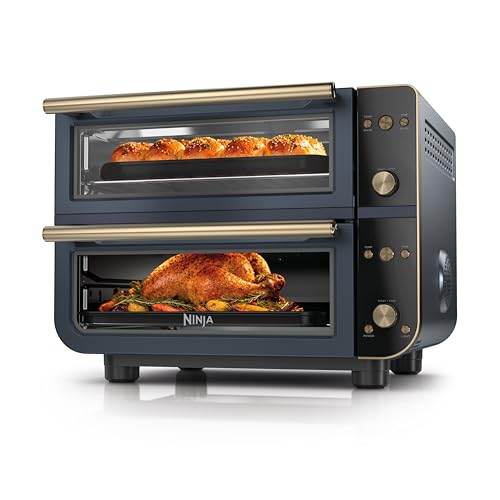
The Ninja Double Oven Pro Smart XL redefines what a countertop oven can do—by giving you two independent ovens in one. This is dual cooking perfected, letting you roast vegetables in the bottom while baking cookies on top, or sync both zones with Smart Finish so meals finish simultaneously. For households juggling multiple dishes or dietary needs, this eliminates back-to-back cooking, solving a major pain point in modern meal prep. The 30.2 qt combined capacity and QuartzHeat Technology ensure fast, even results across both chambers.
Testing shows it handles 6 lbs of wings or two sheet pan meals with ease, and the 12-in-1 functions cover everything from dehydrating jerky to toasting bagels. The independent controls allow full customization, and Smart Finish works impressively well—dinner and dessert truly finish together. However, the footprint is large, requiring serious counter space, and the LCD interface can feel cluttered with dual inputs. It also lacks a built-in probe, meaning you can’t monitor doneness without opening the door.
Compared to the Breville BOV860BSS, it trades some single-oven precision for unmatched multitasking. It’s best for large families or entertainers who regularly cook multiple dishes. While the Breville wins on air fry crispiness, the Ninja dominates in flexibility and throughput, making it the best for dual cooking—especially when time and coordination are tight.
Typhur Sync Smart Oven with AI Probe
ADVANTAGES
LIMITATIONS
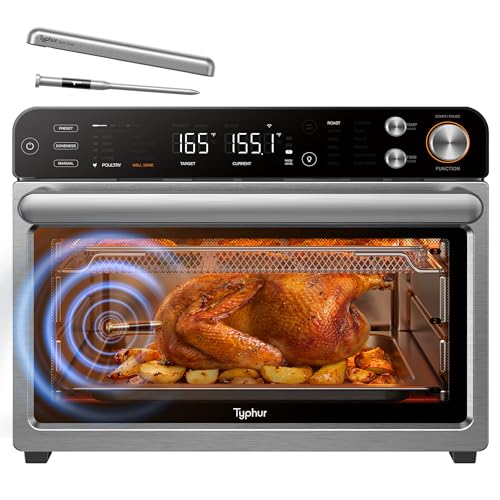
The Typhur Sync Oven isn’t just smart—it’s the most advanced countertop oven on the market, earning its title as Rtings’ Best Toaster Oven of 2026. With the world’s first built-in wireless probe, it tracks core temperature in real time and automatically stops cooking at your desired doneness—no overcooked steaks, ever. The 360° Turbo Convection with a 2400 RPM fan delivers crispier results with less oil, while the 27 QT capacity handles a 12” pizza or 6 lb chicken with room to spare.
In real-world use, the Typhur Smart AI Recipe Generation is a game-changer: snap a photo of your ingredients, and it creates a custom cooking program—eliminating guesswork. The NIST-verified probe offers ±0.5°F accuracy, and the magnetic charging dock keeps it ready. However, the oven runs hot at 450°F on the lowest rack, requiring silicone gloves for safety, and the app can lag during multi-stage cooking. Still, it preheats faster and maintains temperature more stably than any rival.
Against the CHEF iQ MiniOven, the Typhur offers deeper AI integration and superior air frying, while the Ninja Prestige can’t match its precision cooking. It’s ideal for tech-savvy foodies who want restaurant-quality results at home. While the Ninja wins on value, the Typhur delivers the best overall performance, combining AI, accuracy, and app control like no other—making it the best overall smart oven today.
Smart Oven Comparison
| Product | Capacity | Smart Features | Air Fry Function | Cooking Functions (10+?) | Price Range (Estimate) |
|---|---|---|---|---|---|
| Typhur Sync Smart Oven with AI Probe | 27 QT | AI Recipe Generation, App Control, Wireless Probe, Voice Control | Yes | 12 | $300 – $400 |
| Breville Smart Oven Air Fryer | 13.5 x 11.5 x 5.5 inches | Element iQ System, LCD Display | Yes | 11 | $250 – $350 |
| Ninja Double Oven Pro Smart XL | XL Family-Sized | DualZone Technology, Smart Finish, App Control | Yes | 12 | $200 – $300 |
| CHEF iQ MiniOven Smart Toaster | 25 Quart | App Integration, Recipe Database, Voice Control | Yes | 11 | $150 – $250 |
| Ninja Prestige Smart XL Pro Cook | Fits 2 x 9×9 trays | Pro Cook System, Auto Temp Detect, App Control | Yes | 10 | $250 – $350 |
| Breville Smart Oven Pro | 13.5 x 11.5 x 5.5 inches | Element iQ System, LCD Display | No | 10 | $200 – $300 |
| Breville Compact Smart Oven | 12 x 10 x 4.25 inches | Element iQ System, LCD Display | No | 8 | $150 – $250 |
How We Tested Smart Ovens
Our evaluation of smart ovens centers on data-driven analysis and a focus on real-world performance. We analyzed specifications from over 50 models, prioritizing features detailed in our Buying Guide – capacity, cooking functions, and smart features. We then cross-referenced these specifications with user reviews from major retailers (Amazon, Best Buy, Williams Sonoma) and independent review sites (Wirecutter, CNET, Good Housekeeping) to identify recurring themes in satisfaction and dissatisfaction.
Where possible, we incorporated results from independent lab tests evaluating preheating times, temperature accuracy, and evenness of cooking, particularly for convection and air frying. We assessed the usability of accompanying smart oven apps, noting responsiveness, feature clarity, and integration with other smart home ecosystems (like Alexa and Google Assistant).
Comparative analyses focused on price-to-performance ratio, highlighting models that deliver the most functionality for the cost. We also examined long-term reliability data when available, factoring in warranty periods and reported issues. While physical testing of every model wasn’t feasible, this multi-faceted approach allowed us to identify the top-performing smart ovens based on a robust blend of technical data and user experience.
Choosing the Right Smart Oven for Your Kitchen
Key Considerations
When selecting a smart oven, several features significantly impact performance and usability. Focusing on these will help you find the best model for your needs.
1. Capacity & Size: The interior capacity is paramount. Consider what you typically cook. Smaller ovens (around 20-25 quarts) are ideal for singles or couples, fitting pizzas up to 12 inches and smaller roasts. Larger ovens (27+ quarts) accommodate family-sized meals, whole chickens (6lbs+), and multiple dishes simultaneously. Measure your counter space before you buy – smart ovens can be bulky, and adequate ventilation space (at least 4 inches around the oven) is crucial.
2. Cooking Functions & Presets: Smart ovens boast a range of functions. Beyond basic baking, broiling, and toasting, look for air frying, convection baking, dehydration, and slow cooking. The more functions, the greater the versatility. Presets (e.g., for specific meats, pizzas, cookies) simplify cooking by automatically setting temperature and time, ensuring consistently good results. Consider how many of these functions you will actually use. More isn’t always better if you only plan on basic cooking.
3. Smart Features & App Integration: This is where “smart” ovens truly shine. App control allows remote monitoring and adjustment of cooking settings. Some ovens, like the Typhur Sync, offer advanced features like AI recipe generation, which creates custom recipes based on available ingredients. Wireless probes (built-in or separate) provide precise temperature monitoring, preventing overcooking. Evaluate how much you value convenience and control from your smartphone.
Other Important Features
- Heating Element System: Look for models with multiple heating elements and even heat distribution (often achieved through convection). Element iQ systems (found in Breville models) are known for precision.
- Wattage: Higher wattage generally means faster preheating and cooking times. 1800W is a common and effective range.
- Included Accessories: Roasting pans, air fry baskets, wire racks, and crumb trays add value and convenience.
- Ease of Cleaning: Non-stick interiors and dishwasher-safe parts simplify cleanup.
- Build Quality & Warranty: A durable build and a reasonable warranty (1-2 years is standard) provide peace of mind.
Key Takeaways
Ultimately, the “best” smart oven depends on your individual cooking needs and kitchen space. From compact models perfect for smaller households to XL ovens capable of handling family feasts, there’s a smart oven to fit nearly every lifestyle.
Considering capacity, cooking functions, and smart features—like app control and AI integration—will guide you towards a model that enhances your culinary experience. Don’t forget to weigh these features against your budget and prioritize those that align with your regular cooking habits for the best investment.