
It’s a cold evening, you switch on your portable electric heater, and nothing happens. Or maybe the fan runs but the air stays cold. Or the heater works for a few minutes and then shuts off. It’s frustrating, especially when you were counting on that heater to get through the winter.
The good news is that a portable electric heater that is not working often has a simple cause that you can fix in minutes without any tools. A tripped safety switch, a dusty vent, a thermostat set too low or a faulty outlet can all make a perfectly good heater appear dead. In other cases, the problem is more serious and the right decision is to stop using the heater altogether. This guide walks you through both: how to find the cause step by step, how to fix what’s safe to fix, and how to recognise when it is time to repair or replace.
Quick Answers
- Heater won’t turn on at all: check the outlet, plug and cord, then the tip-over switch and the overheat cut-off.
- Fan runs but no heat: check the thermostat setting, the mode selector and the overheat protection.
- Heater turns off by itself: usually overheating from blocked vents or dust, or a tripping breaker.
- Burning smell, sparks, melted plug: unplug immediately and stop using the heater.
- Never open the casing or bypass safety switches. That is dangerous and can cause fire or electric shock.
Safety First: Before You Troubleshoot Anything
A heater draws a lot of power and gets hot, so take a few precautions before you start:
- Unplug the heater and let it cool completely before touching it, cleaning it or moving it.
- Keep your hands dry and never handle a heater while standing in water or on a wet floor.
- Don’t open the casing. Internal parts can hold heat and the wiring is not meant to be user-serviced.
- Never bypass a safety feature such as the thermostat, tip-over switch or overheat cut-off, even if it seems to be the reason the heater won’t run.
- Stop immediately if you see smoke, sparks or a melted plug, or if you smell burning plastic.
Step-by-Step Troubleshooting Path
Work through the checks in order. Most heater problems are solved in the first four or five steps.

Step 1: Check That the Heater Is Getting Power
It sounds obvious, but a dead outlet is one of the most common reasons a heater appears broken.
- Make sure the plug is pushed all the way into the outlet.
- Plug a small device, such as a lamp or phone charger, into the same outlet to confirm it works.
- Try a different wall outlet, preferably on a different circuit.
- Check your circuit breaker panel or fuse box for a tripped breaker or blown fuse, and reset or replace it as appropriate. If it trips again, don’t keep resetting it.
- If the outlet has a built-in reset button (common in kitchens and bathrooms), press it.
- Avoid extension cords and power strips. Heaters can overload them, and they can also cause poor connections that make the heater cut out.
Step 2: Inspect the Cord and Plug
Look carefully along the whole length of the cord and at the plug. Warning signs include cracked or frayed insulation, exposed wires, bent pins, discolouration, melted plastic or a plug that feels hot or loose in the outlet. If you see any of these, do not use the heater. Damaged cords are a fire and shock hazard and should not be repaired with tape or by amateur wiring.
Step 3: Check the Tip-Over Switch
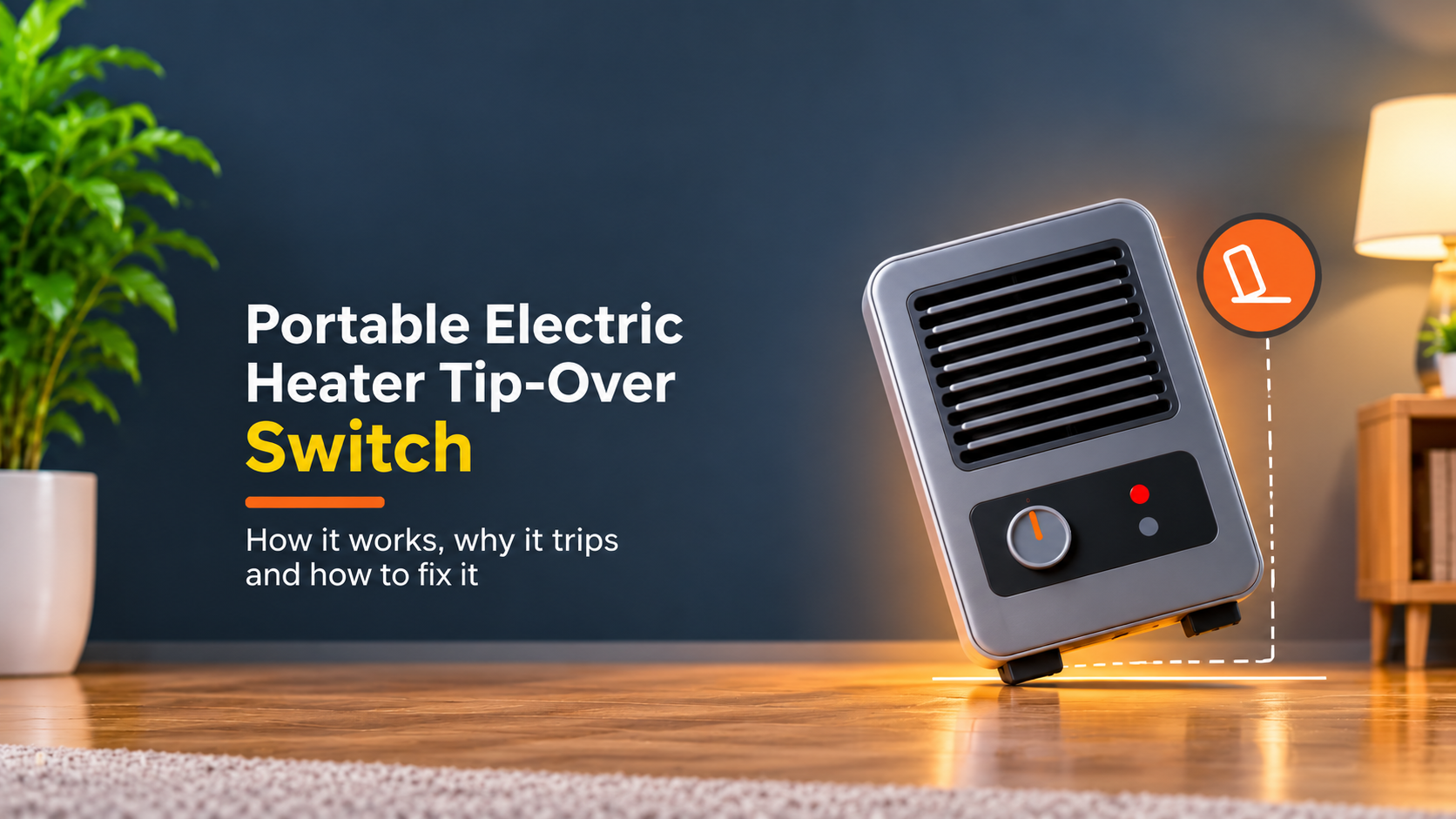
Most modern portable heaters have a tip-over switch that cuts the power if the heater is knocked over or tilted. If the heater sits on a thick rug, a slightly uneven surface or has been moved at an angle, the switch can stay triggered and the heater won’t turn on or will keep shutting off. Place the heater upright on a flat, hard, stable surface, then try switching it on again. If a heater won’t run even when sitting perfectly upright, the switch could be dirty or faulty.
Step 4: Reset the Overheat Protection
Overheat protection shuts the heater down automatically if the internal temperature rises too high. This is usually triggered by blocked vents, dust buildup, covering the heater or placing it too close to a wall or furniture. Many heaters reset automatically after they cool; some have a reset button.
- Switch off and unplug the heater.
- Wait at least 30 minutes for it to cool fully.
- Remove anything blocking the vents and make sure there is clear space around the heater.
- Gently vacuum the vents and grill with a soft brush attachment.
- Press the reset button if your model has one, then plug the heater back in.
Step 5: Check the Thermostat, Mode and Settings
The heater might be working perfectly, but not producing heat because of how it’s set up.
- Thermostat: if it is set lower than the current room temperature, the heater won’t produce heat. Turn it up to maximum as a test.
- Mode selector: make sure it isn’t on “fan only” or a low-power setting.
- Timer: a timer or auto-off setting may be switching the heater off earlier than you expect.
- Eco or energy-saving mode: these modes may cycle the heater on and off to maintain a target temperature.
- Child lock: some models lock the controls. Check the manual for how to unlock them.
- Remote control: replace the batteries and make sure there’s a clear line of sight to the unit.
- Error codes: if the display shows a code, check the manual, as it may point to a specific fault.
Step 6: If Nothing Works, Stop and Decide
If you have been through the steps above and the heater is still dead, the problem is likely internal, such as a failed heating element, thermal fuse, switch or control board. At this point you should stop troubleshooting and decide whether to use the warranty, contact the manufacturer or replace the heater.
The 6 Most Common Reasons a Portable Heater Stops Working

Symptom-Based Troubleshooting Table
Use this table to match what you’re seeing to the most likely cause and the safest next step.
| Symptom | Likely Cause | What to Do |
|---|---|---|
| No lights, no fan, no heat | No power at the outlet, damaged cord or plug, tripped breaker or failed internal fuse | Test another outlet, check breaker, inspect cord. If still dead, stop using it |
| Lights or fan on, but no heat | Thermostat too low, fan-only mode, overheat cut-off or failed heating element | Turn thermostat up, check mode, let it cool and reset; if still cold, replace or repair |
| Blows cold air | Thermostat satisfied, wrong mode, or heating element not working | Raise thermostat and select heat mode; if cold air continues, contact maker or replace |
| Turns off after a few minutes | Overheat protection from blocked vents or dust; tip-over switch; timer; tripping breaker | Clean vents, clear space around it, check timer and surface, test another outlet |
| Trips the circuit breaker | Overloaded circuit or internal electrical fault | Use a circuit with nothing else running. If it trips alone, stop using it |
| Burning smell | Dust burning off (brief) or overheating parts and wiring (serious) | If it fades quickly after first use, it may be dust. If it persists or smells like plastic, unplug and stop |
| Clicking or ticking noise | Normal metal expansion or the thermostat switching on and off | Usually harmless. If loud, rattling or accompanied by other problems, have it checked |
| Remote or display not responding | Dead batteries, child lock or control board issue | Replace batteries, check lock, use manual controls, contact maker if needed |
| Plug or cord hot, melted or discoloured | Poor connection, overload or damaged cord | Unplug immediately. Don’t use the heater, and have the outlet inspected |
Troubleshooting by Heater Type
Ceramic Fan Heaters and Tower Heaters
These rely on airflow for safe operation, so they are especially prone to dust problems. If the fan is slow, noisy or silent, or the heater shuts off after a short time, dust and lint are the first suspects. Clean the vents and grills, and make sure there’s nothing blocking the air intake at the back. If the fan runs but the air is only lukewarm, the heating element or thermostat may be failing.
Oil-Filled Radiator Heaters
Oil-filled heaters are sealed units. If one doesn’t heat, check the outlet, the thermostat dial and the power switches (many have several heat settings). Remember that they warm up slowly, so give the heater ample time before deciding there’s a fault. If you see oil leaking, stop using it and don’t attempt to open it, as it needs to be replaced or disposed of properly.
Infrared and Radiant Heaters
These heaters work by warming people and objects, so the heater can feel “weak” if you’re not standing in its path. If the glow is dim, uneven or one element is out, there’s likely an internal fault. Since the elements are often fragile, avoid moving the heater while it’s hot.
Convector and Panel Heaters
Wall-mounted and freestanding convector and panel heaters often have digital thermostats, timers and programmes. Check that the programme or schedule isn’t telling the heater to stay off, that the correct mode is selected, and that vents are unobstructed. If the display lights up but the heater never produces heat, check the settings again before suspecting a fault.
What You Can Fix Yourself and What You Should Never Attempt

Simple external fixes like changing the outlet, resetting the heater and cleaning the vents are fine for most people. But heaters contain high-power electrical components, and a mistake can cause a fire or electric shock. Don’t open the heater, don’t replace parts with non-original ones and don’t try to bypass any safety device. If an internal repair is needed, it should be done by the manufacturer or a qualified technician.
Repair or Replace? How to Decide
Once you have ruled out simple causes, you need to decide whether the heater is worth fixing. Consider these factors:
- Warranty: check your receipt and the manufacturer’s warranty period. A heater that fails early may be eligible for a free repair or replacement.
- Age: older heaters are more likely to have worn-out safety components, and may lack modern protections such as tip-over and overheat cut-offs.
- Cost of repair: portable heaters are relatively inexpensive, so a repair that costs close to the price of a new unit usually isn’t worthwhile.
- Type of fault: issues involving burning smells, melted parts, sparks or tripping breakers should end the heater’s life, not be repaired.
- Availability of parts: many portable heaters are not designed to be serviced, and parts may not be available.
Signs It’s Time to Replace Your Heater
- The cord or plug is damaged, or has overheated or melted.
- It trips a breaker on its own, even on a different circuit.
- It has produced sparks, smoke or a persistent burning smell.
- The casing is cracked, warped or discoloured by heat.
- The heating element has failed and the unit is out of warranty.
- It lacks tip-over or overheat protection.
- It has been dropped or exposed to water.
If You Need to Buy a Replacement
When shopping for a new heater, a few features can save you from the same issue in the future:
- The right wattage for your room size, usually about 10 watts per square foot for a typical room.
- Tip-over protection and overheat protection.
- An adjustable thermostat and, ideally, a timer.
- A recognised safety certification mark on the product.
- A clear warranty, and a cord long enough to reach a wall outlet without an extension.
- Easy-to-clean vents, especially for fan-driven models.
How to Prevent Heater Problems in the Future
- Clean it regularly. Vacuum the vents and grills at the start of the season and every few weeks of regular use, always with the heater unplugged and cool.
- Use a stable surface. Keep the heater upright on a flat, hard floor, not on carpet or furniture.
- Plug directly into the wall. Avoid extension cords, power strips and shared high-load outlets.
- Keep the vents clear. Never cover the heater or place it too close to walls, curtains or furniture. Leave about 3 feet (1 metre) clear on all sides.
- Treat the cord kindly. Don’t bend it sharply, pinch it under furniture or wrap it tightly around the heater when storing.
- Store it properly. At the end of the season, clean it and store it in a dry place, preferably in its original box.
- Don’t ignore early warning signs. Unusual noises, smells, flickering or a hot plug are signs to stop and investigate.
- Follow the manual. Each model has its own safety limits and instructions.
Frequently Asked Questions
Why is my portable electric heater not turning on?
The most common causes are a dead outlet or tripped breaker, a tripped tip-over switch, overheat protection that hasn’t reset, a damaged cord or plug, or a failed internal component. Check the outlet, place the heater upright on a flat surface, let it cool and then try again.
Why is my heater blowing cold air?
The thermostat may be set lower than the room temperature, the heater may be in fan-only mode, or the overheat protection may have switched off the heating element while the fan keeps running. If the heater still blows cold air with the thermostat at maximum and heat mode selected, the heating element or thermostat may have failed.
Why does my heater keep shutting off?
Frequent shutoffs usually come from overheating caused by blocked vents or dust, a tip-over switch not fully engaged, a timer or eco mode, or a circuit that’s overloaded. Clean the vents, make sure there’s plenty of space around the heater and plug it into a dedicated outlet.
Why does my heater trip the breaker?
Heaters draw a lot of power, so they can trip a breaker if the circuit is shared with other appliances or is already near its limit. If the heater trips the breaker on its own, even on different circuits, there may be an internal fault and you should stop using it.
How do I reset my portable electric heater?
Switch it off, unplug it and let it cool for at least 30 minutes. Clear any blocked vents, then plug it back in. Some models also have a small reset button. Check your manual to see where it is located.
Can I fix a heater with a broken heating element?
For most portable heaters, no. The elements are built into sealed units and are not designed to be user-replaced. Repairing one is usually not worthwhile or safe, and replacing the heater is the normal solution unless it’s still under warranty.
Is a burning smell normal when I first use a heater?
A faint smell for a few minutes after the first use, or after long storage, can come from dust or manufacturing residue burning off. A strong, persistent or plastic-like smell, smoke or visible sparks are not normal. Switch it off, unplug it and stop using it.
How long should a portable electric heater last?
Lifespan depends on the quality, how often you use it and how well you care for it. Many last several seasons with proper use and cleaning, but there’s no fixed number. Replace it if it shows safety problems, regardless of its age.
Final Thoughts
When a portable electric heater stops working, resist the urge to panic or to start taking it apart. Begin with the simple, safe checks: test the outlet, inspect the cord and plug, place the heater upright, let it cool and reset the overheat protection, then check the thermostat and settings. These steps solve the majority of problems in a few minutes.
If the heater still doesn’t work, or if you notice any burning smell, sparks, melted plastic or repeated breaker trips, stop using it. Check your warranty, contact the manufacturer or replace the heater with one that has modern safety features. With regular cleaning and sensible use, your next heater will keep you warm without the headaches.
This article is for general information only. Always follow your heater’s manufacturer instructions, and consult a qualified electrician or technician for any electrical repair.