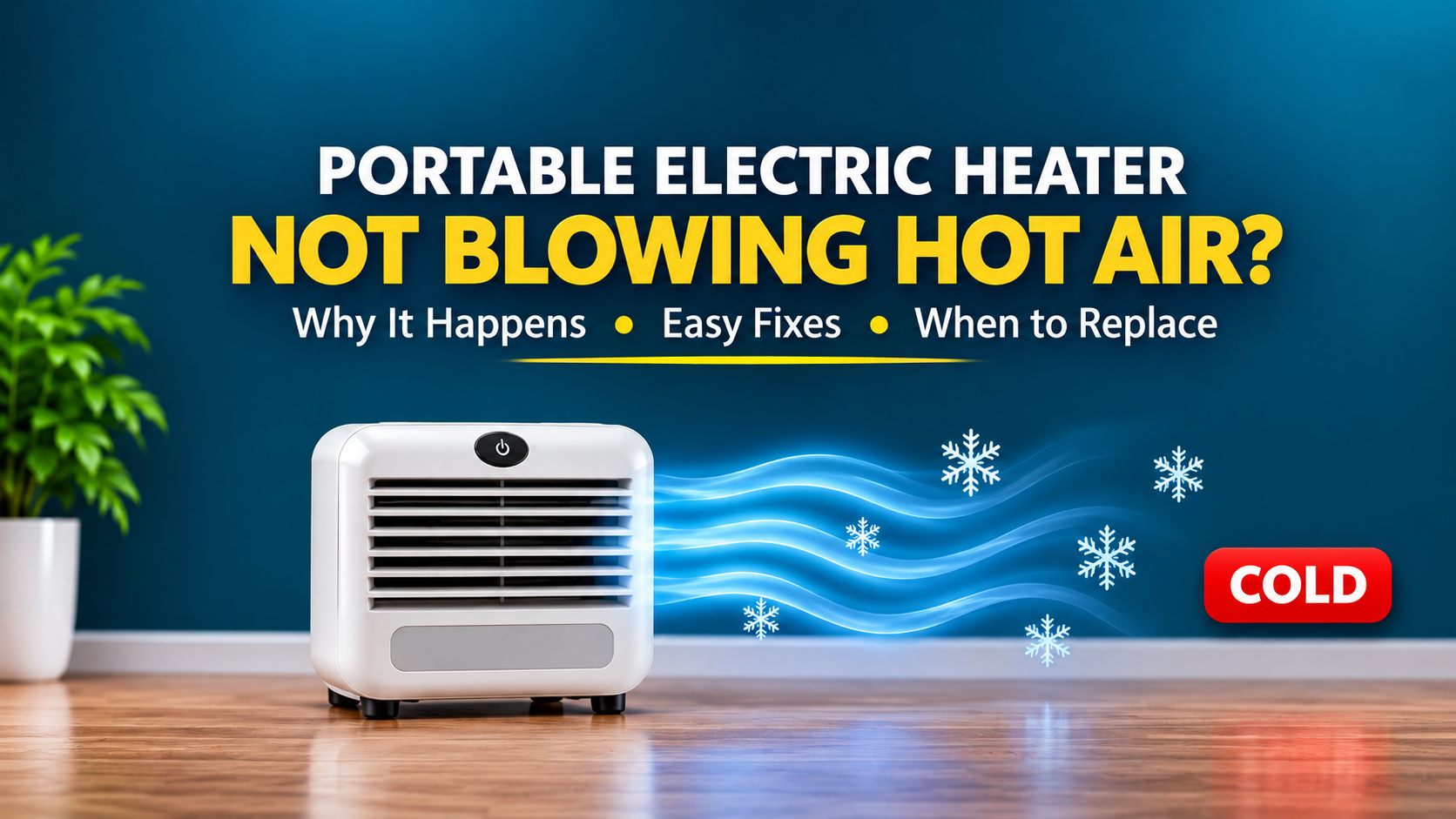

There are few things more disappointing than switching on your portable heater, hearing the fan whirr, and feeling a stream of cold or barely warm air. The heater is clearly on, so why isn’t it doing its job?
A portable electric heater that is not blowing hot air is a very common problem, and the cause is often simpler than people expect. It might be a thermostat setting, a mode selector, a dusty vent or a built-in safety device doing exactly what it was designed to do. Sometimes the heater is perfectly fine but too weak for the room. And in some cases the heating element has failed and the unit needs to be replaced.
This guide explains how a fan heater produces warm air, the most likely reasons it blows cold or lukewarm air, how to test each cause safely, what is normal versus what is a real problem, and how to get more warmth from the heater you already own.
Quick Answers
- Cold air only: check the thermostat, the mode (fan-only or low), and the overheat protection first.
- Lukewarm air: the heater may be too small for the room, running in eco mode, on a poor power connection, or clogged with dust.
- Heat that fades after a few minutes: look for blocked vents, dust and overheat protection cycling.
- Fan runs but nothing improves after a full reset: the heating element or thermal fuse has probably failed.
- Never open the heater or bypass safety switches. If it needs internal repair, contact the manufacturer or replace it.
First, Check Your Expectations
Before you start troubleshooting, it helps to know what a healthy portable heater actually feels like. A common 1,500-watt heater produces roughly 5,100 BTU of heat per hour. That’s enough to warm a small to medium room, but the air coming out of it will feel comfortably warm rather than scorching hot, particularly if the room is large or the thermostat is close to its target. And some behaviours that look like faults are perfectly normal.

How a Fan Heater Makes Hot Air
Understanding the basic parts makes troubleshooting much easier. A typical fan heater, including most ceramic and tower models, has five key components that work together:

- The fan pulls room air in and pushes it across the heating element. If it’s weak or clogged, airflow drops.
- The heating element converts electricity into heat. Many modern heaters use ceramic elements. If it fails, the fan will keep running but the air stays cold.
- The thermostat senses the room temperature and switches the heat on and off to hold your chosen setting.
- The overheat cut-off switches off the heating if the unit gets too hot, usually because of blocked airflow.
- The tip-over switch cuts power if the heater is tilted or knocked over.
When one of these parts, or the setting that controls it, isn’t doing its job, the fan may still run while the heat stays off. That’s why “fan on, no heat” is such a common complaint.
Safety First
- Unplug the heater and let it cool completely before touching, cleaning or moving it.
- Don’t open the casing or touch internal parts.
- Never bypass the thermostat, overheat protection or tip-over switch.
- If you notice sparks, smoke, a melted plug or a persistent burning smell, stop using the heater immediately.
Which Symptom Do You Have?
The cause usually depends on the kind of problem you’re seeing. Use the guide below to find the most likely cause first.

Cause 1: The Thermostat Is Set Too Low (or Misread)
This is the single most common reason a fan heater blows cold air. The heater only produces heat when the room temperature is below the thermostat setting. If the dial or digital setting is lower than the current room temperature, the fan may run without any heating.
How to fix it:
- Turn the thermostat to its maximum setting as a test.
- On a digital model, check whether the display is in Celsius or Fahrenheit. A setting that looks reasonable in the wrong unit can be well below the room temperature.
- Check the manual for how to switch units and how the thermostat works.
- Keep the heater away from direct sunlight and nearby warm appliances, which can fool the thermostat sensor into thinking the room is already warm.
Cause 2: Wrong Mode or Low Heat Setting
Many heaters have several modes: fan only, low heat, high heat, eco and sometimes an automatic mode. If the selector is on “fan only”, the heater will happily blow cool air all day. Heaters with two heat levels, for example a lower and a higher wattage setting, will produce noticeably cooler air on the lower setting.
How to fix it: select the highest heat setting, switch off eco mode and check that the oscillation function isn’t spreading the warm air too thinly while you test it.
Cause 3: The Overheat Protection Has Tripped
If vents are blocked or dusty, the heater can overheat internally. To protect itself, the overheat cut-off switches the heating element off. On many models the fan keeps running, which means you get cold air even though the unit seems to be working. Some reset automatically after cooling; others have a reset button.
How to fix it:
- Switch the heater off and unplug it.
- Let it cool for at least 30 minutes.
- Remove anything blocking the intake or outlet, and leave at least 3 feet (about 1 metre) of clear space around it.
- Clean the vents (see Cause 4).
- Press the reset button if your model has one, then plug the heater back in.
Cause 4: Dust and Lint Are Choking the Airflow
Dust, pet hair and lint collect on the intake grill, the fan and the element. They reduce airflow, make the heater run hotter inside and can trigger the overheat protection. They also cause the heater to smell of burning dust when it first heats up. If the airflow is weak, the air that comes out can feel lukewarm because less air is being pushed across the element, and the heater may shut off its heating more often.
How to fix it: with the heater unplugged and cool, use a vacuum with a soft brush attachment to clean the intake and outlet grills. Wipe the casing with a dry cloth. If your model has a removable filter, clean it according to the manual. Do this regularly, especially if you have pets.
Cause 5: Poor Power Supply (Outlets, Extension Cords and Overloaded Circuits)
Heaters need a solid power connection. A loose plug, a worn outlet, a long or thin extension cord, or a circuit shared with other appliances can reduce the voltage reaching the heater or cause it to cut out. The result can be weak heat, intermittent heat or a tripping breaker.
How to fix it:
- Plug the heater directly into a wall outlet, not an extension cord or power strip.
- Try a different outlet, ideally on another circuit.
- Make sure the plug fits snugly and doesn’t get hot.
- Avoid running other high-power appliances on the same circuit at the same time.
- If the plug or outlet is discoloured, warm or melted, stop using it and have the outlet checked by an electrician.
Cause 6: The Heater Is Too Small for the Room
Sometimes there is nothing wrong with the heater at all. A heater that’s too weak for the space, or a room that loses heat quickly, can leave you with a stream of merely warm air that never seems to raise the temperature. A common rule of thumb is about 10 watts per square foot for a typical, reasonably insulated room, and more for rooms with drafts, high ceilings or poor insulation.
| Room Size | Typical Wattage Needed |
|---|---|
| Up to 100 sq ft (9.3 m²) | About 1,000 W |
| Around 150 sq ft (14 m²) | About 1,500 W |
| Around 200 sq ft (18.6 m²) | About 2,000 W or more |
How to fix it: close the door, block drafts, use the heater in a smaller area, and place it closer to where you sit. If the room is simply too large, consider a heater with higher output or a more targeted type of heating.
Cause 7: A Tripped Tip-Over Switch
If the heater is tilted, on a soft carpet or on an uneven surface, the tip-over switch may cut power or prevent the heating from starting. Place the heater upright on a flat, hard surface and try again.
Cause 8: A Failed Heating Element or Thermal Fuse
If you’ve been through all the checks above, let the heater cool fully and reset it, and it still blows cold air at maximum settings with a clear outlet and clean vents, the problem is likely internal. Common faults include a burnt-out or cracked heating element, a blown thermal fuse, a faulty thermostat or a failed control board.
Most portable heaters are sealed, inexpensive units and are not designed to be repaired. Opening them is unsafe, and replacement parts are rarely available. If the heater is under warranty, contact the manufacturer or the seller. Otherwise, replacing it is usually the safest and most economical choice.
Symptom-Based Troubleshooting Table
| What You Notice | Most Likely Cause | Best First Step |
|---|---|---|
| Fan runs, air is cold from the start | Thermostat too low, fan-only mode, or tripped overheat protection | Max thermostat, select heat mode, cool down and reset |
| Air is only lukewarm | Low heat setting, eco mode, undersized heater or poor power connection | Use high setting, plug directly into the wall, check room size |
| Warm at first, then cold | Overheat cut-off or thermostat cycling | Clean vents and increase clearance around heater |
| Weak airflow | Dust-clogged grill or fan | Vacuum vents when unplugged and cool |
| Cold air only on the lower setting | Low-wattage mode selected | Switch to high heat |
| Cold air even after full reset | Failed heating element or thermal fuse | Check warranty or replace the heater |
| Burning smell, sparks or hot plug | Serious electrical or overheating fault | Unplug and stop using immediately |
Heaters That Don’t “Blow” Hot Air by Design
If your heater isn’t a fan heater, “not blowing hot air” may simply be how it works.
- Oil-filled radiators have no fan. They warm up slowly and radiate heat from their surface.
- Infrared or radiant heaters warm people and objects directly, so you feel heat only when you’re in its path.
- Convector and panel heaters may have no fan, or only a small one, and rely on warm air gradually circulating through the room.
With these types, judge the heater by whether the room is getting warmer over time, not by the feel of the air at the outlet. If an oil-filled or panel heater stays cold, check the power, thermostat and mode settings, and look for leaks or damage.
How to Get More Warmth From Your Heater
Even a healthy heater can feel disappointing if the setup isn’t right. These simple changes can make a noticeable difference:
- Close the door and keep the heated space as small as practical.
- Block drafts with draft excluders, weatherstripping and thick curtains. Keep fabric well away from the heater.
- Place it sensibly. Point it toward the area where you sit, but keep the recommended clearance from furniture and walls.
- Turn off oscillation if you want to feel focused warmth.
- Use the highest setting first to warm the room, then lower it to maintain the temperature.
- Add a rug and warm layers to make the room feel warmer at the same temperature.
- Keep it clean. A clear, dust-free heater delivers better airflow and works more efficiently.
When to Replace Your Portable Heater
- It blows cold air at maximum heat even after a full reset and cleaning.
- The cord, plug or outlet shows burns, melting or discolouration.
- It trips the breaker, sparks or smells strongly of burning plastic.
- The casing is cracked, warped or has been dropped or wet.
- It lacks tip-over and overheat protection.
- The cost of repair is close to the price of a new heater.
What to Look for in a Replacement
- The right wattage for your room size.
- Multiple heat settings and an adjustable thermostat, ideally digital.
- Tip-over and overheat protection and a recognised safety certification mark.
- Easy-to-clean vents or a removable filter.
- A timer and, if you like, a remote control for convenience.
- A solid warranty, so a faulty element is covered.
Frequently Asked Questions
Why is my portable heater blowing cold air?
Most often the thermostat is set below the room temperature, the heater is in fan-only or low mode, or the overheat protection has switched the element off. Dust, a poor power supply or a failed heating element are other possible causes.
Why does my heater blow cold air after a few minutes?
This usually points to overheat protection, caused by blocked vents or dust, or to the thermostat reaching its target and switching the heat off. Clean the vents, give the heater more clearance and raise the thermostat setting.
Is it normal for a heater to blow cold air at first?
A brief period of cooler air right after you switch on is normal, because the element needs a few seconds to heat up. If the air is still cold after several minutes on maximum heat, there is probably a problem.
Why does my heater fan keep running after I turn the heat off?
Some heaters run the fan for a short while after the heat is switched off to cool the element. This is normal and helps protect the unit.
Can a dirty heater blow cold air?
Yes. Dust and lint can restrict airflow, cause overheating and trigger the overheat protection, which switches off the heating element while the fan may keep running. Cleaning the vents often fixes it.
Can I fix a broken heating element myself?
No. Portable heater elements are built into sealed units and are not meant to be replaced by users. Attempting to open or repair the unit is dangerous. Use the warranty if it applies, or replace the heater.
Why does my heater only blow lukewarm air?
It could be running on a low heat setting or in eco mode, receiving reduced power through an extension cord, struggling with a large or drafty room, or have dusty vents. Plug it directly into a wall outlet, select high heat and make sure the room isn’t too large for the heater’s wattage.
Do I need to reset my heater?
If it’s blowing cold air or shut off by itself, a reset often helps. Switch it off, unplug it, let it cool for at least 30 minutes, clear any blockages and plug it back in. Check the manual in case your model has a reset button.
Final Thoughts
When your portable electric heater isn’t blowing hot air, the fix is often quick and free. Check the thermostat and mode first, give the heater a proper cool-down and reset, clean the vents, and plug it directly into a healthy wall outlet. Then ask whether the heater is simply too small for your room, because a perfectly healthy heater can feel disappointing in a large or drafty space.
If the heater still blows cold air after all these steps, or if you see any burning smell, sparks or damaged plugs, stop using it. Check your warranty or replace it with a model that has the right wattage and modern safety features. A little maintenance and the right setup will keep your heater delivering warm air all winter.
This article is for general information only. Always follow your heater’s manufacturer instructions, and consult a qualified electrician or technician for any electrical repair.