







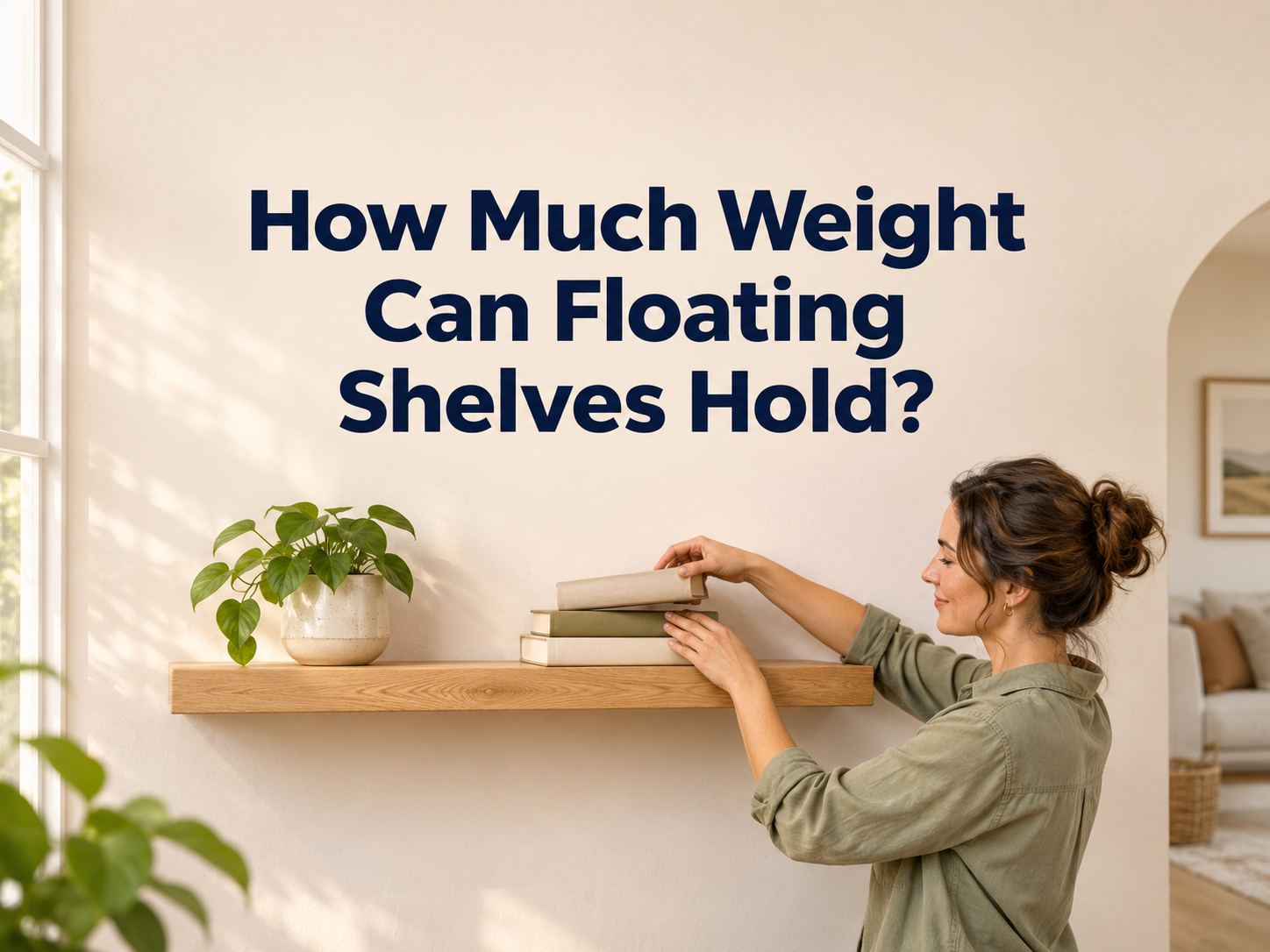
Floating shelves are popular because they look clean, light and modern. But the moment you start planning what to put on one, an important question comes up: how much weight can a floating shelf actually hold? A row of paperbacks, a few framed photos and a plant are very different loads from a stack of hardcover books or a set of ceramic dishes, and guessing wrong can leave you with a drooping shelf or, worse, one that pulls out of the wall.
This guide explains what decides a floating shelf’s weight limit, gives you realistic figures for common setups, shows you how to estimate the weight of what you want to display, and tells you how to get the most capacity from your shelves safely.
Typical Weight Capacity of Floating Shelves
There is no single number that fits every floating shelf, but the ranges below are a useful starting point. They assume the shelf is installed correctly with the hardware that came with it.
| Type of Floating Shelf | Typical Capacity |
|---|---|
| Thin decorative shelf (hollow or lightweight board) | 5 to 15 lbs (2 to 7 kg) |
| Standard 1 to 2 inch thick shelf, hidden rods, studs | 25 to 50 lbs (11 to 23 kg) |
| Solid hardwood shelf with thick steel bracket, studs | 50 to 75+ lbs (23 to 34+ kg) |
| Heavy-duty or industrial floating shelf system | 75 to 100+ lbs (34 to 45+ kg) |
| Glass floating shelf | 10 to 25 lbs (4.5 to 11 kg), limited by glass thickness |
| Corner floating shelf | 10 to 30 lbs (4.5 to 14 kg) |
What Determines a Floating Shelf’s Weight Limit?
The weight a floating shelf can hold depends on a chain of parts. The shelf is only as strong as its weakest link, and for floating shelves that is often the wall fixing rather than the shelf board itself.
1. The Wall Type and How You Fix to It
This is the biggest factor. Wall studs, solid wood framing behind the wall surface, are the strongest fixing points in most homes. Plain drywall is weak, and small plastic anchors can give way at surprisingly low loads. Brick, concrete and plaster over masonry can be very strong when the right plugs and screws are used.
2. The Bracket and Hidden Rods
Hidden brackets use steel rods or plates that slide into the shelf. Thicker, longer and more numerous rods carry more. A bracket with two thin 3/8 inch rods will hold far less than one with three solid 1/2 inch rods. Rods that reach deep into the shelf hold better than short ones.
3. Shelf Depth
The deeper the shelf, the more leverage the load puts on the bracket and wall. A load at the front of a 12 inch shelf twists the bracket much harder than the same load on a 6 inch shelf. This is why deeper shelves usually have lower ratings.
4. The Shelf Material and Thickness
Solid hardwood and thick plywood resist bending and crushing. Hollow-core boards, thin MDF and particleboard are lighter but weaker, and can crush around the bracket or sag. The shelf board must be strong enough not to bow or split before the bracket reaches its limit.
5. Shelf Length and Number of Brackets
Longer shelves need more support points. A long shelf with only two brackets will bow in the middle, even if the wall fixings are strong. The weight rating usually assumes a set number of brackets at set spacing.
6. How the Weight Is Distributed
The same 20 lbs (9 kg) is much easier to carry spread evenly or near the wall than concentrated at the front edge or in the middle of a long span.
How to Estimate the Weight of What You Want to Display
Many people underestimate how heavy everyday items are. Use the guide below to estimate your load before you decide how many shelves you need.
| Item | Approximate Weight |
|---|---|
| Paperback book | 0.5 to 1 lb (0.2 to 0.5 kg) |
| Hardcover book | 1.5 to 3 lbs (0.7 to 1.4 kg) |
| Large coffee-table book | 4 to 8 lbs (1.8 to 3.6 kg) |
| Small framed photo | 1 to 2 lbs (0.5 to 0.9 kg) |
| Medium potted plant | 5 to 15 lbs (2.3 to 6.8 kg), more when watered |
| Ceramic vase | 2 to 8 lbs (0.9 to 3.6 kg) |
| Dinner plates (stack of 6) | 6 to 10 lbs (2.7 to 4.5 kg) |
| Small speaker or TV box | 5 to 15 lbs (2.3 to 6.8 kg) |
What Can You Put on a Floating Shelf? Weight Guide by Use
How to Increase the Weight Capacity of Floating Shelves
- Mount into studs. Fix the bracket through at least two studs whenever possible, using long, strong screws.
- Use proper anchors where there are no studs. Heavy-duty toggle bolts or metal anchors rated well above your load are far better than small plastic plugs.
- Choose a stronger bracket. Look for thick steel rods or plates, more rods per shelf and rods that reach most of the shelf depth.
- Pick a thicker, denser shelf. Solid wood or thick plywood carries more and bows less.
- Keep the shelf shallow. Reducing depth cuts the leverage on the wall.
- Keep spans short. Add brackets for longer shelves, or use two shorter shelves instead.
- Add a backing board. Fix a wide board to the studs and mount the shelf to it, to spread the load over a bigger area.
- Place heavy items near the wall. The closer to the wall, the less stress on the bracket.
How Wall Type Affects the Weight Limit
| Wall Type | Best Fixings | Notes |
|---|---|---|
| Drywall over wood studs | Long screws into studs | Strongest option. Plain drywall anchors give much lower capacity. |
| Drywall over metal studs | Special metal-stud toggles or anchors | Weaker than wood studs. Check the anchor’s rating. |
| Plaster and lath | Long screws into studs, or toggle bolts | Brittle, so drill carefully. |
| Brick or concrete | Masonry plugs and screws | Very strong when installed correctly. |
| Hollow block or tile over wall | Special hollow-wall or tile-rated anchors | Capacity varies a lot. Follow anchor instructions closely. |
Signs Your Floating Shelf Is Overloaded
- The front edge is dipping, or the shelf is tilting downward.
- A gap is opening between the shelf and the wall.
- You can see cracks in the paint or drywall around the bracket.
- The shelf wobbles or moves when you press on it.
- The board is bowing in the middle.
- You hear creaking, popping or cracking sounds.
Common Mistakes When Loading Floating Shelves
- Assuming all floating shelves hold the same weight.
- Ignoring the weight rating on the box or the product page.
- Mounting a heavy shelf into drywall only with small plastic anchors.
- Placing the heaviest items at the front edge.
- Forgetting that plants get heavier when watered.
- Using a floating shelf for a TV, a step or anything you might lean on.
- Adding items gradually until the shelf is crowded and over its limit.
Should You Use a Floating Shelf for Heavy Items?
Floating shelves are best for light to medium loads, with decor, photos, small plants and a modest number of books. If you want to display heavy items such as a large book collection, a big speaker or cast-iron cookware, it is wiser to use a visible-bracket shelf, a bookcase or a heavy-duty system designed for the job. A shelf that looks floating but is badly overloaded is not worth the risk.
Frequently Asked Questions
How much weight can a floating shelf hold in drywall?
Plain drywall with small anchors may hold only around 5 to 15 lbs (2 to 7 kg), and heavy-duty toggle bolts may raise this to about 15 to 30 lbs (7 to 14 kg). For anything heavier, fix into studs.
How much weight can a floating shelf hold in a stud?
Stud-mounted shelves with strong brackets can often hold 25 to 75 lbs (11 to 34 kg) or more, depending on the shelf, bracket and depth. Check the manufacturer’s rating for your exact shelf.
Can a floating shelf hold books?
Yes, but books are heavy. A row of hardcovers can easily reach 25 lbs (11 kg) or more. Use a stud-mounted shelf with a strong bracket and keep the books close to the wall.
Is the weight rating per shelf or per bracket?
It varies by product, so always read the instructions. Most ratings are for the whole shelf installed with the supplied bracket and hardware, with the weight evenly spread.
Does a deeper floating shelf hold less weight?
Generally yes. Deeper shelves create more leverage on the bracket and wall, so their safe load is usually lower than a shallower shelf of the same type.
How can I tell if my floating shelf is too heavily loaded?
Watch for sagging at the front, a gap at the wall, cracks around the bracket, wobbling or creaking. If you notice any of these, remove the load and check the fixings.
Final Thoughts
So, how much weight can floating shelves hold? A typical one holds roughly 10 to 50 lbs (4.5 to 23 kg), and the exact figure depends on four things: the wall and fixings, the bracket, the shelf depth and board, and how the weight is spread. Studs, thick steel brackets and shallow shelves give the highest capacity, while plain drywall and small anchors give the lowest.
Always follow the manufacturer’s rating, leave a safety margin, keep heavy items close to the wall, and choose a different type of shelf for very heavy loads. Do that, and your floating shelves will stay stable, safe and good looking for a long time.