






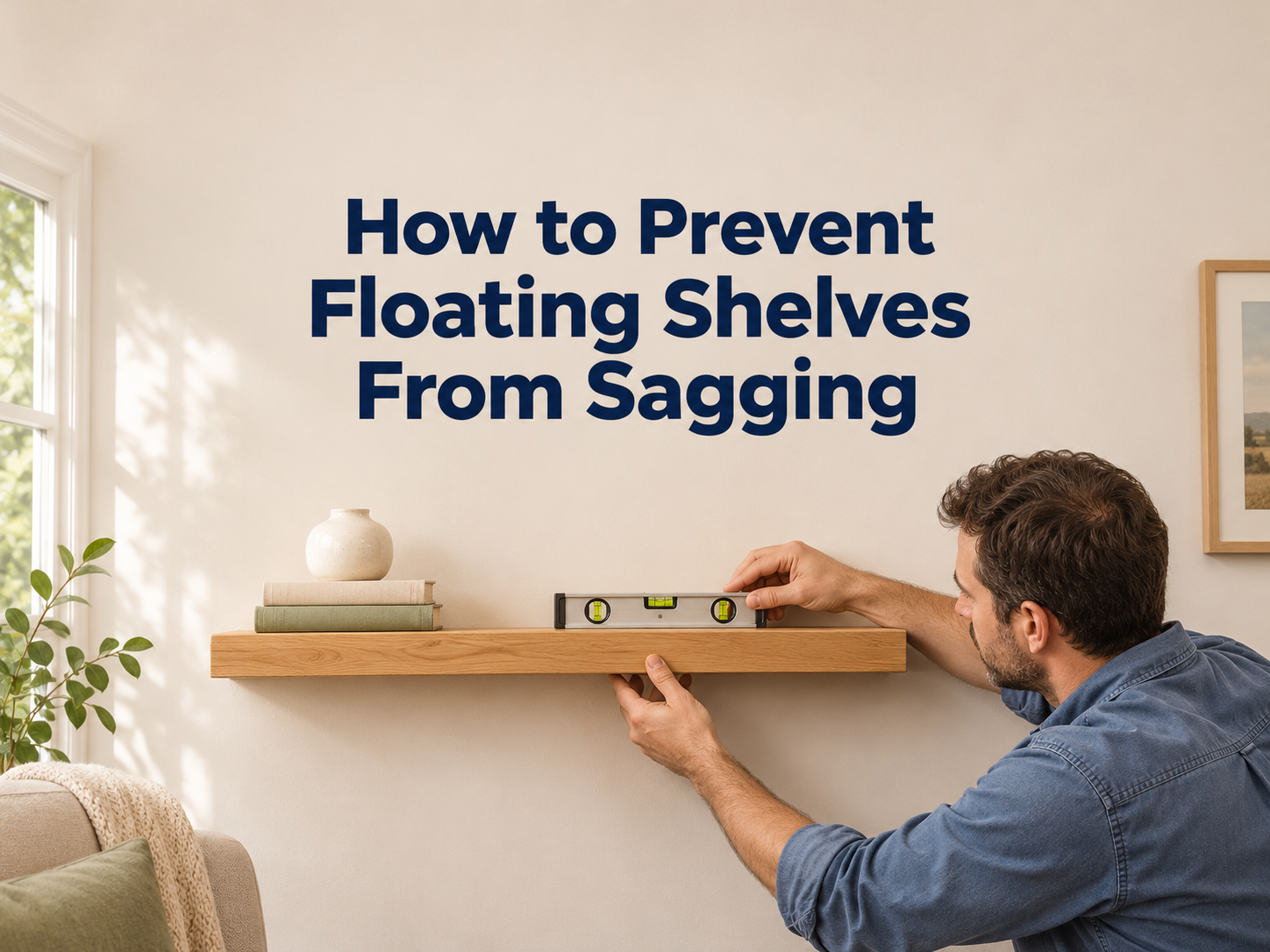
Floating shelves look clean and modern because they seem to hang on the wall with no visible brackets. But that sleek look comes with a catch: a floating shelf is a cantilever, held only at the back and carrying all the weight out in front. Over time, even a well-made shelf can start to droop at the front, tilt away from the wall, or bow in the middle.
The good news is that sagging is almost always preventable. This guide explains why floating shelves sag, and then shows you step by step how to choose, install and load them so they stay level and strong for years.
Why Do Floating Shelves Sag?
To prevent sagging you first need to understand the forces involved. A floating shelf is pulled down by the load and twisted outward from the wall. The hidden bracket and the wall have to resist both at the same time.
- Overloading: every shelf has a weight limit, and books, plants and decor add up quickly.
- Weak wall fixings: screws in plain drywall or the wrong anchors pull out slowly under load.
- Short or thin brackets: a hidden rod that is too short, too thin or made of soft metal will bend.
- Too deep or too long: deep shelves multiply the twisting force, and long spans bow in the middle.
- Thin or weak shelf material: hollow-core boards, particleboard and thin MDF flex and crush around the bracket.
- Poor installation: unlevel mounting, loose bracket screws or a bracket that is not fixed into studs.
- Moisture and humidity: in bathrooms and kitchens, damp air softens board materials and loosens fixings.
Prevention Step 1: Choose the Right Shelf and Bracket
The best defense against sagging is a strong shelf with a strong bracket, picked for the load you plan to carry.
| Choice | Best Option | Avoid |
|---|---|---|
| Shelf board | Solid hardwood or thick plywood (at least 1.5 inches / 38 mm thick for a hollow-core look, or solid 1 to 2 inches) | Thin hollow-core, cheap particleboard |
| Hidden rod brackets | Solid steel rods at least 1/2 inch (12 mm) thick, 2 to 3 rods per shelf, reaching 70 to 80 percent of shelf depth | Short, thin or hollow rods |
| Bracket plate | Heavy-gauge steel with several screw holes | Light sheet metal or plastic |
| Shelf depth | 6 to 10 inches (15 to 25 cm) for most uses | Very deep shelves with a single small bracket |
| Finish | Sealed or painted on all sides | Raw, unsealed board in damp rooms |
Prevention Step 2: Mount Into Wall Studs Whenever Possible
How your shelf attaches to the wall matters just as much as the shelf itself. Wall studs are the strongest fixing points in a typical home.
- Find the studs. Use a stud finder, then mark each stud center. Studs are usually 16 inches (40 cm) apart in many homes, but this varies.
- Screw through the bracket into at least two studs for any shelf holding books or heavy decor.
- Use long, strong screws, typically 2.5 to 3 inches (6 to 7.5 cm), so that they penetrate well into the stud.
- If studs do not line up, use a mounting rail or a wide backing board fixed into studs, then attach the shelf to that.
- In plaster, concrete or brick walls, use the correct masonry plugs and screws for the wall type.
Prevention Step 3: Install It Correctly
- Mark and level. Use a spirit level on the bracket before drilling so that it does not start tilted.
- Drill pilot holes. They prevent splitting and help screws grip.
- Fix the bracket firmly. Use every screw hole provided, and tighten them until the bracket sits flat against the wall with no wobble.
- Slide the shelf on fully. The shelf should push tight against the wall with no gap. A gap means the rods are not fully in.
- Lock it in. Many shelves have set screws underneath. Tighten them to lock the shelf to the bracket.
- Check level again after loading it.
Prevention Step 4: Respect the Weight Limit
Floating shelves are not meant to carry the same load as a bracketed or bookcase shelf. Always keep to the manufacturer’s rating, and treat it as a maximum, not a target.
- Put the heaviest items close to the wall, where the leverage on the bracket is lower.
- Spread the weight evenly instead of piling it in the middle or at the front.
- Do not use a floating shelf as a step, seat or place to lean on.
- For a lot of books, consider several shorter shelves instead of one long one.
- For very heavy loads, switch to visible brackets or a bookcase.
Prevention Step 5: Keep the Span Short
Long shelves bow in the middle even if the wall fixings are strong. A long span needs more support points.
| Shelf Length | Brackets Recommended |
|---|---|
| Up to 24 inches (60 cm) | 2 hidden rods or 1 wide bracket |
| 24 to 36 inches (60 to 90 cm) | 2 to 3 brackets, fixed into studs |
| 36 to 48 inches (90 to 120 cm) | 3 brackets, with solid thick board |
| Over 48 inches (120 cm) | Add a visible support or break into two shelves |
Prevention Step 6: Protect the Shelf From Moisture and Movement
- In bathrooms and kitchens, choose sealed hardwood, waterproof coatings or moisture-resistant boards.
- Wipe spills quickly and avoid leaving damp items on the shelf.
- Keep the shelf out of direct heat sources, which can warp the board.
- Avoid slamming doors or heavy vibrations near the wall.
Prevention Step 7: Check and Maintain Regularly
What If Your Floating Shelf Is Already Sagging?
- Empty it first. Remove the load before checking anything.
- Tighten the set screws and bracket screws. Loose fixings are the most common cause of droop.
- Check the wall fixings. If the bracket has pulled out, re-fix it into a stud or use stronger anchors.
- Look for a bent rod or bracket. Replace it with a thicker, longer one.
- Add a hidden or visible support. A slim steel L-bracket or a small vertical prop at the front corner can restore stability.
- Replace a bowed board. If the shelf itself has curved, a new thick board is the real fix.
- Move it. Shelving into a stud line can transform a weak mount.
Common Mistakes to Avoid
- Buying a floating shelf based on looks alone, without checking the weight rating.
- Mounting into drywall with small plastic anchors and loading it with books.
- Using only one bracket on a long shelf.
- Skipping the set screws that lock the shelf in place.
- Loading the front edge with the heaviest items.
- Installing without a level, or leaving the bracket loose.
- Ignoring early signs, such as a gap at the wall or a slight tilt.
Frequently Asked Questions
Why is my floating shelf sagging at the front?
This is usually from loose bracket or set screws, wall fixings that have worked loose, a bracket that is too short or thin, or too much weight. Unload the shelf and check each of these in order.
How much weight can a floating shelf hold?
It depends on the bracket, the wall and the shelf. Many hold about 10 to 50 lbs (5 to 23 kg). Shelves fixed into studs with thick steel rods hold the most, while shelves in plain drywall hold much less. Always check the manufacturer’s rating.
Do floating shelves have to be mounted into studs?
Not always, but studs are strongly recommended for anything heavier than light decor. In hollow walls, use heavy-duty toggle bolts rated well above the load.
How deep should a floating shelf be?
For most uses, 6 to 10 inches (15 to 25 cm) works well. Deeper shelves put more twisting force on the bracket and wall, so they need stronger fixings and lighter loads.
What is the best material for floating shelves?
Solid hardwood and thick plywood resist sagging best. Hollow-core and thin particleboard shelves are lighter but weaker, and should only carry light items.
Can I fix a sagging floating shelf without removing it?
Sometimes. Tightening the set screws, adding a hidden support or a small front prop can help. If the bracket has pulled out or the board is bowed, you will need to remove and repair or replace it.
Final Thoughts
Floating shelves sag because of leverage: depth, load and weak fixings work together against the bracket. To prevent it, choose a thick, solid shelf and a long, strong steel bracket, mount it into wall studs with long screws, keep the span short, and stay well inside the weight limit.
Add a quick check every few months, tighten any loose screws and move heavy items close to the wall. With the right setup, your floating shelves will stay straight and secure, and keep their clean, modern look for many years.