
Handy Heater Turbo Energy Efficiency: How Much Electricity Does It Really Use?

A handy heater turbo is one of the most popular ways to take the chill off a small room. It is cheap to buy, light to carry and warms up in seconds. But the question that worries almost every buyer, and every person who has seen an unexpectedly high electricity bill after winter, is simple: how energy efficient is a handy heater turbo, and what will it cost to run?
In this guide we explain how these heaters use electricity, what “efficiency” actually means for an electric heater, how to calculate your own running cost, which habits waste power, and how to get the most warmth from every unit of electricity.
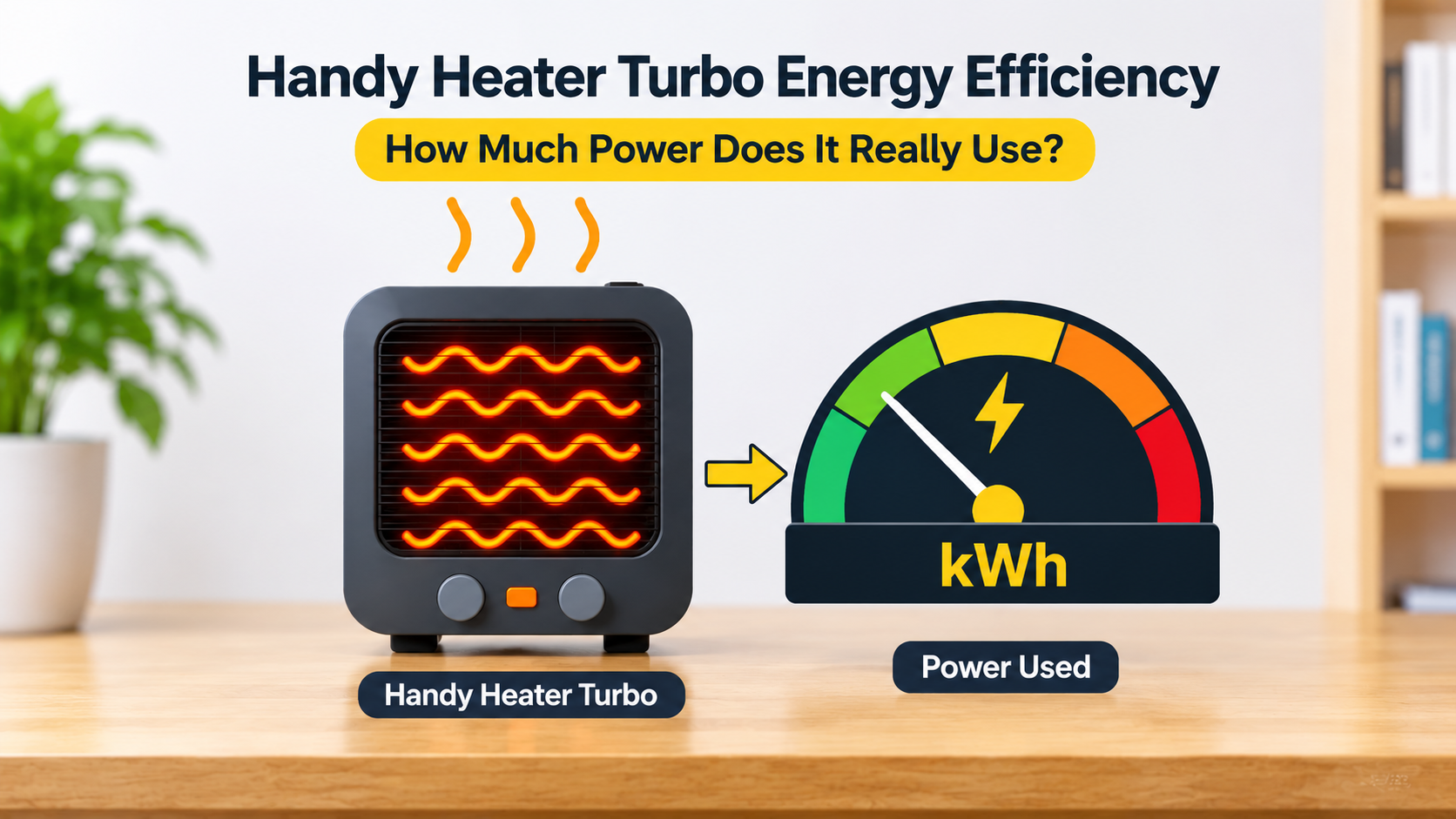
A handy heater turbo converts almost all the electricity it draws into heat, so in that technical sense it is highly efficient. But it is not cheap to run, because it draws a lot of power (often 1000 to 2000 watts) while it is on. Real energy efficiency depends on the wattage setting, how long you run it, the size and insulation of your room, and whether you control it with a thermostat or timer.
- What energy efficiency means for a room heater
- How a handy heater turbo uses electricity
- How to calculate running cost
- Does turbo mode waste more electricity?
- Where the heat goes: why rooms feel cold
- Factors that change real-world efficiency
- Common myths about heater electricity use
- 12 practical ways to save energy
- How it compares with other heater types
- How to measure your own heater’s usage
- Frequently asked questions
- Final verdict
What Energy Efficiency Means for a Room Heater
For many appliances, efficiency means how much useful output you get from the electricity you put in. A light bulb, for example, is judged by how much light it makes compared with how much heat it wastes. A heater is different. Its only job is to make heat, so virtually every watt it draws ends up as heat inside your room. Whether it is a handy heater turbo, a ceramic fan heater or an oil-filled radiator, the conversion from electricity to heat is close to 100 percent.
That has an important consequence. Two heaters with the same wattage will add the same amount of heat to the room over the same period and cost about the same to run. A heater is therefore not “more efficient” just because of its shape, its colour or the word “turbo” on the box.
So where does real-world efficiency come from? It comes from how well the heat is used: choosing the right wattage, heating the right space, stopping heat from escaping, and not running the heater when you do not need it. The rest of this article focuses on exactly those things.
How a Handy Heater Turbo Uses Electricity
A handy heater turbo has a metal coil element and a small fan. When you switch it on, electricity flows through the coil, which heats up, and the fan pushes the warm air into the room. The amount of electricity it draws is shown as wattage (W) on the label or the back of the product. Many compact models have two or three settings, for example a fan-only mode, a lower heat level and a higher “turbo” level.
Electricity is billed in units, officially called kilowatt-hours (kWh). One unit is the energy used by a 1000 W appliance running for one hour. This is the number that decides your bill, not the plug type or the size of the heater.
How to Calculate Running Cost
Wattage ÷ 1000 × hours used = units (kWh) consumed.
Units consumed × your electricity price per unit = running cost.
The table below shows the units consumed for typical wattage levels. Multiply the unit figure by your own electricity rate to find the cost. Check the label on your own heater, because actual wattage differs by brand and model.
| Heater power | 1 hour | 4 hours | 8 hours |
|---|---|---|---|
| 800 W (low setting) | 0.8 units | 3.2 units | 6.4 units |
| 1000 W | 1.0 unit | 4.0 units | 8.0 units |
| 1500 W | 1.5 units | 6.0 units | 12.0 units |
| 2000 W (high turbo setting) | 2.0 units | 8.0 units | 16.0 units |
Notice how quickly the numbers grow. Running a 2000 W heater for 8 hours uses 16 units, which is equal to running a 1000 W heater for 16 hours. This is why the setting and the hours matter so much.
Does Turbo Mode Waste More Electricity?
Turbo mode does not waste electricity in the sense of converting it badly. It simply draws more power each second, so it adds heat to the room faster. Two things are true at the same time:
- High power heats the room faster. You reach a comfortable temperature sooner, which is useful when the room is very cold.
- High power costs more per hour. If you leave it on turbo for hours with no thermostat, you will use far more units than you need.
The smart way to use it is to treat turbo like a booster: start on the high setting to take the chill off, then move to the lower setting (or switch off) once the room feels comfortable. A thermostat or timer, if your model has one, does this job automatically.
Use the highest setting for the first 10 to 20 minutes in a cold room, then drop to a lower setting. Do not leave it on turbo all night or all day.
Where the Heat Goes: Why Rooms Feel Cold
If every watt becomes heat, why does a room sometimes stay cold even with the heater on? Because heat does not stay still. It keeps escaping through windows, walls, door gaps, the ceiling and the floor. The heater has to keep replacing that lost heat, and the colder it is outside and the leakier the room is, the more heat it must replace.
Factors That Change Real-World Efficiency
1. Room size and ceiling height
A compact heater is designed for a small to medium room. In a large hall or a room with a very high ceiling, there is more air to warm and the heat spreads thin. The heater runs longer and the room may still feel cool.
2. Insulation and draughts
A sealed room with curtains, a door seal and closed windows keeps heat much better than a draughty one. Many people can improve comfort more by blocking gaps than by buying a stronger heater.
3. Outside temperature
The bigger the difference between inside and outside temperature, the faster heat leaks out. On the coldest nights, the same heater uses more energy to achieve the same comfort.
4. Thermostat and timer
A thermostat switches the element off when the set temperature is reached and on again when the room cools. That avoids running at full power for hours. Many basic handy heaters have only simple switches, so you need to manage the on and off times yourself, or use a plug-in timer designed for the heater’s power rating.
5. Placement
Put the heater where its warm air can circulate through the room, not tight against a wall, behind furniture or under a window with open curtains. Safe clearance around it also gives better airflow.
6. Fan speed and dust
A dusty grill and fan restrict airflow. The heater then works less effectively and its parts get hotter. Cleaning it regularly (after unplugging and cooling) keeps it working as it should.
Common Myths About Heater Electricity Use
Myth
- “A small handy heater uses almost no electricity.”
- “Turbo mode wastes power.”
- “Leaving it on low all day is cheaper.”
- “A new heater is always more efficient.”
Reality
- Small does not mean low power. Many compact heaters draw 1000 W or more.
- Turbo draws more per hour but heats faster. Total use depends on how long it runs.
- Long hours add up quickly, even on a lower setting. Heat only when and where you need it.
- Any electric heater converts nearly all power to heat. Thermostats, controls and safety features differ, not the basic conversion.
12 Practical Ways to Save Energy
- Heat only the room you are using. A small heater in a closed room works better than trying to warm the whole home.
- Close doors and windows. This is the simplest and cheapest improvement.
- Use thick curtains. Close them at night to cut heat loss through glass.
- Block door gaps. A door seal or rolled towel at the bottom reduces draughts.
- Use turbo as a booster only. Warm the room, then switch to a lower level.
- Choose the right wattage. Too weak and it runs forever; too strong and it overshoots the comfort you need.
- Use a thermostat if available. It prevents hours of unnecessary full-power running.
- Turn it off when you leave the room. Heating an empty room wastes units.
- Wear warm clothes and use blankets. A few layers let you accept a lower room temperature.
- Warm yourself, not the whole room. For short tasks, place the heater safely nearby instead of running it for hours.
- Keep the heater clean. Dust-free grills and fans improve airflow and performance.
- Use the sunlight. Open curtains on sunny days to let free warmth in, then close them before dark.
Energy saving should never come at the cost of safety. Keep at least 1 metre (3 feet) of clear space around the heater, plug it directly into a wall socket, never cover it or dry clothes on it, and do not leave it running while you are away or asleep unless it has proper auto shut-off protection.
How It Compares With Other Heater Types
Because nearly all electric heaters convert power to heat at about the same rate, the practical differences lie in how the heat is delivered and controlled.
| Heater type | How the heat feels | Energy-saving strengths |
|---|---|---|
| Handy heater turbo (coil fan heater) | Quick warm air, strong but short-lived once switched off | Low purchase price, fast warm-up for short use; basic models often lack a thermostat |
| Ceramic fan heater | Steady warm air, usually gentler | Thermostat and timer common, which can cut wasted running time |
| Oil-filled radiator | Slow to warm up, keeps radiating after switch-off | Holds heat well, good for long periods in a closed room |
| Radiant (infrared) heater | Warms people and objects directly | Useful for spot heating when you sit in front of it |
In short, a handy heater turbo is an excellent short-burst heater. If you need steady heat for many hours, a model with a good thermostat, or a different heater type, can make the same electricity feel more comfortable.
How to Measure Your Own Heater’s Usage
If you want exact numbers rather than estimates, use a plug-in energy meter (also called a watt meter or power monitor). You plug the meter into the wall, plug the heater into the meter, and it shows real-time watts and total units used. It is a small, inexpensive tool that tells you precisely how much your heater costs on each setting.
No meter? You can still estimate. Read the wattage on the heater’s label, note how many hours you use each setting every day, and apply the formula from earlier in this article. Add the totals for a week and you will quickly see which habits cost the most.
Frequently Asked Questions
Is a handy heater turbo energy efficient?
In the technical sense, yes: it converts nearly all the electricity it draws into heat. In the practical sense, it can still be expensive to run because it draws high power. Real efficiency depends on your settings, running time and how well the room holds heat.
How many units does a handy heater turbo use per hour?
It depends on the wattage. A 1000 W heater uses about 1 unit per hour at full power, a 1500 W heater about 1.5 units and a 2000 W heater about 2 units. Check the label on your own heater for its exact rating.
Does a handy heater turbo use a lot of electricity?
Compared with a fan, light or phone charger, yes. Heating appliances are among the highest power users in a home. Using it in short bursts, in a closed room, keeps the total manageable.
Is it cheaper to leave the heater on low all day?
Usually not. A lower setting still draws power continuously, and long hours add up. It is generally better to heat the room when you need it, use a thermostat if possible, and switch off when you leave.
Will a thermostat really save electricity?
Yes, in most cases. Once the room reaches the set temperature, the heater stops drawing full power until the room cools again. That can cut total running time compared with a heater that stays on continuously.
Is a ceramic heater more energy efficient than a handy heater turbo?
At the same wattage, both turn almost all electricity into heat. A ceramic heater is not magically cheaper, but many models include thermostats and timers that help you avoid wasting electricity.
What is the best wattage for a small room?
Many small rooms are comfortable with roughly 1000 W to 1500 W when the room is closed and reasonably sealed. Larger, draughty or very cold rooms need more heat or a longer warm-up time, so choose based on your actual space.
Can I run a handy heater turbo all night to stay warm?
It is best not to. Besides using many units of electricity, running a heater unattended during sleep carries safety risks unless the model has reliable overheat and tip-over protection. Warm the room before bed, use warm bedding, and switch the heater off.
Final Verdict
The handy heater turbo is efficient at turning electricity into heat, but it is not a low-cost way to heat a room for long periods. Its real value lies in speed and convenience: quick warmth, a low price and easy portability.
- Use it as a booster rather than an all-day heater.
- Know the wattage and calculate the units you actually use.
- Keep the room sealed so the heat you pay for stays inside.
- Control run time with a thermostat, timer or simple discipline.
Follow these steps and you will enjoy a warmer room, a lower bill and a safer winter, whichever handy heater turbo you choose.