
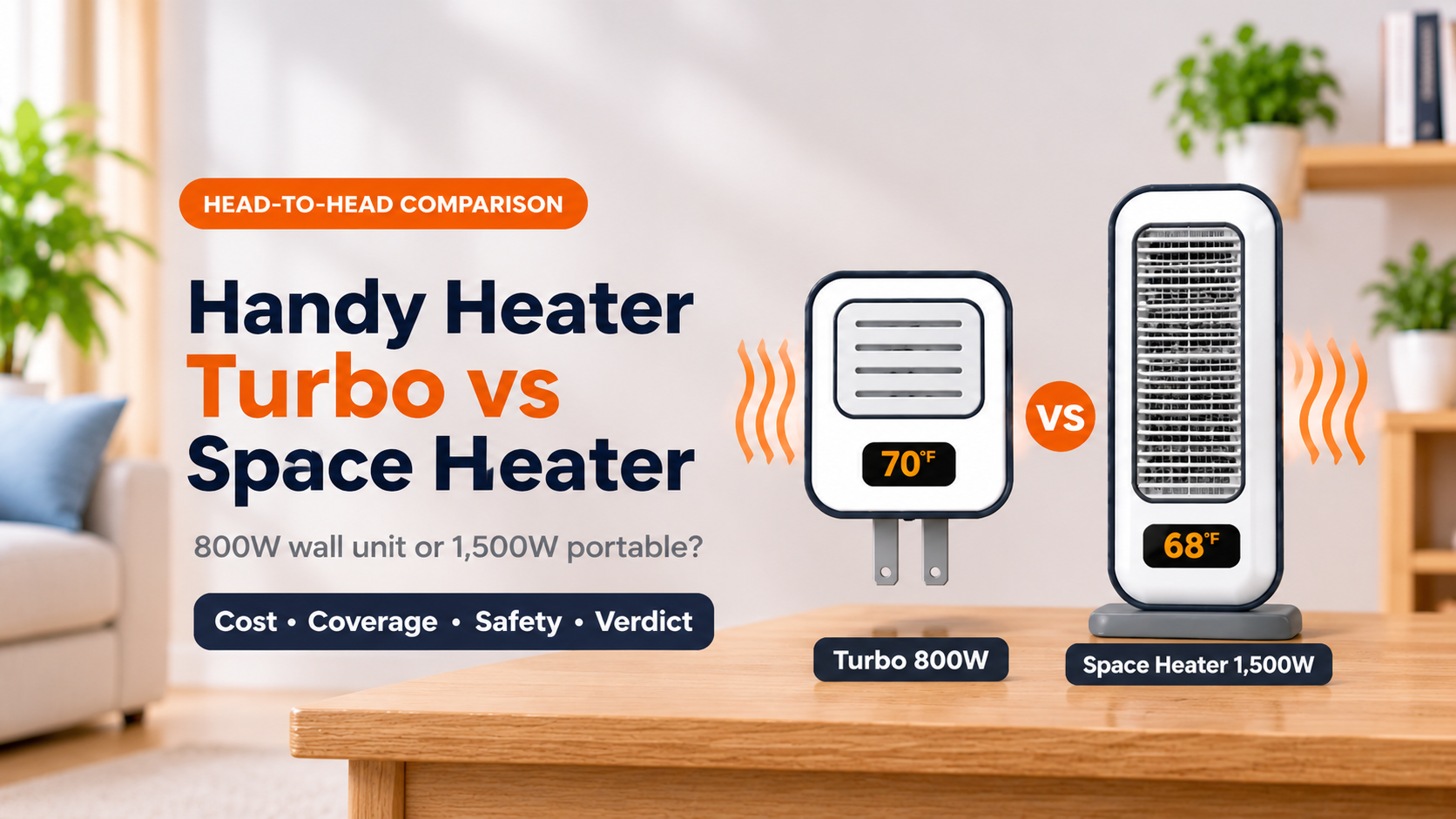

When the weather turns cold, you have a choice to make. Do you buy a compact plug-in heater like the Handy Heater Turbo, or a traditional space heater that sits on the floor and usually delivers more power? Both promise to warm one room without heating the entire house, but they are built for different jobs.
This guide compares the Handy Heater Turbo vs a typical space heater on the things that matter: heating power, room size, running cost, safety, portability and value. By the end you will know which one fits your room, your budget and your habits.
Quick answer
Choose the Handy Heater Turbo (800W) for small spaces of up to about 80 square feet, such as bathrooms, closets, nurseries and desk areas, where saving floor space and keeping running cost low matter most. Choose a 1,500W space heater for rooms of about 80 to 150 square feet, such as bedrooms and dens, where you need more heat and want to move the heater around.
The Two Heaters at a Glance
What is the Handy Heater Turbo?
The Handy Heater Turbo is a compact ceramic heater that plugs directly into a wall outlet. Retailer listings for the Turbo 800 describe an 800 watt ceramic element, an adjustable thermostat, a digital LED display, a programmable timer of up to 12 hours, automatic shut-off, a stay-cool housing and ETL listing. It typically costs about $20 to $30. Handy Heater makes other models with different wattages, so always confirm the rating on your own unit.
What do we mean by “space heater”?
“Space heater” is a broad term for any portable heater that warms a single room. In practice, most people mean a freestanding electric unit rated at up to 1,500 watts, usually a ceramic fan heater, a tower heater or an oil-filled radiator. Many 1,500 watt models offer multiple heat settings (often 1,500 watts on high and 1,000 watts on low), a fan-only mode and features such as oscillation. For this comparison we use a typical 1,500 watt ceramic space heater as the benchmark.

Heating Power and Room Size
Heating power is the biggest difference between the two. An electric heater converts essentially all the electricity it uses into heat, and each watt produces about 3.412 BTU per hour.
- Handy Heater Turbo: 800 watts, about 2,730 BTU per hour
- Typical space heater: 1,500 watts, about 5,118 BTU per hour
A common planning guideline for electric heaters is about 10 watts per square foot for a room with standard 8 foot ceilings and average insulation. On that basis:
- The Turbo suits roughly 80 square feet, around the size of a bathroom, small nursery or home office nook.
- A 1,500 watt heater suits roughly 150 square feet, around the size of a standard bedroom or small den.
These numbers fall in drafty or poorly insulated rooms, where you may need to allow 12 to 15 watts per square foot. The Turbo’s real-world coverage can drop to about 53 to 67 square feet, and a 1,500 watt heater to about 100 to 125 square feet.
Running Cost: Is the Turbo Really Cheaper?
Per hour, yes. At the 2026 US average residential electricity price of about 18 cents per kWh:
- The Turbo (0.8 kW) costs about 14 cents per hour.
- A 1,500 watt heater (1.5 kW) costs about 27 cents per hour.
That means the Turbo uses about 47 percent less electricity every hour it runs.

| Daily Use | Turbo (800W) Per Month | 1,500W Heater Per Month | Difference |
|---|---|---|---|
| 2 hours | $8.64 | $16.20 | $7.56 |
| 4 hours | $17.28 | $32.40 | $15.12 |
| 8 hours | $34.56 | $64.80 | $30.24 |
The catch: cost per unit of heat is the same
Here is the part many comparisons leave out. Both are electric resistance heaters, so both turn nearly all electricity into heat. That means the cost of each BTU of heat is essentially identical. At 18 cents per kWh, producing 10,000 BTU costs about 53 cents with either heater.

This changes how you should think about value. The Turbo is cheaper per hour because it produces less heat, not because it is more efficient. In a room that needs 1,500 watts to be comfortable, an 800 watt heater will either run constantly and still fall short, or leave the room cool. In a room that needs only 700 watts, a 1,500 watt heater will simply switch off more often through its thermostat, so you will not pay much more. The right question is not “which costs less per hour” but “which is sized correctly for my room.”
Footprint and Portability
Handy Heater Turbo: It plugs into the wall and hangs there, so it uses no floor space and no extension cord, and no one can knock it over. The trade-off is that it is fixed to the outlet. You can unplug and move it to another outlet, but it will always be low on the wall, which may not be where you need the heat most.
Space heater: A freestanding unit goes anywhere in the room, can be pointed at a chair or desk, and can move between rooms. It needs floor space, a nearby outlet and a clear area around it, and it can be tipped over by a child, pet or careless foot.
Safety Comparison
Any electric heater needs respect. According to widely repeated fire-safety guidance, portable heaters are involved in a significant number of home fires every year, mostly when they are placed too close to flammable materials or left running unattended.
| Safety Factor | Handy Heater Turbo | Typical 1,500W Space Heater |
|---|---|---|
| Tip-over risk | None, it is on the wall | Possible; look for tip-over shut-off |
| Electrical load | About 6.7 amps at 120 volts | About 12.5 amps; near the limit of a 15 amp circuit |
| Automatic shut-off | Listed for the Turbo 800 | Common; check the model |
| Surface temperature | Stay-cool housing listed | Varies; oil radiators get very hot |
| Safety certification | ETL listed | Look for a recognized listing such as UL or ETL |
| Cord and outlet risk | No cord; outlet must be sound | Cord and plug can overheat if damaged or on a shared circuit |
Important points for either type:
- Plug directly into the wall. Never use extension cords, power strips or surge protectors with a heater.
- Keep at least 3 feet clear in front of the unit.
- A 1,500 watt heater should ideally have its circuit largely to itself. Other devices on the same circuit can trip the breaker.
- Check that the outlet is tight. A loose outlet can make a plug-in heater run hot. If the plug or outlet becomes warm, discolored or loose, stop using it.
- Turn off or unplug the heater when you leave the room or go to sleep, and follow the manual for your exact model.
Other Types of Space Heaters Worth Knowing
The “space heater” category is wider than ceramic fan units. If neither of the two main options feels right, these alternatives may suit you better.
| Type | Best For | Drawback |
|---|---|---|
| Ceramic fan or tower heater | Quick warm-up of a small to medium room | Fan noise; heat stops quickly when switched off |
| Oil-filled radiator | Quiet, steady heat for bedrooms and longer use | Slow to warm up; heavy; hot surface |
| Infrared or radiant heater | Warming people directly, such as at a desk or in a drafty spot | Does not heat the air well |
| Wall outlet heater (like the Turbo) | Small rooms where floor space matters | Limited power and placement |
Feature Comparison: Controls and Convenience
- Thermostat: The Turbo has an adjustable thermostat. Most mid-range space heaters also do, while very cheap models may have only a basic dial.
- Timer: The Turbo 800 is listed with a programmable timer up to 12 hours. Many space heaters have timers, but not all.
- Oscillation: A common space heater feature that spreads heat across a room. The Turbo does not oscillate.
- Heat settings: Many 1,500 watt heaters offer low and high settings, which helps you match output to the room. The Turbo’s single 800 watt level is simpler but less flexible.
- Remote control and displays: Common on higher-priced space heaters; the Turbo has a digital LED display.
- Noise: The Turbo is described as quiet. Fan-based space heaters tend to be noisier, while oil-filled radiators are usually the quietest.
Handy Heater Turbo vs Space Heater by Room
| Room | Better Pick | Why |
|---|---|---|
| Bathroom | Turbo | Small room, no floor space, low cost |
| Closet, pantry, laundry room | Turbo | Very small spaces need little power |
| Home office or cubicle | Turbo | Desk-side warmth without clutter |
| Nursery or small guest room | Turbo | Wall-mounted, no tip-over risk; follow baby-safety advice |
| Standard bedroom (110–150 sq ft) | Space heater | More power for the larger space |
| Den or small living area | Space heater | Movable and stronger |
| Large living room (200+ sq ft) | Neither | Use central heating or a larger dedicated heater |
| Garage or workshop | Neither | Large, poorly insulated; needs a purpose-built heater |
Pros and Cons
Handy Heater Turbo
Pros:
- Plugs into the wall with no floor footprint and no tip-over risk
- Low power draw and low hourly running cost
- Thermostat, timer and auto shut-off listed
- Inexpensive to buy
Cons:
- Only suited to rooms of about 80 square feet or less
- Fixed position, low on the wall
- Cannot be easily aimed or moved around a room
Typical 1,500W Space Heater
Pros:
- More heat for rooms of up to about 150 square feet
- Portable and can be aimed where you need it
- Often has multiple heat settings, oscillation and remote control
Cons:
- Costs almost twice as much per hour at full power
- Needs floor space and a clear area around it
- High circuit load; should have its outlet largely to itself
Which Should You Choose?

Choose the Handy Heater Turbo if you:
- Need to warm a small room, bathroom, nursery, closet or desk area
- Want to save floor space and avoid a heater that can be knocked over
- Want a low hourly cost and a simple, inexpensive unit
Choose a 1,500W space heater if you:
- Need to heat a bedroom, den or larger office
- Want a portable heater you can move between rooms
- Want a faster warm-up and more flexibility with heat settings
Consider owning both if you:
Have a house with a mix of small and medium rooms. A Turbo in the bathroom or office plus one portable 1,500 watt heater for the bedroom or living area can cover most needs for under $100 in total, though you should only run one at a time on the same circuit.
Frequently Asked Questions
Is the Handy Heater Turbo better than a regular space heater?
It depends on the room. For small spaces of up to about 80 square feet it is a good, space-saving, low-cost option. For larger rooms a regular 1,500 watt space heater has the power the Turbo lacks.
Is the Handy Heater Turbo cheaper to run than a space heater?
Per hour, yes. It costs about 14 cents per hour compared with about 27 cents for a 1,500 watt heater at 18 cents per kWh. But cost per unit of heat is the same, so a heater that is too small for your room may not save you money.
Which heats a room faster?
A 1,500 watt space heater, because it produces almost twice as much heat per hour. In a very small room, both will feel warm quickly.
Which is safer?
The Turbo has no tip-over risk and a lower electrical load. But safety depends mostly on how you use any heater: plug directly into the wall, keep flammables away, and never leave it running unattended. Choose a heater with a recognized safety listing and automatic shut-off features.
Can I use the Turbo as my main heat source?
No. It is a personal, supplemental heater for a small area. It will not replace central heating.
Do I need a special outlet for either heater?
No special outlet is needed, but a 1,500 watt heater uses most of a 15 amp circuit, so avoid running other high-power devices on the same circuit. The Turbo uses about half that load.
Can I use either one with an extension cord?
No. Plug heaters directly into the wall. Extension cords and power strips can overheat.
Is an oil-filled radiator better than both?
For quiet, steady heat over long periods in a bedroom, many people prefer an oil-filled radiator. It warms up more slowly and is heavier, but the heat lingers after the thermostat shuts off.
How do I know what size heater I need?
Multiply your room’s length by its width to get square feet, then multiply by 10 to estimate the watts needed. Add 20 to 50 percent for poorly insulated or drafty rooms.
Final Verdict
The Handy Heater Turbo and a typical space heater are not really competitors; they are tools for different sizes of job. The Turbo is a neat, low-cost, space-saving heater that does best in rooms of about 80 square feet or less. A 1,500 watt space heater gives you almost twice the heat and the freedom to move it, which makes it the better choice for bedrooms, dens and larger offices.
Measure your room first, match the wattage to the space, and prioritize safe use over everything else. Pick the Turbo for a small room and you will pay about 14 cents an hour and keep your floor clear. Pick a 1,500 watt space heater for a bigger room and you will pay about twice that, but you will actually feel the difference.
Cost and coverage figures are estimates based on an 800 watt Turbo rating, a typical 1,500 watt space heater, the 2026 US average residential electricity rate of roughly 18 cents per kWh, and a planning guideline of about 10 watts per square foot. Actual results depend on insulation, climate, local rates and settings. Features of space heaters vary by model. Always read and follow the manual and warnings supplied with your specific heater.