
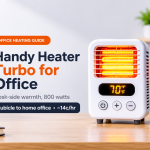

Cold hands make it hard to type. Cold feet make it hard to focus. Whether you work in a chilly cubicle, a private office with a stubborn thermostat, or a spare room at home, being uncomfortable at your desk costs you energy and concentration. A small plug-in heater is a popular fix, and the Handy Heater Turbo is one of the most talked-about options.
This guide looks at the Handy Heater Turbo for office use honestly: which offices it suits, what it costs over a working month, the safety and workplace rules you need to check first, and when you should choose something else.
Quick answer
The Handy Heater Turbo 800 is an 800 watt wall outlet heater that works well for a cubicle, home office or small private office up to about 80 square feet. It costs roughly 14 cents per hour at residential rates, or about 11 cents at the average commercial rate. Before using one at work, check your employer’s or landlord’s rules, because many workplaces restrict personal space heaters.
What Is the Handy Heater Turbo?
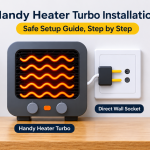
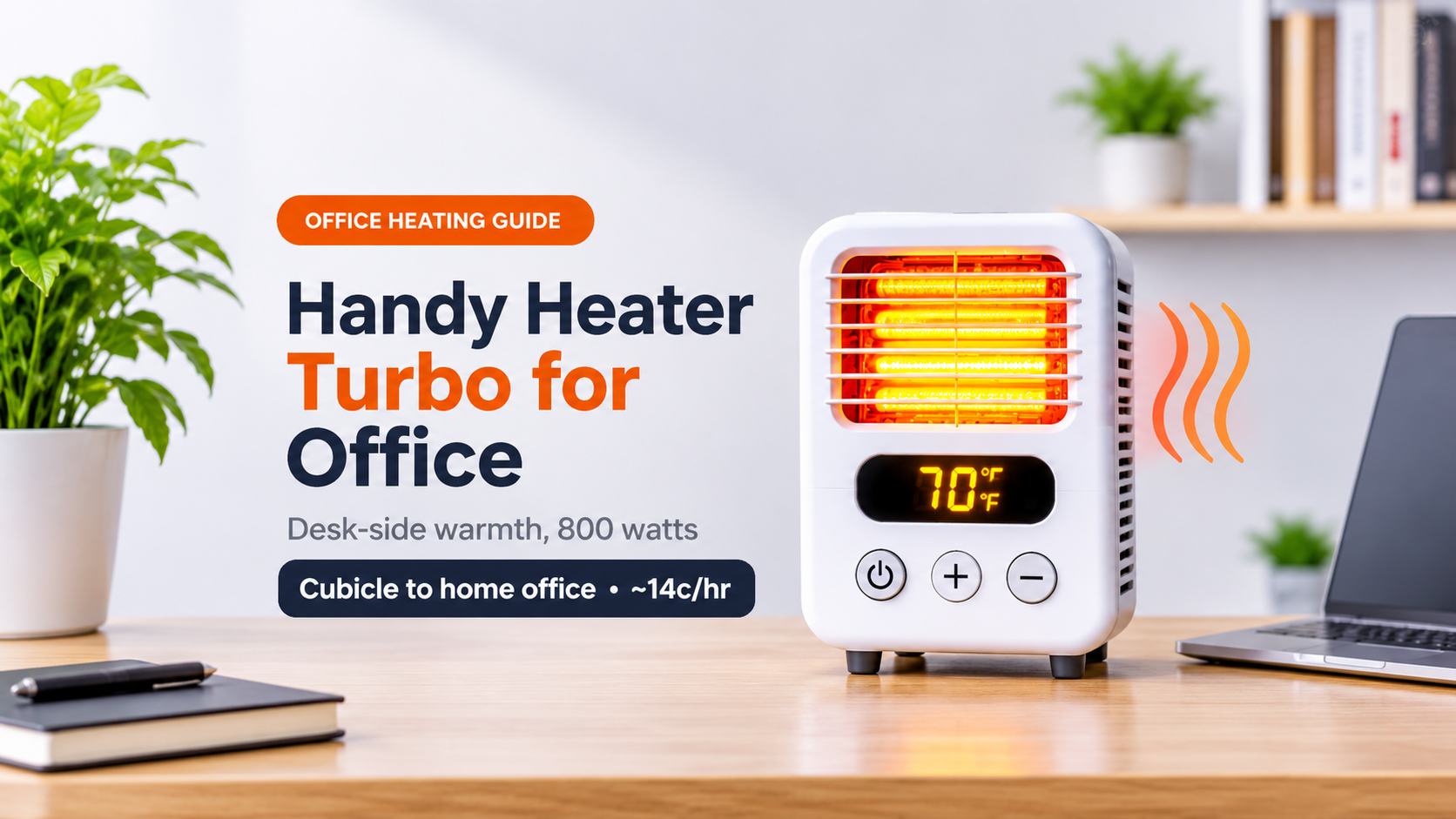
The Handy Heater Turbo is a compact ceramic heater that plugs directly into a standard wall outlet. It has no floor stand and no long cord, which is a real advantage in a tight work area. Retailer listings for the Turbo 800 describe these features:
- 800 watt ceramic heating element
- Adjustable thermostat with a digital LED display
- Programmable timer of up to 12 hours
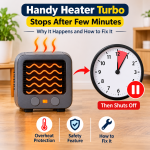
- Automatic shut-off protection and a stay-cool housing
- ETL listed for safety compliance
It typically sells for about $20 to $30. Handy Heater makes several models at different power levels, so confirm the wattage printed on your own unit. This article is about the 800 watt Turbo.
Why People Use It at Their Desk
- No desk or floor clutter. It sits in the wall outlet, so it does not take up legroom or desk space.
- Personal warmth. You warm your own area instead of raising the thermostat for coworkers who may feel differently.
- Quiet enough for a working space. Retailer descriptions highlight quiet performance, though you should still expect some sound.
- Timer and thermostat. You can pre-warm your area and avoid running it all day.
- Low running cost. At 800 watts it uses far less electricity than a 1,500 watt space heater.
Which Offices Suit the Handy Heater Turbo?
An 800 watt heater produces about 2,730 BTU of heat per hour. Using the common guideline of about 10 watts per square foot for standard 8 foot ceilings and average insulation, that is enough for roughly 80 square feet.

| Workspace | Typical Size | How the Turbo Performs |
|---|---|---|
| Cubicle | 36–64 sq ft | Great for desk-side warmth, if the outlet is in your cubicle |
| Home office nook | 50–80 sq ft | Great |
| Small private office | 80–120 sq ft | Good at the desk; the far corners will stay cooler |
| Medium private office | 120–200 sq ft | Desk-side warming only |
| Shared office or meeting room | 250+ sq ft | Not suitable |
| Open-plan floor | 1,000+ sq ft | Not suitable |
In a larger room, think of the Turbo as a way to warm the person, not the room. You will feel the heat most strongly close to the unit, and it will not noticeably change the temperature across a big space. Drafty or poorly insulated offices reduce the effective area further, to roughly 50 to 65 square feet.
Check the Rules Before You Bring One to Work
This is the part many buyers skip, and it matters most for office use. A personal heater that is perfectly fine at home may not be allowed in a shared workplace.

- Ask first. Many employers, building managers and landlords restrict or ban personal space heaters for fire-safety and electrical load reasons. Check your workplace policy, facilities team or lease before buying. Breaking a rule can mean having the heater removed or, in some cases, a formal warning.
- Plug into the wall, not a strip. Never use an extension cord, power strip or surge protector with a heater. Some office furniture outlets and under-desk power strips are not designed for this load.
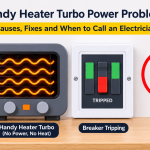
- Mind the circuit. An 800 watt heater draws roughly 6.7 amps on a 120 volt circuit. Office circuits are often shared by several desks, monitors, printers and other equipment, so a heater can add enough load to trip a breaker if the circuit is busy.
- Keep a 3 foot clear zone. Keep paper, cardboard, cables, fabric chairs and curtains well away from the front of the unit.
- Unplug when you leave. Do not leave a heater running in an empty office, and do not rely only on the thermostat when you go home for the night.
If your workplace does not allow space heaters, ask facilities about the thermostat, or consider options that do not use heating elements such as a heated seat cushion, wrist warmers or a warm drink. Some workplaces permit low-power heated pads even where heaters are banned, but always ask.
How Much Does It Cost to Run in an Office?
An 800 watt heater uses 0.8 kWh per hour at full power. At the 2026 US average residential rate of about 18 cents per kWh, that is roughly 14 cents per hour. Businesses generally pay a lower rate, with the commercial average around 13.5 cents per kWh, which works out to about 11 cents per hour. If you work from a home office, use the residential figures. If you work in a commercial building, your employer usually pays the bill, which is another reason to check policy first.

| Workday Use | Per Day (18¢) | 22 Workdays (18¢) | 22 Workdays (13.5¢) |
|---|---|---|---|
| 2 hours | $0.29 | $6.34 | $4.75 |
| 4 hours | $0.58 | $12.67 | $9.50 |
| 6 hours | $0.86 | $19.01 | $14.26 |
| 8 hours | $1.15 | $25.34 | $19.01 |
These figures are maximums. The thermostat switches the element off when your area reaches the temperature you set, so actual use is usually lower. For your own number, use: watts ÷ 1,000 × your rate per kWh × hours used. Rates vary widely, with higher prices in New England, New York, California and Hawaii.
Handy Heater Turbo vs Other Office Heaters
| Option | Strengths | Weaknesses |
|---|---|---|
| Handy Heater Turbo (800W, wall outlet) | No desk or floor space, timer and thermostat, low cost | Limited area; needs a free wall outlet; may be restricted at work |
| Under-desk heater | Warms legs and feet directly | Takes legroom; cord management |
| 1,500W tower or fan heater | Heats larger private offices faster | Higher cost and load; takes floor space |
| Heated cushion or wrist warmers | Very low power; often easier to get approved | Warms you, not the space |
Where to Put It at Your Desk
- Use the outlet nearest your seat so the heat reaches you without a cord running across the floor.
- Keep the front clear. Do not tuck it behind a desk, filing cabinet or chair where it cannot release heat.
- Avoid blocking walkways. A wall unit that sticks out near a doorway is a tripping and bumping risk.
- Keep it away from paper stacks and cardboard. Offices have plenty of flammable material.
- Do not use it for drying anything, such as wet coats or umbrellas.
6 Ways to Stay Warm at Your Desk

- Position it right. Place it near your desk with at least 3 feet of clear space.
- Use the thermostat. A steady, comfortable setting beats running at full power.
- Warm up first. Switch it on shortly before you sit down, then let the thermostat maintain it.
- Layer clothing. A sweater, scarf or fleece lets you keep the heater setting lower.
- Block drafts. Door gaps and window leaks are common causes of cold offices.
- Warm your hands. Wrist warmers or a hot drink help with the coldest part of the day.
Pros and Cons
Pros
- Compact, wall-mounted and quiet, with no desk or floor footprint
- Low 800 watt power use and low hourly cost
- Thermostat, timer and auto shut-off
- Affordable and easy to try
Cons
- Only suited to small spaces of about 80 square feet
- May be banned or restricted by your employer or building
- Needs a free, working wall outlet near where you sit
- Not suited to large or open-plan offices
Who Should Buy It?
It is a good choice if you:
- Work from a home office, cubicle or small private office
- Have permission to use a personal heater at work
- Want to warm your own space rather than change the thermostat for everyone
Look at something else if you:
- Work in a large, shared or open-plan space
- Are not allowed to use heaters at your workplace
- Share a circuit that is already heavily loaded
Frequently Asked Questions
Is the Handy Heater Turbo good for an office?
Yes for a cubicle, home office or small private office up to about 80 square feet. In larger offices it works only as a personal, desk-side heater.
Can I use it in a cubicle?
If your workplace allows it and there is an outlet in your cubicle. Check the rules first, because shared offices often restrict heaters.
How much does it cost to run all day?
Eight hours at full power costs about $1.15 at 18 cents per kWh, or about 86 cents at a commercial rate of 13.5 cents. The thermostat usually reduces actual cost.
Will it trip the breaker?
An 800 watt heater draws about 6.7 amps, which a normal 15 amp circuit can handle on its own. But if the circuit is shared with many other devices, the combined load can trip it. If it does, stop using the heater on that circuit.
Can I use it with a power strip?
No. Plug heaters directly into the wall. Power strips and extension cords can overheat.
Is it quiet enough for calls and meetings?
It is described as quiet, but any heater makes some noise. Test it in your own space before relying on it for video calls.
Can I leave it running when I am away from my desk?
No. Switch it off or unplug it whenever you leave the area, and always unplug it at the end of the day.
Is it better than an under-desk heater?
It depends. A wall heater warms the surrounding air and leaves your legroom free. An under-desk heater warms your legs more directly but takes up space under the desk.
Do I need approval from my employer?
In most workplaces, yes, or at least you should check. Many organizations have policies on personal electrical appliances. Ask your manager, facilities team or landlord before buying.
Final Verdict
The Handy Heater Turbo is a practical, low-cost way to keep your own desk area comfortable. It is compact, quiet, uses only 800 watts, and gives you a thermostat, timer and auto shut-off. For a home office, cubicle or small private office, it is a sensible buy at roughly 14 cents an hour.
The deciding factor in a workplace is usually not the heater but the rules. Confirm that personal heaters are allowed, plug it directly into a wall outlet, keep the area around it clear, and unplug it when you leave. Do that, and you can stay warm and focused without turning up the heat for the whole building.
Cost and coverage figures are estimates based on an 800 watt rating, 2026 US average residential (about 18 cents per kWh) and commercial (about 13.5 cents per kWh) electricity rates, 22 workdays a month, and a planning guideline of about 10 watts per square foot. Actual results depend on insulation, climate, local rates and settings. Workplace rules vary; always follow your employer’s policy and the manual and warnings supplied with your specific heater.