

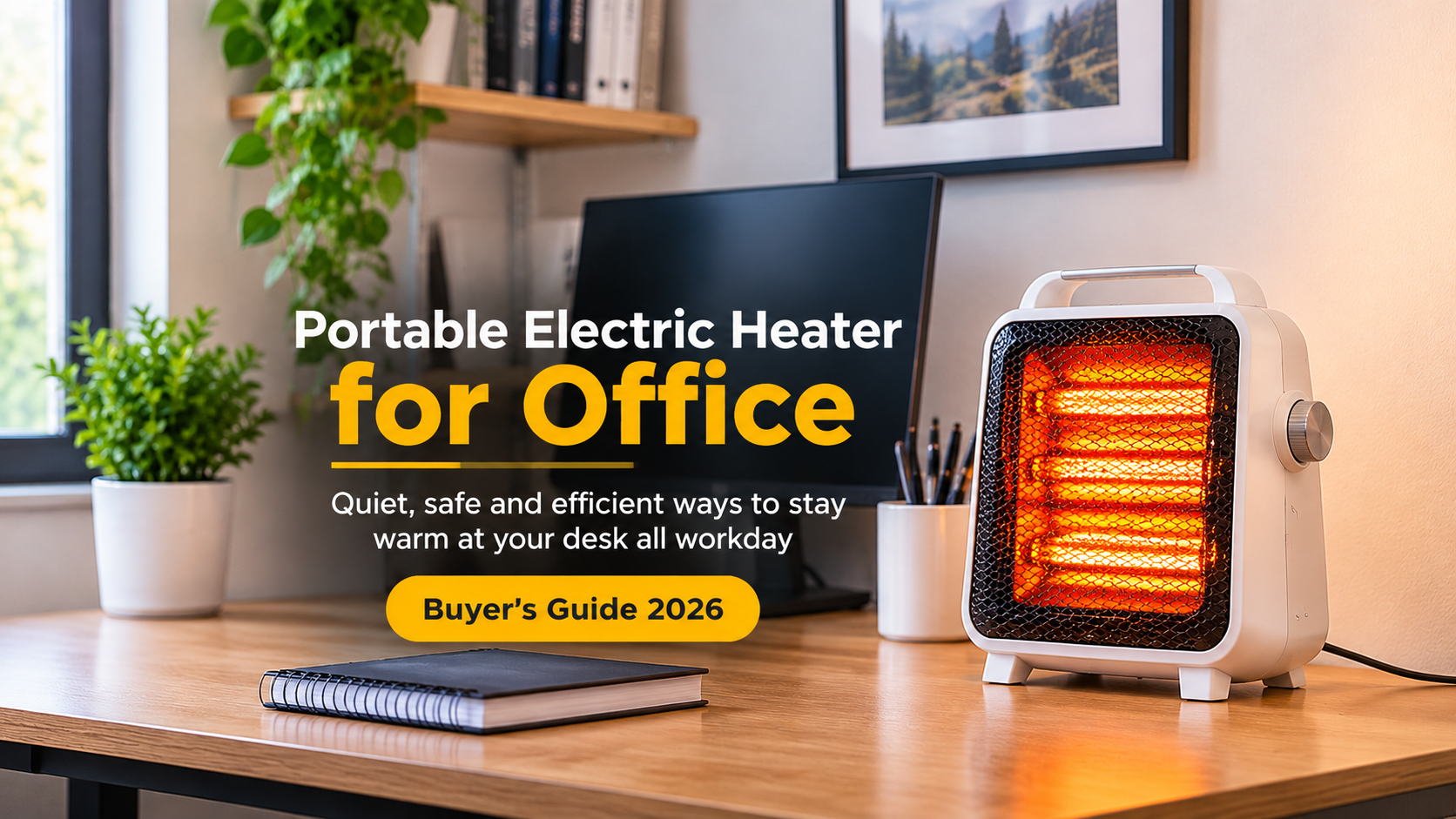

An office that is too cold hurts more than comfort. Stiff fingers make typing harder, cold feet make it difficult to concentrate, and a shivering workday can drag down both mood and productivity. The trouble is that office thermostats are rarely under your control, and what feels fine to one person can feel freezing to another. That is why a portable electric heater for the office has become a desk-side essential for so many people.
An office is a special case, though. You need a heater that is quiet enough for calls, compact enough for a crowded desk, safe around papers and cables, and allowed by your building’s rules. This guide covers how to choose the right size and type, which safety features matter, how much running costs add up to and how to use a heater responsibly at work.
Key takeaways
- Check your workplace policy first. Many offices restrict or ban personal heaters.
- For a cubicle or desk, a low-wattage under-desk or personal heater is usually enough. A private office of about 100 square feet needs around 1,000 W.
- Quiet operation, automatic shut-off, tip-over protection and overheat protection are the key features for offices.
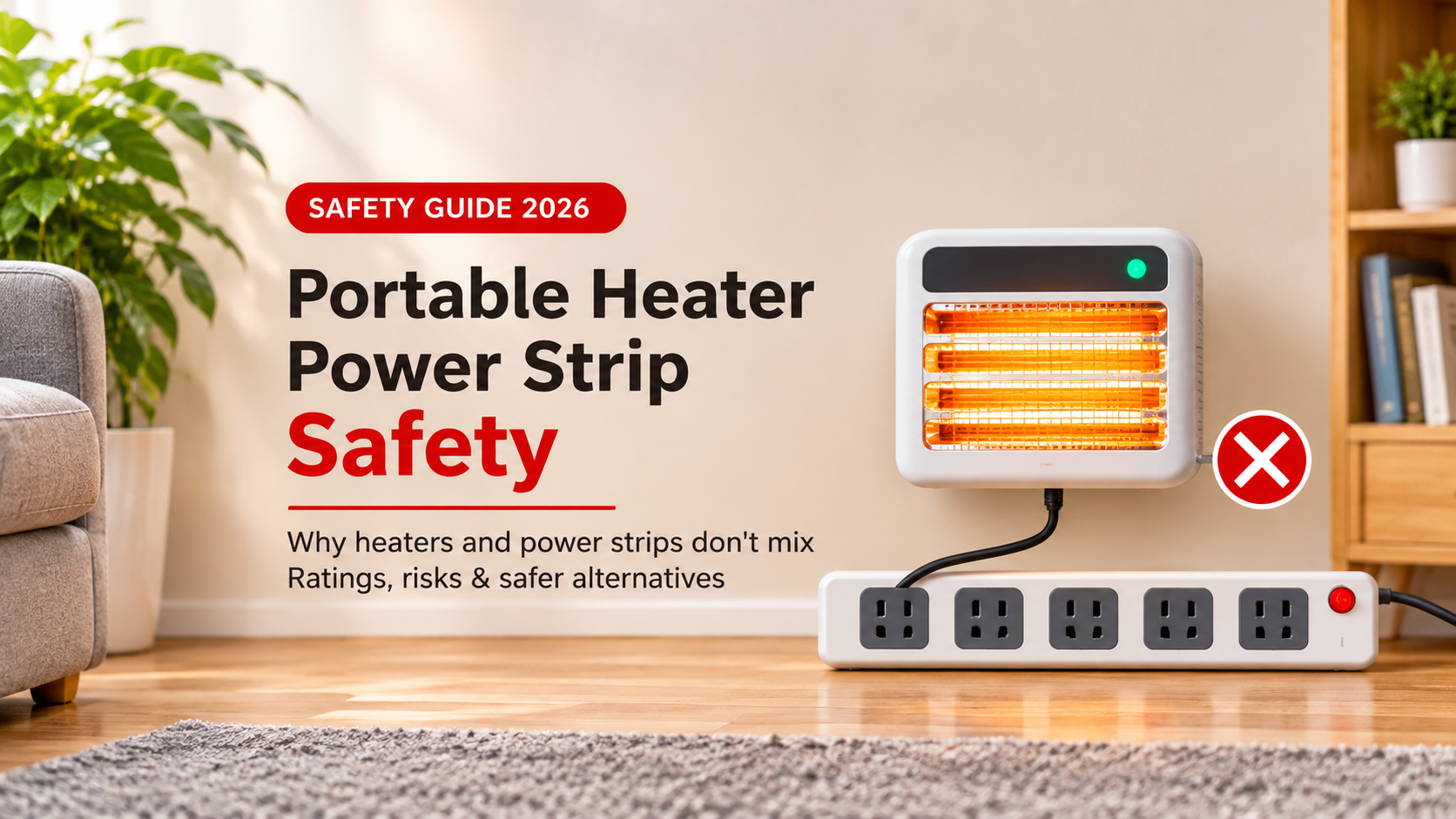
- Plug the heater straight into the wall, never a power strip, and keep paper and clutter well clear.
- A low-power desk heater can cost only a few cents per hour to run.
Check your workplace rules first
Before you buy, find out whether you are allowed to use a personal heater at work. Many companies, landlords and building managers restrict them for fire-safety and electrical reasons. Shared circuits in offices can also trip if too many high-power devices run together.
- Ask your facilities manager, office manager or building management about heater policy.
- Ask whether there are limits on wattage, or an approved-product requirement.
- Ask whether the heater must have specific safety certifications.
- If heaters are not allowed, ask whether the building can adjust the temperature or provide a supplied option.
Working from a home office is different, because the rules are yours to set. Even so, the same safety habits apply, so it is worth reading on.
How much power does an office heater need?
The right wattage depends on how much space you want to warm. For a whole small room, plan on about 10 watts per square foot. For a single desk, you do not need to heat the room at all. You only need to warm yourself.

Desk and cubicle
If you share an open-plan office or work in a cubicle, a compact personal heater or under-desk unit is the practical choice. Low wattage keeps it unobtrusive, easy on shared circuits and more likely to be accepted by office management.
Small private office
A private office of about 100 square feet is a good match for a heater of about 1,000 W. A 1,500 W model, the maximum most standard outlets can supply, covers rooms up to roughly 150 square feet, with a thermostat to cycle it off when the room is warm.
Best types of portable heaters for an office
All plug-in electric heaters convert nearly all of their electricity into heat, so none is meaningfully more efficient than another in raw terms. What matters in an office is how quietly it works, how fast you feel warm, and how much desk or floor space it takes.
| Heater type | How it heats | Best office use | Trade-off |
|---|---|---|---|
| Under-desk heater | Compact radiant unit aimed at legs and feet | Cold feet at a desk; shared offices where a low-power unit is acceptable | Warms one person, not the room |
| Personal desktop ceramic heater | Small fan pushes warm air toward you | Fast warmth for hands and upper body in a cubicle | Fan hum can be noticeable on calls |
| Infrared (radiant) heater | Invisible rays warm you and nearby objects | Quick spot warmth, works even in drafty spaces | Only warms what it faces |
| Panel or convection heater | Air circulates gently over a flat heated panel | Quiet, slim heat for private offices and home offices | Medium heat-up speed |
| Small oil-filled radiator | Heated oil warms fins that radiate steady heat | Silent, steady warmth in a small private office | Slow to heat; bulky and heavy |

Under-desk heaters: warm feet, low power
Cold feet make everything feel colder. An under-desk heater sits near your legs and feet, tends to be quiet, and uses relatively little power. It is a popular pick for shared and open-plan offices because it warms you rather than the room.
Personal ceramic heaters: fast and compact
A small ceramic heater on or near the desk can warm your hands and upper body in seconds. Fan noise can be a drawback on calls, so check for a quiet mode and keep it pointed at you, not at your papers.
Infrared heaters: instant warmth where you sit
Infrared heaters warm people and objects directly. They work well in drafty spaces and in spots where the air is constantly moving, though they do not raise the temperature of the whole room.
Panel and oil-filled heaters: steady warmth for private rooms
If you have a private or home office, a slim panel heater or a small oil-filled radiator offers quiet, even warmth. They are slower to heat up, but they cycle off quietly and suit long working hours.
Must-have features for office heaters
- Tip-over switch: cuts power automatically if the heater is knocked over.
- Overheat protection: shuts the unit down if it gets too hot.
- Adjustable thermostat: holds a steady temperature and prevents wasted power.
- Auto shut-off timer: turns the heater off if you forget when leaving for a meeting or at the end of the day.
- Low noise or fanless design: keeps calls and concentration undisturbed.
- Compact footprint: fits under a desk or beside a cubicle wall without blocking walkways.
- Cool-touch housing: reduces burn risk in a busy space.
- Safety certification: look for a mark from a recognized testing laboratory on the product or packaging.
- Cord length and plug quality: choose a cord that reaches the wall outlet without an extension cord.
Office heater safety rules
- Plug the heater directly into a wall outlet. Power strips and extension cords can overheat under a heater’s load.
- Keep paper, cardboard, clothing and cables well away from the heater.
- Never leave a heater running unattended. Switch it off when you step away for long, and at the end of the day.
- Place it on a hard, flat surface, never on a chair, box or carpet pile.
- Keep the cord out of walkways so nobody trips on it.
- Do not cover the heater or block its vents.
- Stop using the heater and have it checked if the plug is hot, the cord is damaged or it gives off a burning smell.
How to set up a heater at your desk

- Point the heater toward you rather than at a wall, shelf or stack of files.
- Leave space on all sides so air can move freely.
- Use the lowest setting that keeps you comfortable.
- Switch it off when you leave the desk for more than a short break.
How much does it cost to run an office heater?
Use this formula to estimate running cost:
Cost = (Watts ÷ 1,000) × Hours of use × Price per kWh
The table assumes an example electricity price of $0.16 per kWh and full power for the whole day. Swap in your own rate to see your actual numbers.
| Heater power | Cost per hour | Cost for an 8-hour workday | Cost for 22 workdays |
|---|---|---|---|
| 200 W | $0.03 | $0.26 | $5.63 |
| 400 W | $0.06 | $0.51 | $11.26 |
| 750 W | $0.12 | $0.96 | $21.12 |
| 1,500 W | $0.24 | $1.92 | $42.24 |

If you pay for your own electricity, for example in a home office, a thermostat will usually bring the real number below the worst case. If your employer pays the bill, remember that a heater adds to shared costs, which is another reason a low-wattage, targeted unit is the considerate choice.
Other ways to stay warm at your desk
- Dress in layers so you can adjust easily through the day.
- Use a warm drink and keep a blanket or wrap in a drawer.
- Add a foot rest or mat to insulate your feet from a cold floor.
- Block drafts near your desk, such as a gap under a door, if you are allowed to.
- Move your desk away from windows and vents if possible.
- Talk to your facilities team if the whole area is consistently too cold. A thermostat adjustment may solve it for everyone.
Office heater buyer’s checklist
- Workplace approval and any wattage limits confirmed
- Wattage matched to your space (desk, cubicle or private office)
- Quiet operation, ideally fanless or with a low-noise mode
- Adjustable thermostat and auto shut-off timer
- Tip-over and overheat protection
- Compact, stable footprint
- Recognized safety certification
- Cord long enough to reach the wall without a power strip
- Clear warranty and support
Frequently asked questions
What is the best portable heater for a small office?
For a private office of about 100 square feet, a 1,000 W panel or oil-filled heater gives quiet, steady warmth. For a cubicle or open-plan desk, a low-wattage under-desk or personal ceramic heater is usually the best fit.
Are space heaters allowed in offices?
It depends on your employer and building. Many workplaces restrict or ban personal heaters for fire-safety and electrical-load reasons, so ask your facilities or office manager before buying or using one.
Is an under-desk heater worth it?
If cold feet are your main problem, yes. Under-desk heaters are compact, relatively quiet and use little power, because they warm you directly instead of the whole room.
How much electricity does an office heater use?
It depends on the wattage. A 200 W desk heater uses about 0.2 kWh per hour, while a 1,500 W heater uses 1.5 kWh per hour at full power. At an example rate of $0.16 per kWh, those cost about $0.03 and $0.24 per hour.
Can I plug a heater into a power strip at work?
No. Heaters draw a lot of power, and power strips and extension cords can overheat. Plug the heater directly into a wall outlet.
Are portable heaters noisy?
Fanless models, such as panel, infrared and oil-filled heaters, are nearly silent. Fan-forced ceramic heaters are louder, so look for a quiet mode if you take calls.
Should I leave my heater on when I leave my desk?
No. Turn it off when you step away for longer than a short break, and always at the end of the day. An auto shut-off timer is a helpful backup.
What wattage heater is best for an office?
For a single desk, a heater in the low hundreds of watts is often enough. For a small private office, about 1,000 W suits 100 square feet, and 1,500 W suits up to about 150 square feet.
Final thoughts
The best portable electric heater for an office is quiet, compact, correctly sized and full of safety features. Check your workplace rules first, choose low wattage for a desk or cubicle, step up to a panel or oil-filled model for a private room, and make sure it has tip-over protection, overheat protection and a thermostat.
Pair it with good habits, such as plugging directly into the wall, keeping the area clear and switching off when you leave, and you can stay warm and focused all day without safety worries or a surprise on the electricity bill.