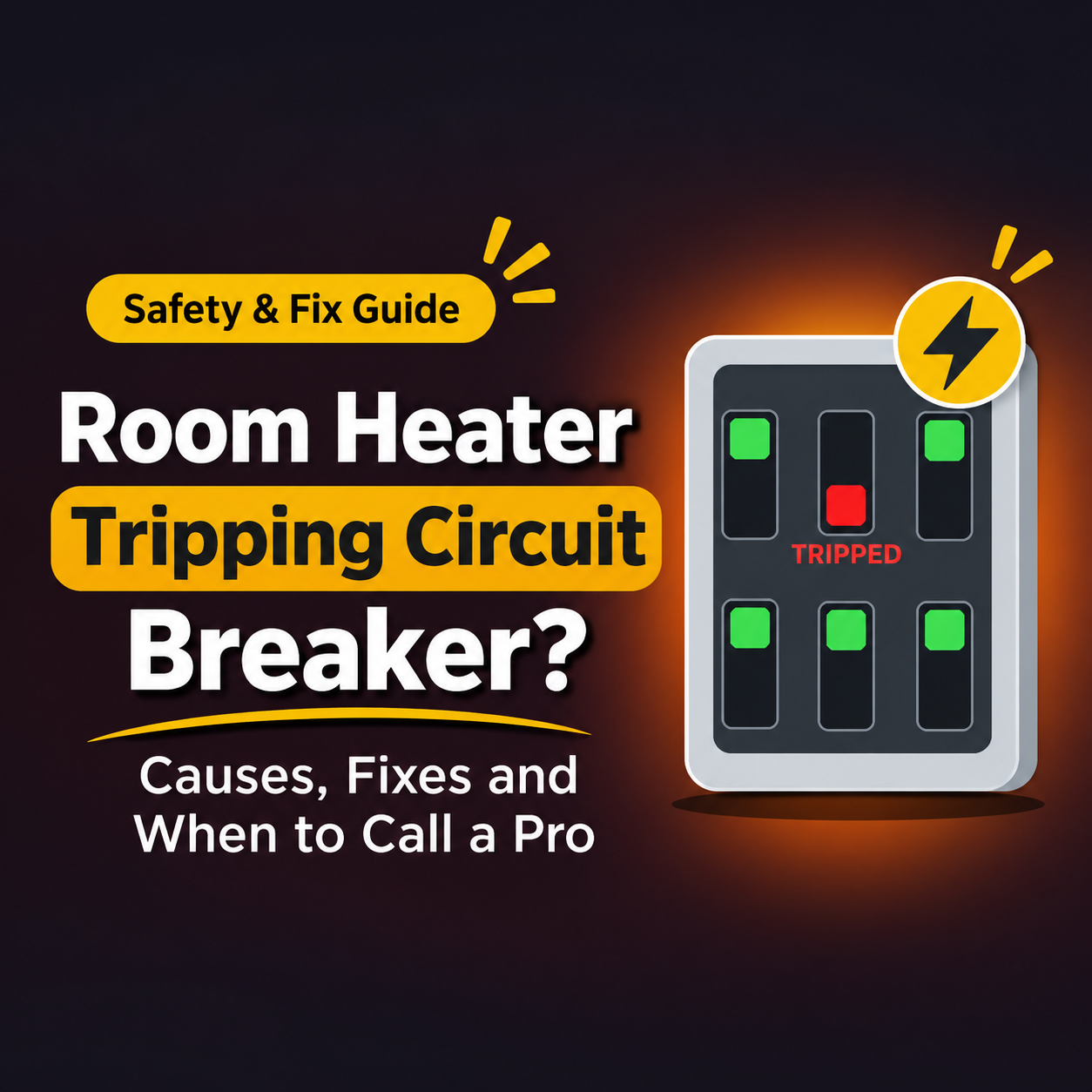
You turn on your room heater, enjoy the warmth for a few minutes, and then everything goes dark. The breaker has tripped again. A room heater tripping the circuit breaker is one of the most common winter electrical problems, and it can be annoying and a little worrying at the same time.
The good news is that a tripping breaker is a safety feature doing its job. It cuts power to protect your wiring from overheating. In most cases the cause is easy to understand and often easy to fix, but sometimes it points to a real electrical fault that should not be ignored. This guide explains why heaters trip breakers, how to find the cause, what you can safely do yourself, and when to call a licensed electrician.
Why a Room Heater Trips the Circuit Breaker
A circuit breaker is a switch that opens automatically when too much current flows through a circuit, or when current flows where it should not. Room heaters are among the highest-power appliances you can plug into a normal outlet, so they push a circuit close to its limit more easily than most devices.
There are three main ways a breaker trips:
- Overload: Too many watts are being used on one circuit.
- Short circuit: Live and neutral wires touch each other, causing a sudden surge of current.
- Ground fault: Current leaks to the ground or to a person through a damaged part or moisture.
The Math: How Much Power Does a Heater Use?
Most portable room heaters are rated at 1500 watts on a standard 120-volt household circuit. You can find the current (amps) a heater draws with a simple formula:
Amps = Watts ÷ Volts
For example, a 1500-watt heater on 120 volts draws 12.5 amps. In areas with 230-volt supply, the same 1500 watts draws only about 6.5 amps, which is why overload trips happen less often there.
A typical 15-amp household breaker is designed to carry no more than 80 percent of its rating continuously, which is about 12 amps. A 1500-watt heater is already slightly above that limit by itself, so any extra device on the same circuit can easily cause a trip.
10 Common Reasons a Room Heater Keeps Tripping the Breaker
1. Too Many Devices on the Same Circuit
Bedrooms, living rooms, and offices often share one circuit with lights, TVs, chargers, and other plugs. When a heater is added, the total load goes over the limit. Try running the heater alone on the circuit, or move it to a different room’s outlet.
2. Using an Extension Cord or Power Strip
Thin extension cords and ordinary power strips are not designed for heaters. They can overheat, cause voltage drop, and trip the breaker. Plug the heater straight into a wall outlet.
3. Heater Wattage Is Too High for the Circuit
A 2000-watt heater on an old or low-rated circuit will trip more often than a 1000- or 1500-watt model. Check the wattage on the label and compare it to your circuit rating.
4. Damaged or Worn Power Cord
Cracks, kinks, or crushed sections in the cord can cause a short circuit. Look for melted plastic, bare wire, or discoloration. A damaged cord means the heater should not be used until it is replaced or repaired properly.
5. Faulty Plug or Loose Outlet Connection
A loose plug or worn outlet creates resistance and heat. If the plug or wall plate feels warm or has brown marks, stop using that outlet and have it inspected.
6. Short Circuit Inside the Heater
Dust, worn insulation, or loose internal wires can touch and cause a short. In this case the breaker trips almost instantly when you plug in or switch on the heater.
7. Damaged Heating Element
A cracked or partly broken element can leak current to the metal body or draw too much power. This can lead to a ground fault or a sudden trip when the heater warms up.
8. Moisture or Humidity
Water or very high humidity inside the heater or outlet allows current to leak. This commonly trips GFCI outlets in bathrooms, basements, and garages. Never use a standard heater in wet areas.
9. Dust and Blocked Vents Causing Overheating
Dirty vents and a clogged air intake cause overheating, which can trigger internal safety parts and sometimes stress the circuit. Clean the heater regularly.
10. Worn Out or Faulty Breaker
Breakers do wear out, especially if they have tripped many times. If your breaker trips even when the load is low, or feels hot or loose, it may need to be replaced by a licensed electrician.
Step-by-Step: How to Find the Cause
- Unplug the heater and reset the breaker. If it trips again with nothing plugged in, the problem is in the house wiring or the breaker, so call an electrician.
- Remove other devices from the circuit and test the heater alone.
- Plug directly into the wall. Do not use extension cords or power strips.
- Observe when it trips. An instant trip usually means a short circuit or ground fault. A trip after several minutes usually means overload or overheating.
- Inspect the cord and plug for damage, heat marks, or melted spots.
- Clean the vents after the heater has fully cooled.
- Try a different circuit, such as another room, to see if the problem follows the heater.
- Lower the setting. Use a lower-wattage mode if the heater has one.
Does It Trip Right Away or After a While?
| When It Trips | Likely Cause | What to Do |
|---|---|---|
| Instantly when plugged in | Short circuit in cord or heater | Stop use, inspect or replace |
| Instantly when switched on | Faulty switch, element, or wiring | Repair by a technician or replace |
| After 2 to 10 minutes | Overload or shared circuit | Dedicated circuit, remove other loads |
| After an hour or more | Heat build-up or aging breaker | Clean heater, check breaker |
| Only in damp areas | Ground fault (GFCI) | Do not use in wet rooms |
| Even with no load | Bad breaker or house wiring | Call a licensed electrician |
What About GFCI and AFCI Breakers?
Many homes have special breakers or outlets that trip more easily than a standard breaker:
- GFCI (Ground Fault Circuit Interrupter): Detects tiny current leaks, usually near water. If a GFCI trips with your heater, check for moisture, a damaged cord, or an element fault.
- AFCI (Arc Fault Circuit Interrupter): Detects dangerous electrical arcing. It may trip when a cord or plug is worn or loose.
These devices are there for your protection. If your heater trips one repeatedly, treat it as a warning and do not bypass it.
How to Stop the Breaker from Tripping
- Give the heater its own circuit whenever possible.
- Choose a lower-wattage heater (for example, 900 to 1200 watts) if your wiring is old or shared.
- Do not run other high-power devices like hair dryers, kettles, irons, or microwaves at the same time.
- Use the thermostat and eco mode so the heater cycles on and off instead of running at full power all the time.
- Warm the room, not the whole house: A small heater in a closed room works better and draws less power than a big heater in a large open space.
- Keep the heater clean and inspect the cord at the start of every winter.
- Consider an oil-filled or ceramic heater with adjustable power levels for more control over load.
When to Call an Electrician
Some problems are not DIY jobs. Call a licensed electrician if:
- The breaker trips even with nothing plugged in.
- The breaker feels hot, buzzes, or will not stay reset.
- You notice a burning smell, scorch marks, or flickering lights.
- The outlet or wall plate is hot, discolored, or melted.
- Your home has older wiring or aluminum wiring.
- You want a dedicated circuit installed for a heater.
Repair or Replace the Heater?
If the cause is overload or a bad outlet, the heater is usually fine. If the heater itself has a short circuit, a damaged cord, or a cracked element, replacing it is often safer and cheaper than repair, especially for older or low-cost models. A heater older than 5 to 7 years that trips instantly should be retired.
What to Look for in a New Room Heater
- Adjustable wattage settings: Models with 600, 900, and 1500 watt levels give you control over the load.
- Built-in thermostat: Cycles the heater on and off to save energy and reduce continuous load.
- Safety features: Tip-over shutoff, overheat protection, and a cord with a good-quality plug.
- Right size for the room: A common guide is about 10 watts per square foot of floor space.
- Quality certification marks from recognized safety organizations.
- Energy-efficient types: Oil-filled and ceramic heaters with timers help keep running costs down.
Frequently Asked Questions
Why does my heater trip the breaker as soon as I turn it on?
An instant trip usually means a short circuit or ground fault in the heater, cord, or plug. Stop using it and have it checked or replaced.
Is it safe to keep resetting the breaker?
Resetting once or twice to test is fine. Repeated resetting without finding the cause is risky, because the breaker is warning you about overload or a fault.
Can a heater trip the breaker even if it is not overloaded?
Yes. A short circuit, ground fault, damaged cord, moisture, or a faulty breaker can cause a trip even when the load is low.
How many watts can a 15-amp breaker handle?
At 120 volts, a 15-amp breaker is rated for 1800 watts, but for continuous loads like heaters, a safe limit is about 1440 watts (80 percent). That is why a 1500-watt heater often struggles on a shared circuit.
Should I use an extension cord with my heater?
It is best not to. If you must, use a short, heavy-duty cord rated for the heater’s wattage, and never use a power strip or coiled cord.
Does an old breaker trip more easily?
Yes. Breakers can weaken after many trips or years of use. If the breaker trips with normal loads, have an electrician test it.
Will a lower-wattage heater stop the tripping?
Often yes, if overload is the cause. A 1000-watt heater draws much less current than a 1500-watt model and is easier on shared circuits.
Final Thoughts
A room heater tripping the circuit breaker is the electrical system asking for attention. In many homes, the fix is simple: plug the heater directly into a wall outlet, avoid sharing the circuit with other devices, and choose a heater with a suitable wattage. If the breaker trips instantly, trips with no load, or you notice heat, smell, or damage, stop using the heater and get a qualified electrician involved.
Put safety first, never bypass a breaker, and keep your heater clean and in good condition. With the right setup, you can enjoy a warm, comfortable room all winter without the frustration of sudden blackouts.