






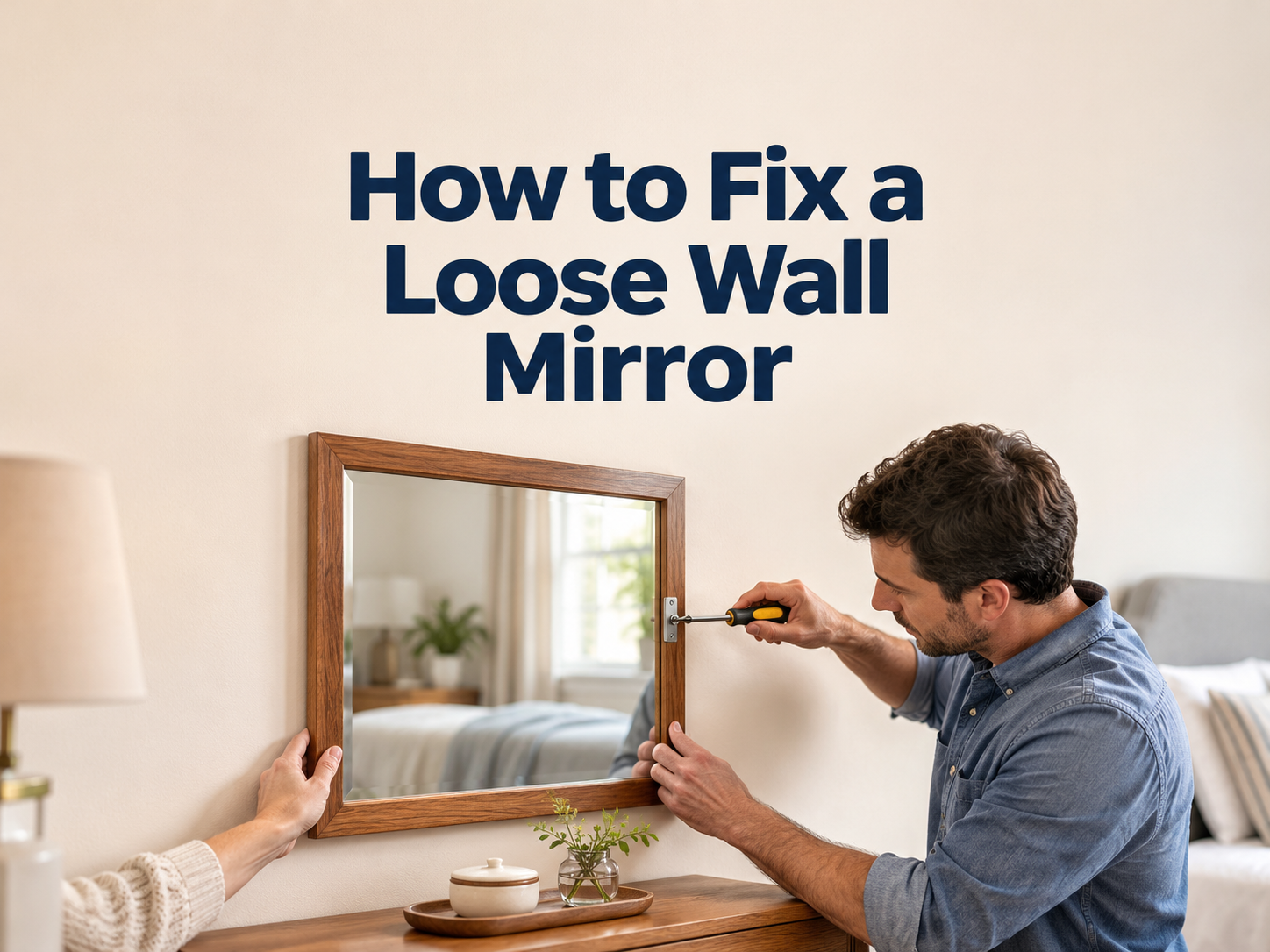

A wall mirror that wobbles, leans to one side or slowly slides down the wall is more than an annoyance. Glass is heavy, and a mirror that is loose today could fall tomorrow. The good news is that most loose mirrors can be fixed in under an hour with basic tools, as long as you identify the real cause first.
In this guide you will learn how to fix a loose wall mirror properly: how to diagnose the problem, which repairs match each cause, how to repair a stripped screw hole, which anchors to trust and when to stop and call a professional.
In this article
- Safety first: before you touch the mirror
- Why wall mirrors come loose
- Match the symptom to the cause
- Tools and materials
- Fixes for the most common problems
- How to repair a stripped screw hole
- Choosing the right wall fixing
- Special cases: clips, adhesive and floor mirrors
- Common mistakes, prevention and FAQs
Safety First: Before You Touch the Mirror
A loose mirror is already unstable, so treat it with care. Do not try to push it back into place or hang from it to test it. Keep the following in mind before you begin:
- Get a helper. Taking a mirror off the wall is a two-person job, even for a medium-sized piece.
- Protect yourself. Wear gloves and closed shoes, and keep your face away from the glass in case it shifts.
- Clear the floor. Remove anything that could trip you and lay down a blanket or cardboard to rest the mirror on.
- Do not stand under it. If the mirror looks ready to fall, support it with one person at each side before anything else.
- Check for cracks. If the glass is cracked, chipped or the backing is damaged, handle it carefully and consider replacing the mirror.
Important
If the mirror is very large, frameless, antique or fixed to the wall with adhesive, do not attempt to remove it yourself. Ask a glazier or a qualified handyman for help.
Why Do Wall Mirrors Come Loose?
Mirrors rarely loosen for no reason. Something has changed in the wall, the hardware or the way the weight is carried. Knowing the cause tells you which repair will last.

1. Weak or Stripped Holes
Drywall and plaster are soft. Over time, screws can wear away the material around them, leaving a hole too wide to grip. When you feel a screw turning without tightening, this is almost certainly the problem.
2. Using the Wrong Anchors
Basic plastic plugs are designed for light loads. A glass mirror can overwhelm them, which makes them slowly pull out of the wall. If your mirror was hung with small plugs, they are a likely culprit.
3. Loose Hanging Hardware
On a framed mirror, the D-rings, hanging plates or wire on the back can loosen over time. The screws holding them to the frame may have backed out, or the wire may have stretched or frayed.
4. Relying on a Single Hook
A single hook lets the mirror pivot. Every bump, door slam or accidental knock can tilt it a little further, until it hangs crooked or slips off.
5. Failed Adhesive
Mirrors stuck up with adhesive strips or glue can let go as the adhesive ages or reacts to heat, steam and damp. Adhesive is particularly unreliable in bathrooms and sunny rooms.
6. Bumps, Vibration and Everyday Wear
Slamming doors, children, pets and even traffic vibration can slowly loosen fixings. A mirror in a busy hallway is more at risk than one in a quiet bedroom.
Match the Symptom to the Cause
Look at how the mirror behaves. The symptom usually points straight to the cause, so you can fix the real problem rather than just tightening a screw that is not the issue.

Tools and Materials You Will Need

- Screwdriver and drill to tighten, remove and re-drill fixings.
- Stud finder to locate solid wood to anchor into, and to check for wires and pipes.
- Spirit level so the mirror ends up straight.
- Replacement anchors or screws rated well above the mirror weight.
- Wall filler, sandpaper and paint for patching old holes.
- Rubber bumpers to keep the bottom of the mirror steady.
- Painter’s tape and a pencil for marking positions.
- A second person for lifting and steadying.
Fixes for the Most Common Problems

Fix 1: Hooks and Wire (Mirror Tilts or Swings)
If a framed mirror leans to one side, the wire may have slipped or the hook may be too small. Take the mirror down and look at the back. Replace stretched or frayed wire with a stronger one, or better still, switch to two D-rings and two wall fixings so the load is shared and the mirror cannot pivot. Tighten the screws that hold the D-rings to the frame, and make sure those screws are not stripping out of the wood. Finally, add rubber bumpers to the bottom corners to stop it moving.
Fix 2: A Stripped Drywall Hole
Move the fixing to a stud if possible, or fit a toggle bolt or similar heavy-duty anchor. The full repair is covered in the next section.
Fix 3: A Spinning or Loose Anchor
If the anchor itself rotates in the wall, it has lost its grip. Do not keep tightening it. Unscrew it, remove it carefully, and replace it with a bigger or stronger anchor suited to the load. Never reuse an anchor that has already pulled loose.
Fix 4: Loose Mirror Clips
Frameless mirrors are often held by small clips at the top and bottom. Tighten the clip screws gently, because over-tightening can crack the glass. If a clip is bent, worn or has lost its grip, replace it. Check that the bottom of the mirror rests on a support, such as a channel or ledge, rather than hanging only from the clips.
Fix 5: Loose Frame Corners
If the frame itself is coming apart, the mirror can twist and look loose even when the wall fixings are sound. Wood glue on the joints and small metal corner braces on the back can restore rigidity. Work with the mirror lying flat and supported, with the face protected.
Fix 6: An Adhesive-Mounted Mirror
If the mirror is stuck directly to the wall with adhesive, do not simply press it back. Adhesive that has failed will not recover, and stuck-on glass can be dangerous to remove. Support the mirror with clips and a bottom ledge, and ask a glazier or a professional for advice on re-fixing it.
How to Repair a Stripped Screw Hole Step by Step
This is the most common reason a mirror is loose, so it deserves a full walkthrough.

Step 1: Take the Mirror Down
With a helper, lift the mirror off its hooks and rest it on a blanket or cardboard against a wall or on the floor, with the glass facing inward and protected. Never lean it on a hard edge.
Step 2: Remove the Old Anchor and Debris
Pull out the old screw and anchor. Clear crumbs of drywall or plaster from the hole and the area around it. If the surrounding wall is cracked or crumbling, plan to move the fixing to a new spot.
Step 3: Choose a New Fixing Point
The best fix is to move the fixing so it goes into a stud. Use a stud finder, mark the stud, and drive screws long enough to bite properly into the wood. If no stud lines up, use a toggle bolt or snap-toggle anchor rated for much more than the mirror’s weight, and use two or more fixings to spread the load. Scan for wires and pipes before drilling.
Step 4: Patch the Old Hole
Fill the abandoned hole with wall filler, let it dry as directed, sand it smooth and touch up the paint. For small holes in light-duty situations some people press wooden toothpicks and glue into the hole, but that is not strong enough for a heavy mirror. Use proper anchors or studs instead.
Step 5: Rehang, Level and Test
Fit the new hardware, then lift the mirror back into place with your helper. Check it with a level, add bumpers to the bottom corners, and test it with a gentle tug. If anything moves, take it down and fix the issue before you walk away.
Choosing the Right Wall Fixing
A fix is only as good as the fixing behind it. Here is how common options compare when they carry the weight of a mirror.

Whichever you choose, read the load rating on the pack. Those numbers are tested in ideal conditions, so choose hardware rated at least two to three times the weight of the mirror. If you do not know the weight, estimate it: 1/4 inch (6 mm) mirror glass weighs about 3 pounds per square foot (roughly 15 kg per square metre) before the frame is added, and frames can add a lot more.
Rule of thumb
Whenever you can, screw into studs. Use toggle anchors only where studs are not available, and avoid plastic expansion plugs for any glass mirror.
Special Cases
Brick or Concrete Walls
If anchors in a masonry wall have loosened, remove them and check the hole. Use a hammer drill with the correct masonry bit and install sleeve anchors or masonry screws as the maker instructs. Avoid drilling into crumbling mortar.
Plaster and Lath
Old plaster is brittle. Find the studs behind it where possible and use toggles with care otherwise. Drill small pilot holes slowly, and avoid hammering.
Leaning Floor Mirrors
A tall mirror that slips or wobbles against the wall needs an anti-tip strap or bracket fixed into a stud. Use non-slip pads under the bottom edge as well, and keep it away from busy walkways.
Bathroom Mirrors
Steam and damp weaken adhesives and can corrode cheap fixings. Use stainless or corrosion-resistant hardware, and keep liquid away from the mirror edges.
Common Mistakes to Avoid
- Over-tightening screws. It can strip the hole or crack the glass or frame.
- Reusing a loose anchor. It has already failed once.
- Using one hook for a heavy mirror. Two points are safer and stop tilting.
- Using sticky strips as a repair. They are not suitable for heavy glass.
- Skipping the stud finder. Hitting a pipe or wire is dangerous.
- Doing it alone. Dropping a mirror is how most accidents happen.
- Ignoring damage to the wall. Repair crumbling areas before re-fixing.

How to Stop a Mirror from Coming Loose Again
- Fix into studs wherever you can, and use rated anchors where you cannot.
- Use two hanging points rather than one.
- Add rubber bumpers at the bottom corners.
- Check hardware once or twice a year, and tighten anything that has backed out.
- Keep the mirror away from slamming doors and heavy traffic areas.
- Use corrosion-resistant fixings in damp rooms.
When to Call a Professional
Some jobs are not worth the risk. Contact a qualified handyman, installer or glazier if:
- The mirror is very large, heavy, frameless or antique.
- It is stuck to the wall with adhesive.
- The wall is crumbling, damp or has hidden services behind it.
- The glass is cracked or the backing is damaged.
- The mirror hangs above a bed, a cot or a seating area.
Frequently Asked Questions
Why does my wall mirror keep tilting?
Most often it is hanging from a single hook or a stretched wire. Switching to two hanging points and adding rubber bumpers at the bottom normally stops it.
Can I fix a loose mirror without taking it down?
You can tighten visible clips or add bumpers in some cases, but if the wall fixing is the problem, you should take the mirror down. Repairing it while it hangs is risky.
How do I fix a screw that keeps spinning in the wall?
The hole has lost its grip. Remove the screw, move the fixing to a stud or use a heavy-duty toggle anchor, and patch the old hole.
Can I use glue or toothpicks to fix a stripped hole?
That can work for very light items, but it is not strong enough for a glass mirror. Use proper anchors or screw into a stud.
What is the best anchor for a heavy mirror in drywall?
Screws into a stud are best. If there is no stud, a toggle or snap-toggle anchor with a high load rating is a better choice than plastic plugs. Use several points and stay well within the rated load.
Is it safe to leave a loose mirror on the wall?
It is not a good idea. If the mirror moves, makes noise or shows a gap behind it, take it down or support it until it is repaired.
How often should I check my wall mirrors?
Give them a quick check once or twice a year, and after anything that might have knocked them. Look for tilt, gaps, wobble and any cracks in the wall near the fixings.
Final Thoughts
Fixing a loose wall mirror is a matter of working out why it moved and fixing that cause, not just tightening whatever is nearest. Replace weak anchors, anchor into studs where you can, use two hanging points and finish with bumpers and a level. Be honest about your limits: for big, antique or adhesive-mounted mirrors, bring in a professional.
Take your time, work with a helper and test the mirror before you trust it. A secure mirror looks better, lasts longer and keeps everyone in the room safe.