








A large mirror can transform a bedroom. It bounces light around, makes the room feel bigger and adds a strong design statement. It is also one of the heaviest and most fragile things you will ever hang on a wall. A mirror that falls can injure someone and costs far more than the hardware that would have kept it up.
The good news is that hanging a heavy mirror safely is very achievable if you follow the right process. This guide explains how to hang a heavy bedroom mirror safely: how to work out the weight, choose the right fixings for your wall, hang it level and test it before you trust it.
In this article
- How heavy is your mirror?
- Choosing the right fixing for your wall
- Tools and materials you will need
- Where to hang the mirror
- Four ways to hang a heavy mirror
- Step-by-step instructions
- Special cases: above the bed, frameless and leaning mirrors
- Common mistakes and a final safety checklist
- Frequently asked questions
Step Zero: Find Out How Heavy Your Mirror Really Is
Every safe installation begins with a number. If you do not know the weight, you cannot choose hardware with confidence. Mirror glass is surprisingly dense. As a rough guide, 1/4 inch (6 mm) mirror glass weighs around 3 pounds per square foot (about 15 kg per square metre) before the frame is added.

These figures are for the glass only. Solid wood, metal and ornate frames can add a significant amount, so the real weight is often much higher. The easiest way to be sure is to weigh it. Stand on a bathroom scale holding the mirror and subtract your own weight, or ask a helper to do it. If the mirror came with a label or a product page, check the stated weight and the maker’s hanging instructions.
Rule of thumb
Choose hardware rated for at least two to three times the weight of the mirror. Load ratings on packaging are measured in ideal conditions, so a generous safety margin protects you if the wall is not perfect.
Know Your Wall Before You Buy Hardware
The wall decides which fixing is safe. Hardware that is perfect for brick may be useless in drywall, and the reverse is also true. Take a moment to work out what is behind the surface.

Wood Studs: The Best Option
Studs are the vertical timbers inside a standard framed wall. Screwing straight into them gives the strongest hold. In many homes studs are spaced about 16 inches (40 cm) apart, center to center, though some walls use 24 inches (60 cm). A good-quality stud finder locates them quickly, and tapping the wall and listening for a solid sound can confirm the result.
Drywall With No Stud Behind
Plasterboard or drywall alone is not strong enough to hold a heavy mirror with ordinary plugs. If a stud is not available where you need it, use heavy-duty toggle bolts or snap-toggle style anchors, which spread the load over a wider area behind the board. Use several fixings rather than relying on one.
Plaster and Lath
Older homes often have plaster over thin wooden strips. This material is brittle and can crack when drilled. Locate the studs behind it if you can, and use toggles with care if you cannot. Drill small pilot holes slowly and avoid hammering.
Brick and Concrete
Masonry walls are very strong but need the right tools. Use a hammer drill with a masonry bit and suitable sleeve anchors or masonry screws. Always check the anchor rating and the minimum depth the manufacturer recommends. Do not drill into mortar joints that are crumbling.
Metal Studs
Some modern commercial-style walls use metal studs. Plain wood screws do not hold well in them. Use fixings designed for metal studs and follow their rated load.
Tools and Materials You Will Need

- Stud finder: ideally one that also detects live electrical wires and metal pipes.
- Drill and drill bits: a hammer drill with masonry bits for brick or concrete.
- Spirit level: long enough to check the full width of the mirror.
- Tape measure and pencil: for accurate marking.
- Painter’s tape: to mark positions without marking the paint.
- Rated hardware: D-rings, hanging plates, French cleat, screws or anchors, each rated well above the mirror weight.
- A second person: essential for lifting, positioning and steadying.
Where Should You Hang a Bedroom Mirror?
Planning the position first saves you from drilling extra holes. A few simple rules make most rooms look balanced.

- Center it at eye level. Many designers aim for the center of the mirror to sit about 57 to 60 inches (145 to 152 cm) from the floor. For a tall floor-style wall mirror, make sure the bottom edge is also at a comfortable, safe height.
- Leave space above furniture. Keep a gap of roughly 5 to 10 inches (12 to 25 cm) above a dresser or headboard so it does not feel crowded.
- Avoid heavy traffic spots. Do not hang a mirror where a door, a chair or a person could knock it.
- Think about light. A mirror opposite a window brightens a room, but intense direct sun can cause glare.
- Check behind the wall. Stay clear of outlets, switches and any lines you detect with your scanner.
Four Ways to Hang a Heavy Mirror

1. D-Rings and Screws Into Studs
Many framed mirrors have two D-rings or hanging plates fixed to the back. You mount two screws or hooks, ideally into studs, and hang the mirror from them. Using two points rather than one spreads the weight and keeps the mirror level. Make sure the hanging hardware on the mirror itself is strong and firmly attached.
2. A French Cleat
This is the favorite method for very heavy mirrors. A French cleat is a pair of strips, each with a 45 degree angled edge. One strip is screwed to the wall, ideally across several studs, and the other is fixed to the back of the mirror. The two interlock, so the weight is spread along the whole length. It also makes leveling easy, because you can slide the mirror sideways before it settles. Use solid hardwood or metal and strong screws.
3. Mirror Clips for Frameless Mirrors
Frameless mirrors are often held by clips at the top and a supporting channel or bottom clips below. The bottom support is crucial because the clips alone should not carry the full weight. Because the edges of frameless glass are vulnerable, handle them with great care and consider professional installation for large pieces.
4. Picture Wire and a Single Nail: Not for Heavy Mirrors
Wire and a single nail or hook can be fine for a small, light frame. For a heavy mirror, it is a risk. The wire can stretch or snap, and a single point carries all of the load. Avoid adhesive strips and sticky hooks as well, because they are not designed for the weight and the fragility of a large mirror.
How to Hang a Heavy Bedroom Mirror Safely: Step by Step

Step 1: Weigh the Mirror and Inspect the Back
Confirm the weight, then check the frame and the hanging hardware on the back. Look for loose screws, cracked wood or weak plates. If the existing hardware looks light, replace it with stronger fittings or fit a French cleat.
Step 2: Find and Mark the Studs
Run the stud finder along the wall at the planned height and mark both edges of each stud with painter’s tape. Scan again from the opposite direction to confirm. Studs are usually found at regular intervals, which helps you spot a mistake. Also scan for wires and pipes before drilling.
Step 3: Mark the Height and Plan the Layout
Hold the mirror against the wall with a helper, or measure carefully, and mark the top edge. Measure the distance between the two hanging points on the back of the mirror, then transfer that spacing to the wall. Use a level to make sure the marks are perfectly horizontal.
Step 4: Install the Hardware or the Cleat
Drill pilot holes, then fix your hardware. For wood studs, use screws long enough to go at least 1 inch (2.5 cm) into the stud beyond the wall surface. For drywall without a stud, fit toggle bolts following the pack instructions. For masonry, use a hammer drill and the correct anchors. If you are using a French cleat, screw the wall strip level across studs, with the angled edge facing up and toward the wall.
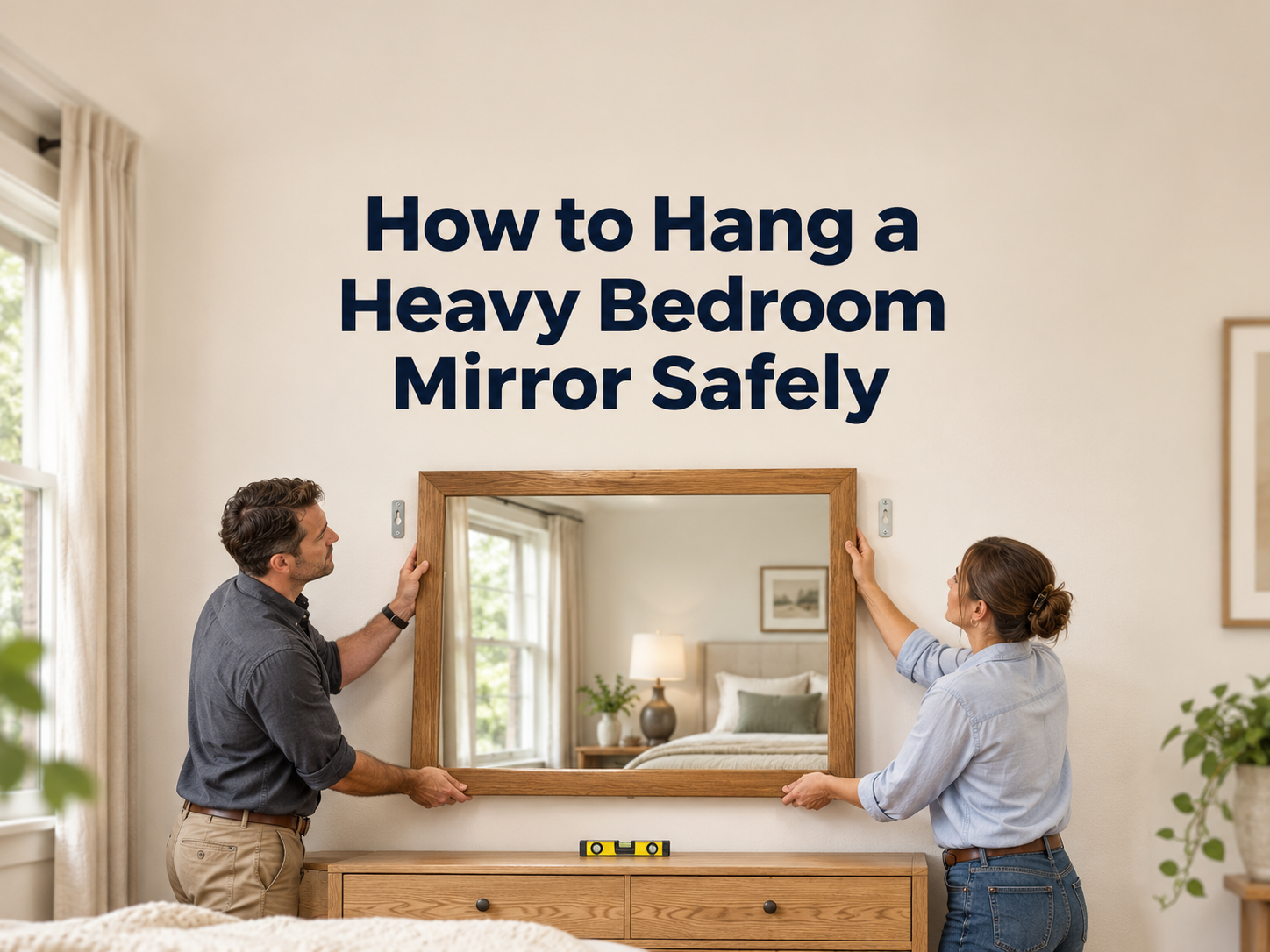
Step 5: Lift and Hang Together
Two people should lift the mirror, one on each side. Keep your fingers away from the glass edges and the bottom corners. Lower the mirror slowly onto the hooks or cleat, and keep supporting it until you are sure it has engaged. Never let go suddenly.
Step 6: Test, Level and Secure
Check that the mirror is level and sits flat. Apply gentle downward pressure to confirm it is seated. Add small rubber bumpers at the bottom corners so the mirror does not slide or tilt. If your hardware supports it, add a locking or safety fixing. Finally, step back and look for any movement or gaps.
Safety reminder
If at any point you are unsure about the wall, the weight or the hardware, stop and consult a qualified installer or handyman. A mirror is not a place to improvise.
Special Cases
Hanging a Mirror Above the Bed
Mirrors above a bed deserve extra care, because a fall would land on a sleeping person. Use stud fixings or a French cleat rather than anchors alone. Many people also apply safety backing film to the back of the glass, which helps hold broken pieces together. If you live in an area with earthquakes, add additional security fixings as recommended by the manufacturer or an installer, or choose a different position altogether.
Leaning Floor Mirrors
A tall mirror that leans against the wall may look relaxed, but it is a tipping hazard, especially around children and pets. Fix it with an anti-tip strap or a safety bracket screwed into a stud, and keep it on a stable, non-slip surface.
Rental Homes
If you rent, check your lease before drilling. Many landlords allow small holes, and heavy mirrors often justify them. If you cannot drill, leaning the mirror with proper anti-tip fixings on furniture or the floor may be the safest compromise. Avoid adhesive strips for heavy mirrors.
Hanging on a Brick or Concrete Wall
Choose a position away from damp patches and check for pipes or conduits. After the anchors go in, wait for any adhesive anchors to cure fully if you use them, as the manufacturer instructs.
Common Mistakes to Avoid
- Guessing the weight. Weigh it or check the specification.
- Using plastic plugs for a heavy mirror. They are meant for light loads only.
- Relying on one hook. Use two points, or a cleat, to share the weight.
- Skipping the stud finder. Hitting wires or pipes is dangerous and expensive.
- Hanging it alone. Heavy glass is awkward and the risk of dropping it is high.
- Trusting old hardware. Replace worn hooks, screws and plates.
- Forgetting to recheck. Look at the mirror again after a week and from time to time.

Frequently Asked Questions
How much weight can a drywall anchor hold?
It depends entirely on the type and the wall. Light plastic plugs hold very little, while heavy-duty toggle bolts can hold much more. Always read the rating on the packaging, assume real-world performance is lower, and use studs for heavy mirrors whenever you can.
Do I have to hang a heavy mirror into a stud?
It is not always possible, but it is the best option. If you cannot reach a stud, use proper heavy-duty toggle fixings in several points, or ask a professional for advice. A French cleat can help you reach more than one stud.
How high should I hang a bedroom mirror?
A common guide is to center the mirror at about 57 to 60 inches (145 to 152 cm) from the floor. Above a dresser, leave about 5 to 10 inches (12 to 25 cm) of space between the furniture and the bottom of the mirror.
Is it safe to hang a heavy mirror above a bed?
It can be safe if it is installed properly into studs with strong hardware or a French cleat. Consider safety backing film, and think carefully about position if you live in an area prone to earthquakes.
Can I use Command strips for a heavy mirror?
No. Adhesive strips are not designed for heavy or large glass mirrors, and they can fail suddenly, especially in warm or humid rooms.
What is the safest way to hang a very large mirror?
A French cleat screwed into several studs is widely considered one of the safest ways, because it spreads the load. For particularly large or valuable mirrors, hiring a professional installer is worth it.
Should I hire a professional?
Consider it for mirrors that are very large, frameless, antique or hung above a bed, or if you are unsure of the wall construction. The cost is small compared with the risk of an accident.
Final Thoughts
Hanging a heavy bedroom mirror safely comes down to a few key decisions: know the weight, match the fixing to the wall, anchor into studs wherever possible and use hardware rated well above what you need. Add a second person, a level and a final test, and you will have a mirror that looks great and stays exactly where you put it.
Take your time with each stage, do not cut corners with cheap hardware and recheck the mirror after the first week. A careful installation today means years of safe, stress-free use.