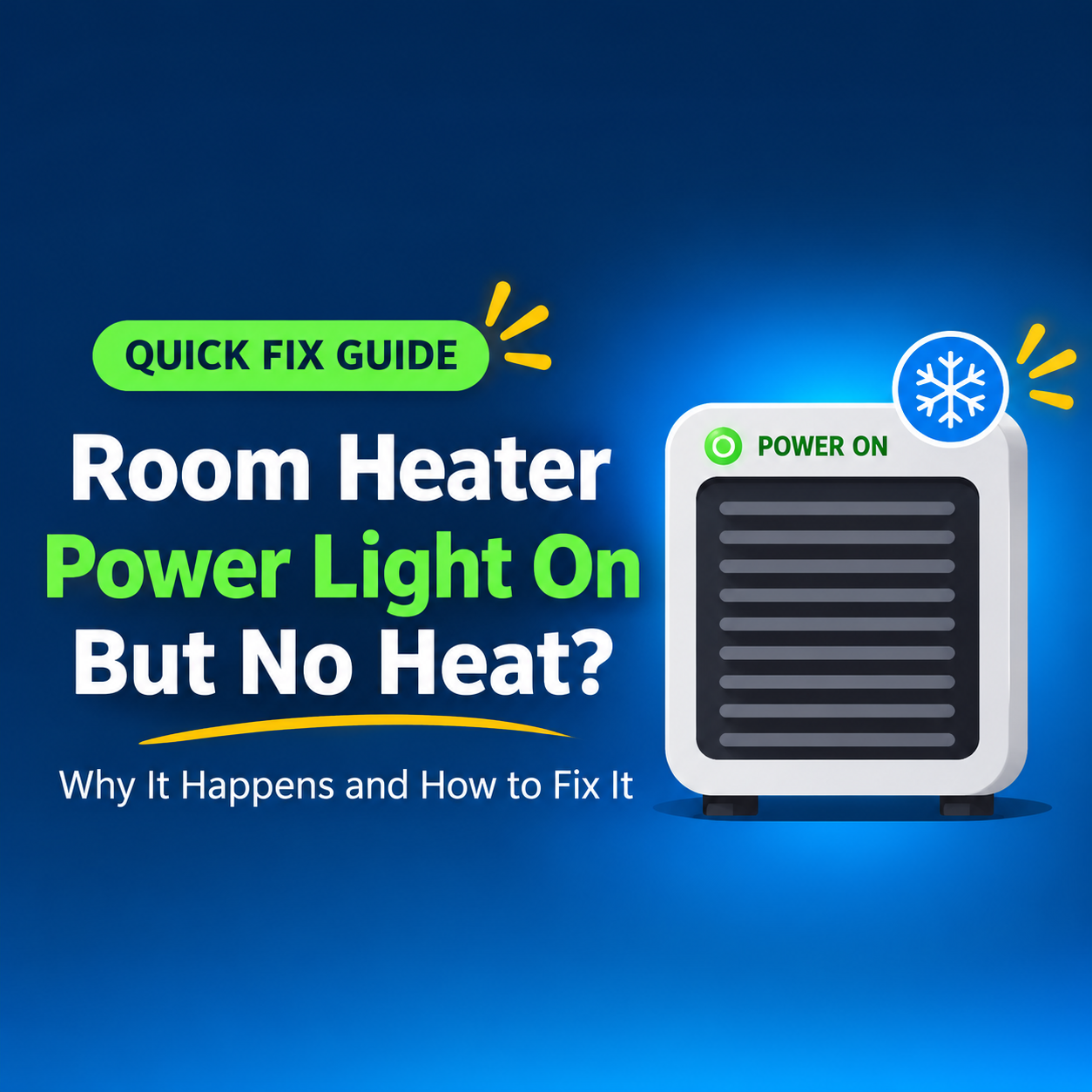
It is a cold night, you plug in your heater, and the power light comes on right away. You hold your hand in front of it and feel nothing but cold air. A room heater with the power light on but no heat is a very common problem, and it confuses many people because the heater looks like it is working.
The reason is simple: the little indicator light and the heating element run on separate parts of the heater. The light only proves that electricity reaches the control panel. It does not prove the heating part is switching on. In this guide you will learn why this happens, how to find the exact cause, which fixes are safe to try at home, and when it is time to buy a new heater.
Why the Power Light Is On but the Heater Gives No Heat
The power light is a tiny bulb or LED that uses a very small amount of current. The heating element, on the other hand, needs a large amount of power (often 1000 to 2000 watts). Between the plug and the element sit several safety and control parts. If one of them stops the flow of high current, the light can still glow while the element stays cold.
Common Symptoms to Look For
- Power light is on, but the fan does not spin (on fan heaters).
- Power light is on, fan spins, but the air stays cold.
- Heater makes a clicking sound, then goes quiet with no warmth.
- Heater worked for a few minutes, then stopped heating while the light stayed on.
- Only some heat settings work (for example, low works but high does not).
- Oil-filled heater feels cool even after an hour with the light on.
10 Reasons Your Room Heater Has Power but No Heat
1. Thermostat Set Too Low
This is the simplest cause and the one most people miss. If the thermostat is set lower than the room temperature, the heater thinks the room is already warm and keeps the element off while the light stays on. Turn the dial to maximum and wait a minute or two.
2. Wrong Mode or Heat Setting
Many heaters have a “fan only,” “low heat,” and “high heat” selector. Make sure you have not accidentally chosen fan-only or a timer or eco mode that delays heating.
3. Tripped Overheat Protection
Dust, blocked vents, or a cloth near the heater can cause overheating. A safety switch then cuts power to the element. The light often stays on because the control panel still has power. Unplug the heater, let it cool, clear the vents, and try again.
4. Blown Thermal Fuse
A thermal fuse is a one-time safety part. When it burns out, it permanently cuts power to the element. This is one of the most common reasons for “light on, no heat.” The fuse is cheap, but it must be replaced with the exact same rating.
5. Tip-Over Switch Not Fully Pressed
The tip-over switch shuts down the element if the heater is tilted. If the heater sits on carpet, a slope, or an uneven floor, the switch may not close. Place the heater on a flat, hard surface.
6. Faulty Thermostat
A worn thermostat may never send the “start heating” signal. If turning the dial up and down makes no difference and there is no click sound, the thermostat could be damaged.
7. Broken or Burnt Heating Element
Over time, the resistance wire or ceramic plate can crack or burn through. The heater still powers on, but the element cannot warm up. A visible break, dark spot, or no continuity on a multimeter confirms this.
8. Loose or Burnt Internal Wiring
Heaters vibrate and heat up repeatedly, which can loosen connectors. A loose or burnt connection may pass enough power for the light but not enough for the element. Melted or darkened wire ends are a warning sign that the heater should be retired.
9. Weak Outlet, Extension Cord, or Low Voltage
A worn outlet or thin extension cord cannot deliver the high current a heater needs. The light may glow but the element will not work properly. Always plug a heater directly into a wall outlet in good condition.
10. Failed Relay or Control Board (Digital Heaters)
Modern heaters with digital displays use a relay or circuit board to switch the element. If the display and light work but you never hear a click, the relay or board may have failed. These repairs are often not worth the cost.
Step-by-Step Fix: What to Do First
- Unplug the heater, wait a minute, and plug it back in.
- Turn the thermostat to maximum and choose the highest heat setting.
- Check the surface. Put the heater on a flat, hard floor, away from carpet edges.
- Clear the vents. Remove dust with a soft brush or a vacuum on low suction.
- Let it cool 30 minutes in case the overheat protector tripped, then restart.
- Test another outlet and avoid extension cords.
- If there is still no heat, move on to testing the thermal fuse, thermostat, and element.
Testing Heater Parts with a Multimeter
If the simple fixes fail, a basic multimeter helps you find the failed part. Always unplug the heater first. Remove the cover carefully and take a photo of the wiring before disconnecting anything.
- Thermal fuse: Set the meter to continuity. A good fuse beeps or shows near-zero resistance. No reading means the fuse is blown.
- Heating element: Check resistance across both ends. A low, steady reading is normal. “OL” or infinite resistance means the element is broken.
- Thermostat: Turn the dial up and check continuity across its terminals. It should show continuity when set to high.
- Power switch or selector: It should show continuity in the “on” positions.
Replace any failed part with an exact match for voltage, wattage, and temperature rating. A wrong fuse or thermostat can cause overheating and fire.
Does the Heater Type Matter?
Yes. The way each type fails is slightly different.
Repair or Replace?
| Situation | Recommended Action |
|---|---|
| Thermostat low, blocked vents, tipped switch | Simple fix at home |
| Blown thermal fuse | Replace the fuse (exact rating) if you are comfortable |
| Faulty thermostat or element | Repair only if the part is cheap and available |
| Burnt wiring or melted parts | Stop using and replace the heater |
| Control board failure or heater older than 5 to 7 years | Replacing is usually the smarter choice |
How to Prevent This Problem
- Clean the vents and grille every month while the heater is in use.
- Keep the heater at least 3 feet (1 meter) away from curtains, bedding, and furniture.
- Always use a flat, hard surface.
- Plug straight into a wall outlet. Avoid thin extension cords and power strips.
- Do not run the heater non-stop for many hours. Give it breaks.
- Store it clean and dry at the end of winter, preferably in its original box or a cover.
Buying Tips If You Need a New Heater
- Safety features: Look for overheat protection and automatic tip-over shutoff.
- Adjustable thermostat: Helps keep a steady temperature and lowers electricity use.
- Right size for the room: A common guideline is about 10 watts per square foot of floor area.
- Heater type: Ceramic and fan heaters warm up fast, oil-filled heaters hold heat longer and run quietly.
- Warranty and parts: A longer warranty and easy-to-find parts make repairs simpler.
Frequently Asked Questions
Why does my heater turn on but not get hot?
The power light only shows that the control part has electricity. The element can still be off because of a low thermostat setting, a tripped safety switch, a blown thermal fuse, or a broken element.
Can a heater have power but no heat because of the thermostat?
Yes. If the thermostat is set too low or has failed, it will not tell the element to turn on, even though the power light is glowing.
Is it normal for an oil-filled heater to feel cool at first?
Yes. Oil-filled heaters warm slowly. Give it 15 to 30 minutes on the highest setting before deciding it is faulty.
How do I reset my room heater?
Unplug it, let it cool for 30 minutes, clear any dust from the vents, place it on a flat surface, then plug it back in and set the thermostat to high. Some models also have a small reset button on the back or bottom.
Is it safe to keep using a heater that gives no heat?
Do not keep it running while you look for the cause. If there is a burning smell, strange noise, or hot plug, unplug it and do not use it until it is checked.
How long should a room heater last?
With good care, many heaters last 5 to 10 years. Dusty vents, overheating, and rough handling shorten the lifespan.
Final Thoughts
A room heater with the power light on but no heat does not always mean the heater is dead. Begin with the easy checks: thermostat, heat setting, flat surface, clean vents, and a good outlet. If those do not help, look at the thermal fuse, thermostat, and heating element, and use a multimeter if you are comfortable doing so.
Most important of all, keep safety first. Unplug before you open the heater, use only exact-match parts, and replace any heater showing burnt wiring or melted plastic. A well-maintained heater keeps your home warm and your family safe through the whole winter.