

Disclosure: This article is for general information. Some retailers or products mentioned on this site may be affiliate partners, which does not change our assessment. Prices and specifications can change, so confirm details with the seller before you buy.
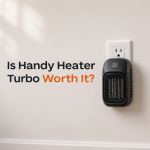
Every winter the same little gadget shows up in TV ads, social media feeds and hardware store shelves: the Handy Heater Turbo. It promises instant warmth, a digital thermostat and zero floor clutter for roughly the price of a takeout dinner. That sounds almost too good to be true, so a fair question is: is the Handy Heater Turbo worth it, or is it just another over-hyped As Seen On TV product?
This guide brings together the published specifications, retailer pricing, buyer feedback and independent consumer-testing reports so you can decide with clear eyes. You will learn what the heater actually is, how much space 800 watts can really warm, what it costs to run, which safety concerns have been raised, who should buy it, who should skip it, and what to consider instead.
The short answer
It can be worth it, but only as a personal, short-session heater for a very small space such as a desk area, a small bathroom or a tiny bedroom, and only if you buy a genuine unit from an established retailer at a normal price (roughly $20 to $33 in the U.S.). It is not a replacement for a proper room heater. Independent testers in Australia and a consumer regulator in Ireland have also raised safety and performance concerns about versions sold online. If you need to warm a whole room, skip it.
What Is the Handy Heater Turbo 800?
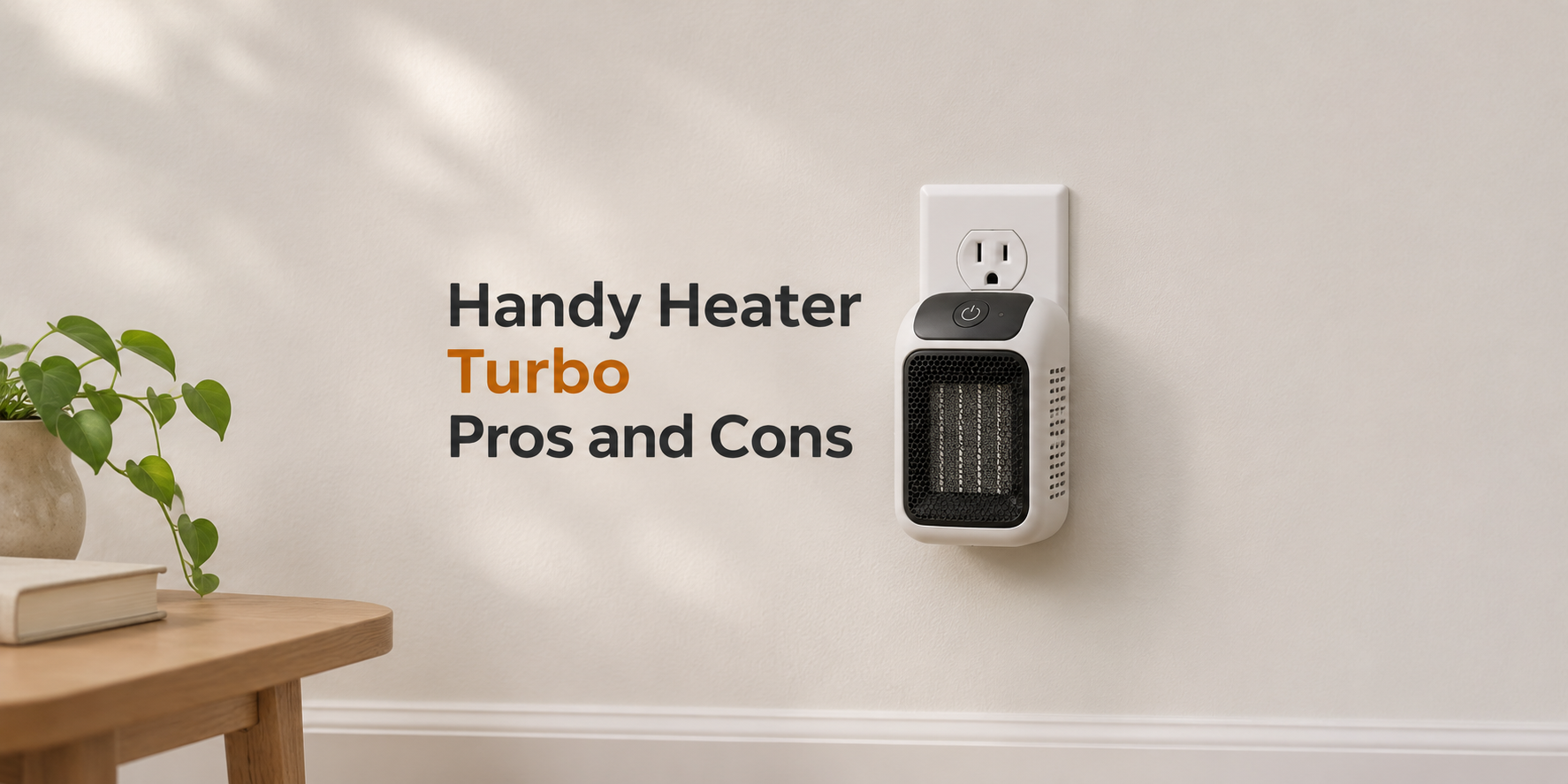
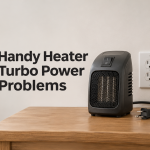
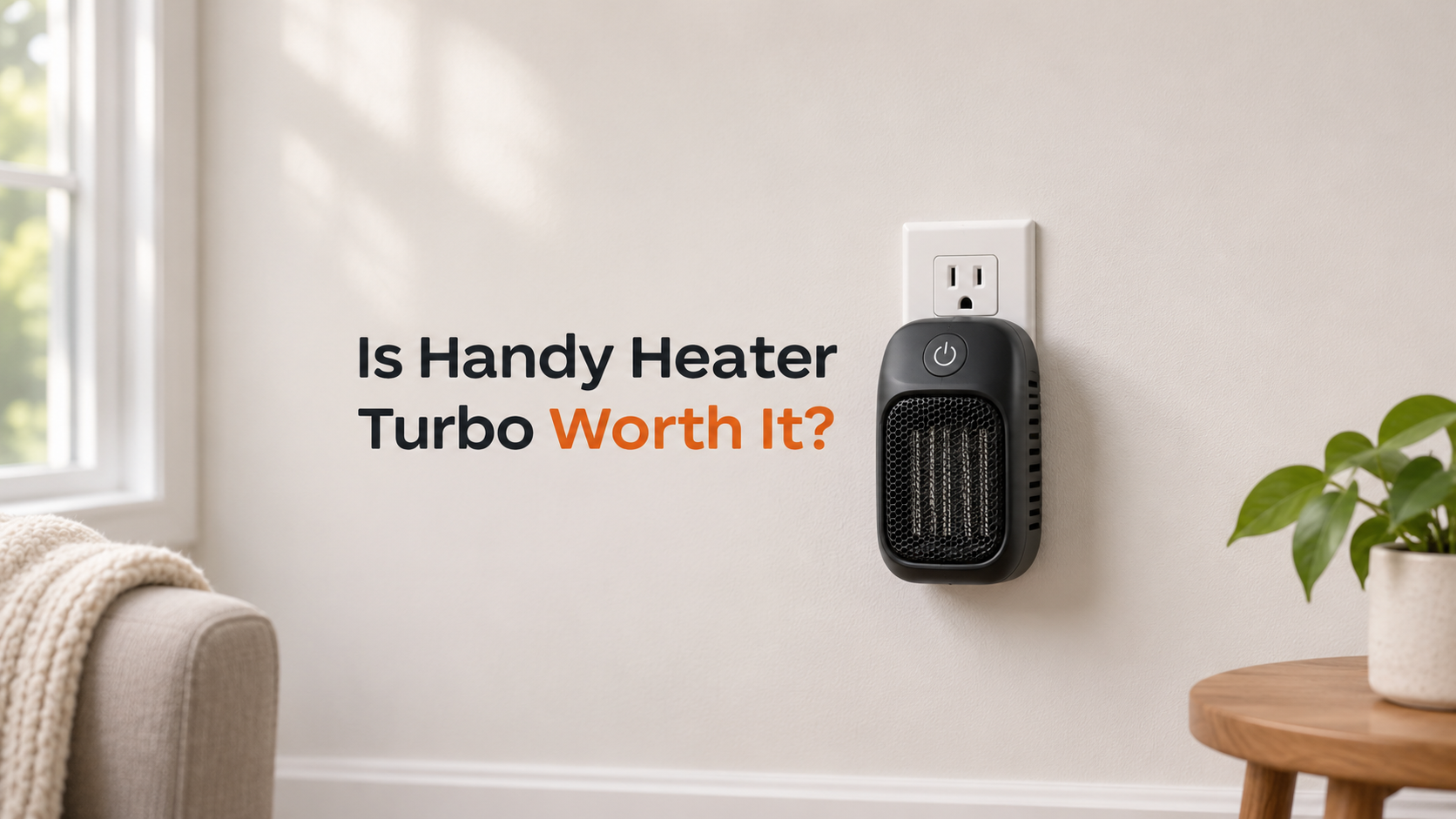
The Handy Heater Turbo 800 is a compact plug-in ceramic heater from Ontel, the company behind the As Seen On TV Handy Heater line. Instead of sitting on the floor like a normal space heater, it plugs directly into a standard 120 V wall outlet and hangs from it. There is no power cord, no base and nothing to trip over.
It has a digital LED display, an adjustable thermostat, a programmable timer and an automatic shut-off. Some retailer listings also mention a rotatable plug, so the display can stay upright whichever outlet you use. It has been listed by major retailers and hardware chains in the U.S. and Canada, including Target, Ace Hardware and Canadian Tire.
The Turbo is the bigger sibling of the original Handy Heater, which was rated at only about 350 to 370 watts. The Turbo raises that to 800 watts, which is a real improvement, but as you will see below, 800 watts still has limits.
Handy Heater Turbo 800 Specifications at a Glance
| Feature | Details |
|---|---|
| Power | 800 watts (about 6.7 amps at 120 V) |
| Heat output | Roughly 2,700 BTU per hour (one retailer lists 2,714) |
| Heating element | Ceramic (PTC) |
| Thermostat | Adjustable, 60°F to 90°F, digital LED display |
| Timer | 12-hour programmable timer |
| Listed safety features | Auto shut-off and stay-cool housing (per retailer descriptions) |
| Certification | ETL listed per retailers; at least one retailer spec sheet shows it is not UL listed |
| Rated area | About 100 sq ft on most retailer pages (some marketing says up to 250 sq ft) |
| Use | Indoor only |
| Typical U.S. price | About $20 to $33 at hardware and big-box retailers |
Specifications vary slightly between listings and regional versions, so treat this table as a guide and always check the label and manual of the unit you actually receive.
How Does the Handy Heater Turbo Work?
The heart of the unit is a ceramic PTC element. PTC stands for positive temperature coefficient, which simply means the ceramic resists electricity more as it gets hot. That makes it heat up quickly and naturally limits how hot the element itself can get, which is why ceramic heaters are generally considered safer than old exposed-coil models.
The built-in digital thermostat senses the room temperature and switches the heating on and off to hold the number you set, anywhere from 60°F to 90°F. The 12-hour timer lets you schedule it to run for a set period instead of leaving it on indefinitely. Most compact ceramic heaters of this type also use a small fan to push warm air out gently, which is why the Turbo is advertised as quiet.
One point of honesty about the “energy efficient” label that appears in the marketing: virtually every electric resistance heater turns almost all of the electricity it uses into heat, so the Turbo is not magically more efficient than any other plug-in heater. Its real advantage is that it heats only the small area next to it instead of an entire home.
How Much Space Can It Really Heat?
This is the single most important question, and the answer depends on whose numbers you believe.
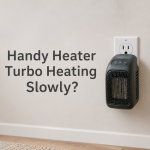
A widely used rule of thumb is about 10 watts of heating power per square foot for a room with standard ceilings. By that math, 800 watts is enough for roughly 80 square feet, about the size of a small bathroom or a spare room. Most hardware-store listings say about 100 square feet. Some online marketing claims up to 250 square feet, but that figure is hard to reconcile with an 800-watt output, especially in a cold or drafty room.
Real results also depend on insulation, ceiling height, drafts, windows and how cold it is outside. In practice, a heater like this warms the air and objects right around the outlet. It is good at taking the chill off a desk area or a small room, and it is poor at changing the temperature of a large, open or drafty space. A standard full-size portable heater runs at 1,500 watts, almost twice the Turbo’s output.
How Much Does It Cost to Run?
Electricity cost is easy to estimate. An 800-watt heater uses 0.8 kilowatt-hours (kWh) for every hour it runs at full power. At an example rate of $0.17 per kWh, that is about 13.6 cents per hour. Your own rate will differ, so swap in the number from your bill.
Used for a couple of hours a day, the heater costs only a few dollars a month. Run it 12 hours a day and you are into serious money, close to $50 a month in this example. Those figures assume full power the whole time, and the thermostat will cut the element on and off once the room reaches your target temperature.
There is one more thing to understand. A small heater can lower your total energy use only if you actually turn your central heating down and heat just the space you are using. If you run it on top of your normal heating, it simply adds to the bill.
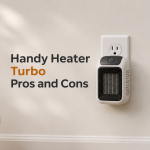
Handy Heater Turbo Pros
- Space-saving design. It plugs straight into the wall with no cord, base or floor footprint.
- Low price. At roughly $20 to $33 at major retailers, the upfront cost is small.
- Useful controls for the price. A digital thermostat and a 12-hour programmable timer are features you do not always get on budget heaters.
- Quiet operation. The manufacturer positions it as quiet enough to use while working or relaxing.
- Easy to move. Unplug it and use it in another room or take it to a different outlet in seconds.
- Quick warmth in tiny spaces. For a small, enclosed area, it can take the edge off.
Handy Heater Turbo Cons
- Limited heating power. 800 watts is only about half of a standard 1,500-watt portable heater.
- Not for large rooms. It is designed for personal and small-room use, and it is not meant for outdoor use.
- Heat is tied to the outlet. Wall outlets are often low and behind furniture, which limits where the warmth can go.
- It hangs from your outlet. A plug-in heater puts weight and heat on the outlet, which is a problem if the socket is old or loose.
- Safety questions about some versions. Independent testers and a regulator have raised concerns (details below).
- Lookalikes and inflated prices. Cheap imitations and overpriced marketplace listings are common.
- No remote control. You adjust everything on the unit itself.
Safety Concerns You Should Know About
Any honest answer to “is the Handy Heater Turbo worth it” has to cover safety, because a heater that is cheap but unsafe is never a bargain. Here is what has been reported.
Independent testing in Australia
In 2025 the Australian consumer group CHOICE named the Handy Heater Turbo 800 among its Shonky Award winners, a yearly list of products and services it considers poor value or unsafe. Its testers said the unit they examined produced far less heat than the advertising suggests. They also listed build concerns, including no thermal protection device, wiring that was not adequately secured and a heating element mounted directly on plastic.
Two caveats matter. Australia’s electrical rules differ from those in North America, and plug-in heaters of this design do not comply with the current Australian standard. CHOICE also tested the version that Australian shoppers can find online, which may not be identical to the retail versions sold in U.S. and Canadian stores. Even so, it is a serious red flag and a good reason to be careful about where you buy.
A safety notice in Ireland
Ireland’s Competition and Consumer Protection Commission published a Product Safety Information notice about an 800-watt wall-mounted Handy Heater Turbo sold online by one seller. The notice said the product may pose a risk of fire or electric shock, noted that no evidence of compliance with EU low-voltage electrical regulations had been provided, and told anyone who had bought it to stop using it. This concerned a specific product sold in a specific market, but it underlines that the seller and the exact unit matter.
Lookalikes on online marketplaces
Buyer feedback on marketplace listings includes complaints about receiving cheap lookalikes inside Handy Heater boxes, for example a plug with only two flat pins and a dented unit in poor packaging. These reports are anecdotal and cannot be verified, but the pattern is consistent with what happens to many popular As Seen On TV products. Counterfeits may not have been tested to any safety standard at all.
Earlier criticism of the original Handy Heater
In 2019, Consumer NZ reviewed the earlier, lower-powered 370-watt Handy Heater and concluded that it was not powerful enough to warm a room as the ads claimed. That is a different and older model, but the lesson carries over: small plug-in heaters warm the area right next to them, not a whole room.
What this means for you
- Buy from an established retailer with a clear return policy rather than an unknown seller or a social media ad.
- Check that the unit and its packaging carry a recognized safety mark and a model number, and compare them with the retailer’s product photos and the manual.
- Remember that a certification mark on a listing does not guarantee that the particular unit in your hand is genuine, so inspect it when it arrives.
- Stop using it and return it if the plug is loose, the housing feels flimsy, there is a burning smell or anything looks discolored.
How to Use It Safely
Whatever heater you choose, safe habits matter more than any feature on the box. Fire safety guidance for portable heaters consistently comes back to the same points: keep combustibles about three feet away, plug the heater directly into the wall without power strips or extension cords, never leave it running unattended and turn it off when you go to sleep.
Plug-in heaters add one extra rule: pay attention to the outlet itself. It is normal for a plug to feel a little warm, but a loose fit between the plug and the outlet can overheat, so do not use a plug-in heater in a worn or loose socket. Also keep it away from water, and never use it with wet hands.
Who Should Buy the Handy Heater Turbo?
- People who want a little extra warmth around a desk, workspace or reading nook, near an outlet.
- Anyone with a very small room, such as a spare room, small bedroom or entry, who needs a short boost in warmth.
- Shoppers who want a cheap, low-commitment gadget to take the chill off for short sessions while they are in the room.
Who Should Skip It?
- Anyone hoping to heat a living room, open-plan area, basement or any space much larger than about 100 square feet.
- Anyone who wants to leave a heater running overnight or unattended.
- Homes with old, worn or loose outlets, or where the only outlet is behind furniture.
- Anyone tempted by a deeply discounted offer from an unfamiliar website or social media ad.
- Readers in Australia, where plug-in heaters of this design do not comply with the current electrical standard.
Where to Buy and What to Pay
Across several U.S. hardware and big-box listings, the Handy Heater Turbo 800 has typically sat between about $20 and $33, with sales dipping lower. Some marketplace listings and trackers show much higher prices, and a few international listings ask close to $100, which is far more than the product is worth.
- Do: buy from well-known retailers and hardware chains, keep your receipt and note the return window.
- Do: check that the model name, wattage and certification details match the product page.
- Do not: trust ads that promise dramatic “today only” discounts or claim the heater can warm an entire home.
- Do not: pay marketplace prices well above the typical retail range.
Be careful with customer reviews too. Some reviews shown on retailer pages were collected as part of promotions, and ratings on marketplace listings can be mixed. Read a spread of reviews, especially the middle ratings, before you decide.
Better Alternatives to Consider
Depending on what you need, another type of heater may suit you better than a plug-in unit.
| Option | Typical power | Best for | Trade-off |
|---|---|---|---|
| Plug-in wall heater (like the Turbo) | About 800 W | Desk, nook, tiny room | Low output, strain on the outlet |
| Full-size ceramic tower or fan heater | Up to 1,500 W | Bedrooms and small to medium rooms | Takes floor space, some fan noise |
| Oil-filled radiator | Often up to 1,500 W | Steady, quiet heat in a bedroom | Slow to warm up, heavy |
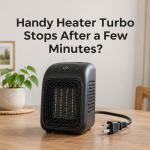
| Small desktop ceramic heater | Often 200 to 1,000 W | Warming hands and feet at a desk | Very small coverage area |
| Heated throw or blanket | Much lower | Warming your body, not the room | Only warms the person using it |
Whichever type you choose, look for an independent safety certification, a thermostat, overheat protection and, for floor-standing models, a tip-over switch.
Final Verdict: Is the Handy Heater Turbo Worth It?
The Handy Heater Turbo is a clever idea at a low price. The thermostat, the 12-hour timer and the no-floor-space design are genuinely handy, and in a very small space it can take the chill off without much fuss. At around $20 to $33 from a reputable retailer, it is an easy gadget to justify as a personal heater.
But the limits are real. At 800 watts it is not a room heater, the heat is tied to wherever your outlet happens to be, and the safety questions raised by independent testers and a regulator are reasons to buy carefully and use it sensibly. If you only need a bit of warmth near a desk or in a tiny room, and you buy a genuine unit from a trusted seller, it can be worth the money. If you want to warm a whole room, or you plan to leave it running for hours unattended, put your money into a full-size heater with proven safety features instead.
Frequently Asked Questions
Is the Handy Heater Turbo worth buying?
It is worth considering as a cheap, personal heater for a desk or very small room if you buy a genuine unit from an established retailer. It is not worth it if you expect it to heat a whole room.
How many watts does the Handy Heater Turbo use?
It is rated at 800 watts, which is about 6.7 amps on a 120 V outlet.
Can the Handy Heater Turbo heat a whole room?
Not a large one. Retailer listings generally rate it for around 100 square feet, and a common rule of thumb suggests about 80 square feet. It works best for small spaces and for warming the area near the outlet.
How much does it cost to run?
At full power it uses 0.8 kWh per hour. At $0.17 per kWh that is about 13.6 cents an hour, or roughly $8 a month at two hours a day. Because the thermostat cycles the heater, real costs are often lower.
Is it safe to leave on overnight?
Fire safety guidance for portable heaters generally advises turning them off when you leave the room or go to sleep. Follow the manufacturer’s manual and avoid running any small heater unattended.
Can I use it with an extension cord or power strip?
No. Plug it directly into a wall outlet, and do not share that outlet with another appliance. Extension cords and power strips can overheat under a heater’s load.
Does it have overheat protection?
Retailer descriptions mention an automatic shut-off and a stay-cool housing. Details can vary between versions, so confirm exactly which protections your unit has by reading its manual and label.
Is the Handy Heater Turbo a scam?
The heater itself is a real product sold by well-known retailers. The problems tend to surround it: exaggerated advertising claims, lookalike products and ads promising steep one-time discounts. Buying from a recognizable retailer with a return policy removes most of that risk.
Bottom Line
The Handy Heater Turbo 800 earns a cautious thumbs-up for the right job and a firm thumbs-down for the wrong one. Use it as a small, short-session heater in a tiny space, buy from a trusted seller, follow basic heater safety rules and keep your expectations realistic. If you need real warmth for a whole room, a full-size heater with a recognized safety certification is the smarter buy.