





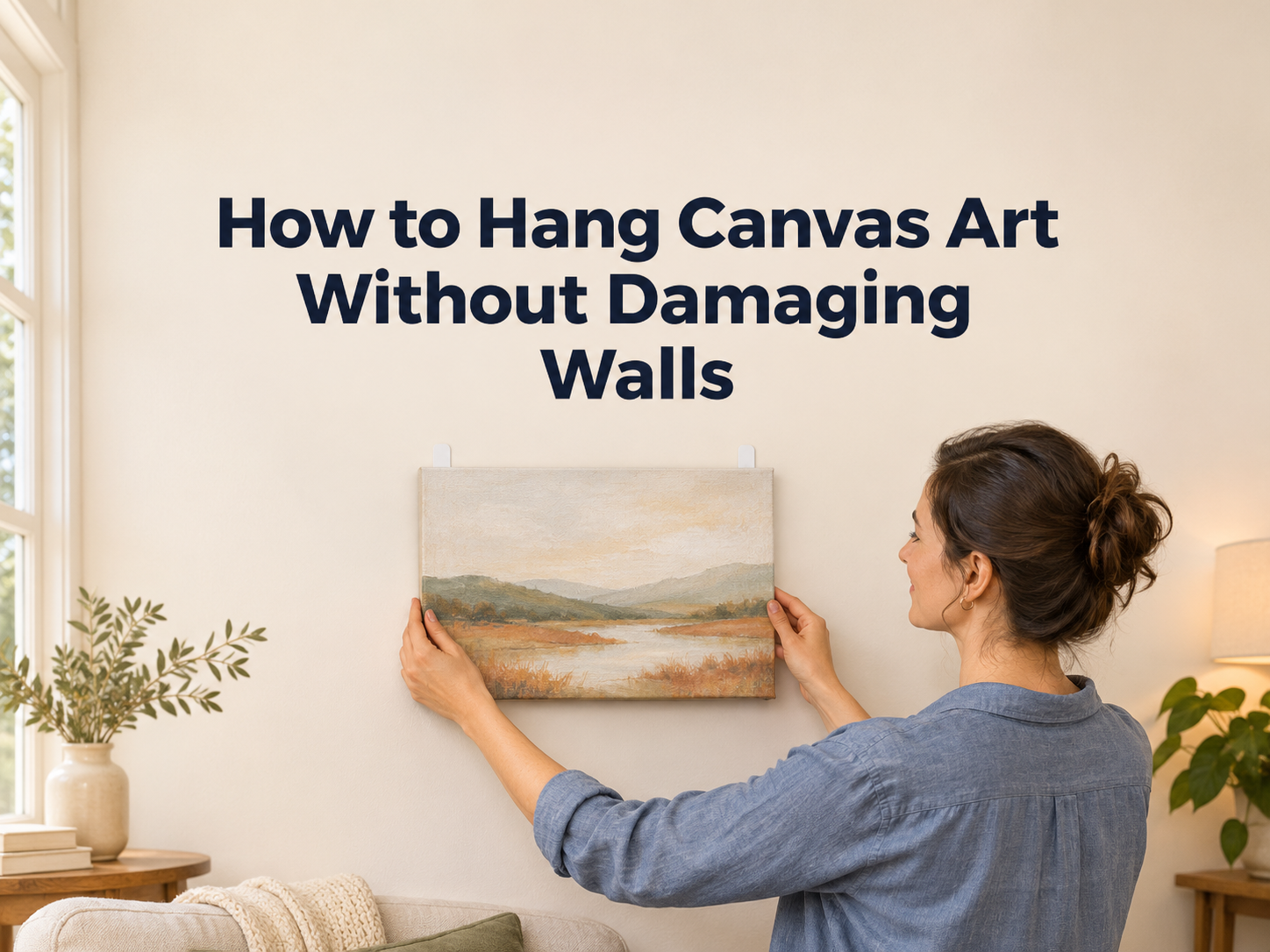
A canvas print or painting can transform a bare wall, but the thought of hammering nails into it makes many people hesitate. If you rent, if you have just painted, or if you simply like to rearrange your decor, you want a way to hang art without leaving holes, torn paint or sticky marks behind. The good news is that canvas is one of the easiest kinds of art to hang without damage, because it is light, frameless and flat.
This guide explains every practical way to hang canvas art without damaging walls: adhesive strips, removable hooks, over-the-door and rail systems, leaning and shelf display, and even the least damaging way to use a nail. You will also learn how to match the method to your wall type and canvas weight, how to hang it level and how to take it down safely.
First, Check Two Things: Weight and Wall Surface
Every damage-free method has limits, so before you buy anything, find out how heavy your canvas is and what kind of wall you have.
1. Weigh Your Canvas
Use a kitchen or bathroom scale. Most canvas prints are lighter than people expect, but large or gallery-wrapped canvases with thick wooden frames can be heavy.
2. Know Your Wall Surface
| Wall Type | Damage-Free Friendliness | Notes |
|---|---|---|
| Smooth painted drywall (cured paint) | Best | Strips and removable hooks work well |
| Freshly painted wall (under 3 to 4 weeks) | Risky | Paint has not fully cured and can peel off with the adhesive |
| Flat or matte paint | Fair | Chalky surface grips less well and can lift |
| Textured walls (orange peel, knockdown) | Poor for adhesives | Use a rail, over-door or leaning method |
| Wallpaper | Risky | Can tear. Test first or use a picture rail |
| Brick, concrete, tile | Poor for adhesives | Use special brick clips or a leaning display |
| Wood paneling | Good | Clean first, and test the adhesive in a hidden spot |
| Glass, metal, smooth tile | Good | Adhesive hooks or suction mounts work |
The Best Ways to Hang Canvas Art Without Damaging Walls
Method 1: Adhesive Hanging Strips
Adhesive strips are small sticky pads, often in two interlocking parts, that stick to the wall and the canvas frame. When you are ready to remove them, you pull a tab slowly and the adhesive stretches free without leaving residue on most surfaces.
- Check the package for the weight rating, and use more strips than the minimum. Stay well under the stated limit.
- Clean the wall spot with rubbing alcohol on a cloth and let it dry. Dust and grease prevent sticking.
- Clean the back of the canvas frame in the same way, and make sure it is flat. Canvas that is stretched on a rounded or very thin frame can be hard to stick.
- Press the strips onto the back of the frame, near each corner, and then press the canvas against the wall for about 30 seconds.
- Wait about an hour before letting go of the full weight, if the instructions advise it.
- To remove, pull the tab straight down parallel to the wall, slowly, stretching the strip until it releases.
Method 2: Removable Adhesive Hooks
Removable hooks hold a canvas from its back wire or sawtooth hanger, just like a regular nail would, but they stick to the wall instead. They are ideal when your canvas already has a hanger or hanging wire.
- Choose hooks rated for at least twice the weight of the canvas, so there is a safety margin.
- Clean the wall first, stick the hook firmly and wait the recommended time (often an hour) before hanging the art.
- For larger pieces, use two hooks side by side to share the load and keep the canvas level.
- Use hooks designed for the wall type, such as paint-safe or wallpaper-safe versions.
Method 3: Over-the-Door Hooks and Back-of-Door Hanging
If you only want to display a canvas on a door, or on the back of one, an over-the-door hook rests on the top edge of the door and needs no fixing at all. This is a handy choice in a dorm or rented room and is perfect for lighter canvases.
Method 4: Picture Rail, Rod or Rail Hanging Systems
A picture rail or a hanging rail system uses a track, mounted once near the ceiling, with cords or hooks that you can slide and adjust. Some systems use a single small fixing, and others mount on the top of a door frame or sit on top of a wall with a clip, leaving the wall surface untouched.
- Great for gallery walls, because you can swap and move art freely.
- Works for heavier canvases when the rail is rated for the load.
- Look for a rail that clips to the ceiling edge or wall-top, or one that mounts with adhesive for rental homes.
Method 5: Command-Style Hanging Tapes and Poster Strips for Very Light Canvas
For very light, thin canvas boards, small canvas panels or unframed canvas, double-sided removable mounting tape or small poster strips work. They are only for light, flat items, and are not suitable for any heavier canvas.
Method 6: Lean the Canvas (Zero Fixings)
Often the simplest and most stylish method is to not hang it at all. Lean the canvas against the wall on a shelf, mantel, dresser, console table, windowsill or on the floor.
Method 7: Tension Rods, Pole Systems and Magnetic Hangers
- Tension poles wedge between the floor and ceiling and hold hooks or shelves. They suit lighter canvases.
- Magnetic hanging systems work on steel surfaces, such as a metal wall panel or a fridge side, for lightweight pieces.
- Window and glass suction mounts are good for very light, small canvas pieces on smooth, clean glass.
The Least Damaging Way to Use a Nail or Screw
Sometimes a heavy canvas needs a real fixing. If you are allowed, a small nail leaves only a tiny hole that you can fill in seconds, which is often less damage than a messy adhesive removal.
- Use a thin picture-hanging nail or a small hook with a built-in angled nail, rather than a large screw.
- Place a small piece of painter’s tape over the spot before drilling or hammering, so the paint and plaster do not crack.
- Aim for a stud for heavy canvases, or use a rated wall anchor.
- When you remove the nail, fill the tiny hole with spackle or even a dab of toothpaste for a very small one, sand lightly, and touch up the paint.
Choosing the Right Method
| Canvas Weight | Best Damage-Free Method | Notes |
|---|---|---|
| Under 2 lbs (0.9 kg) | Adhesive strips, small removable hooks, mounting tape | Easiest case. Use extra strips for safety |
| 2 to 5 lbs (0.9 to 2.3 kg) | Heavy-duty strips or hooks, rails, leaning | Use more than one strip or hook |
| 5 to 10 lbs (2.3 to 4.5 kg) | Rail system, picture rail, leaning, or one small nail | Adhesives are less reliable at this weight |
| Over 10 lbs (4.5 kg) | Small nail into a stud, rated anchors, or lean on furniture | Avoid adhesive-only solutions |
How to Hang Canvas Art Level and Centered
- Center at about 57 inches (145 cm). This is the standard gallery height for the middle of the artwork.
- Above furniture, leave about 6 to 8 inches (15 to 20 cm) between the bottom of the canvas and the furniture top.
- Use a spirit level or a level phone app and check the canvas on the wall before pressing it fully on.
- Mark with painter’s tape or a light pencil. Pencil marks wipe off with an eraser later.
- Cut a paper template to the size of the canvas and tape it to the wall to test the position before committing.
- For a gallery wall, lay the canvases out on the floor first, keep gaps of about 2 to 3 inches (5 to 7.5 cm) and photograph the layout to follow.
How to Remove Canvas Art Without Damage
- Support the canvas with one hand so it does not fall.
- If using adhesive strips, pull the tab slowly and parallel to the wall, stretching it until it frees.
- If it resists, warm it with a hair dryer for about 20 seconds to soften the adhesive.
- If a hook was used, slide the canvas off, then remove the hook the same way as the strip.
- Clean off any light residue with a little rubbing alcohol or a mild cleaner on a soft cloth.
- For a nail hole, fill with spackle, sand smooth and touch up with matching paint.
Common Mistakes to Avoid
- Applying strips to freshly painted walls before the paint has cured.
- Skipping the cleaning step, so the adhesive cannot bond.
- Using strips or hooks with too low a weight rating.
- Pulling adhesive strips straight out instead of stretching them down.
- Using adhesive on textured walls, wallpaper or damp surfaces such as bathrooms with steam.
- Hanging a canvas on a surface with temperature swings or direct heat, which weakens adhesives.
- Not pressing firmly for the full time or loading the weight too soon.
- Putting heavy canvas on adhesive only, with no backup, in a place where it could fall on someone.
Frequently Asked Questions
Can you hang canvas art without nails?
Yes. Adhesive strips, removable hooks, rail systems and leaning displays all let you hang or display canvas without nails or screws.
Do adhesive strips damage walls?
Used correctly, they usually do not. Damage is mostly caused by fresh or poor-quality paint, textured or wallpapered walls, using strips that are too weak, or pulling them off the wrong way.
How much weight can adhesive strips hold?
It varies by product. Many hold a few pounds per set, and some heavy-duty types hold more. Always check the package rating and use more strips than the minimum.
How long should I wait to hang a canvas after painting?
Wait about 3 to 4 weeks for paint to fully cure before using adhesive products, and check the paint manufacturer’s advice.
How do I hang a heavy canvas without damaging the wall?
For heavy pieces, a rail system, a single small nail into a stud, or leaning the canvas on furniture is safer than adhesives, and a tiny nail hole is easily filled later.
How do I hang canvas on a textured or brick wall?
Adhesives do not grip well on rough surfaces. Use a rail or over-door system, brick clips made for masonry, or lean the canvas on a shelf or floor.
Can I hang canvas in a bathroom with strips?
Steam and humidity weaken most adhesives, so it is better to choose special moisture-resistant products or a different method, and to keep the canvas away from direct shower splash.
Final Thoughts
Hanging canvas art without damaging your walls comes down to three things: knowing the weight of your canvas, knowing your wall, and choosing the right method. Light canvases suit adhesive strips and removable hooks, many pieces work beautifully on a rail system, and leaning art against a wall is the safest, simplest option of all.
Clean the surface, follow the weight limits, wait for new paint to cure, and remove adhesives slowly. Do that and you can hang, rearrange and take down your favorite canvas art as often as you like, and your walls will stay smooth, clean and ready for the next piece.