

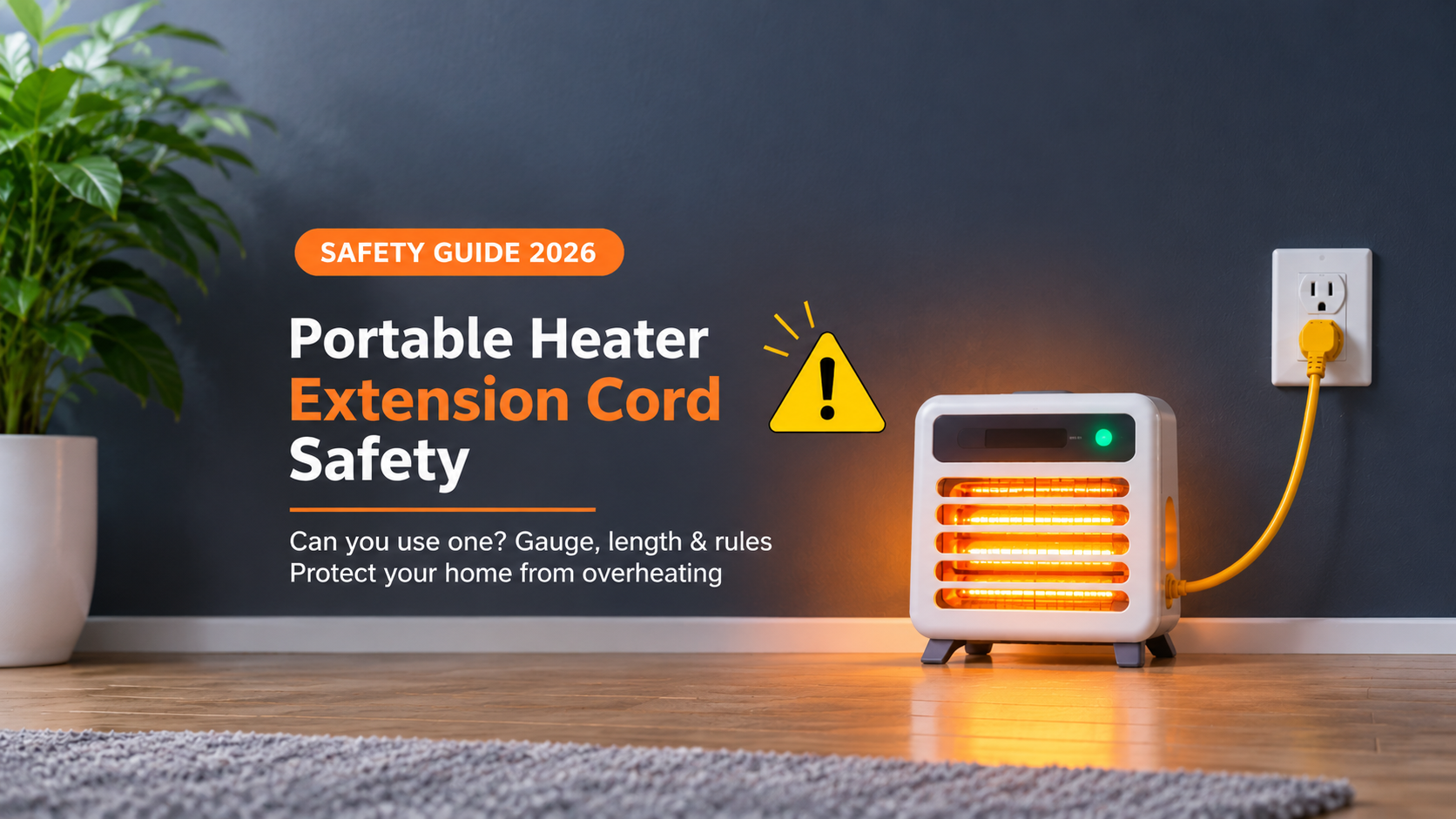
You bring home a new heater, find the nearest wall socket is across the room and reach for an extension cord. It feels harmless, and millions of people do it every winter. But portable electric heater extension cord safety is one of the most important topics in home heating, because this single choice can turn a safe appliance into a fire hazard.
The reason is simple. Heaters draw a very large amount of electric current for long periods, and ordinary extension cords are often not built for that. In this guide you will learn why the risk exists, what to do if you have no other option, how to pick the right cord by gauge, length and rating, and which safer alternatives you can use instead.
Can You Use an Extension Cord With a Portable Electric Heater?
The standard advice from heater manufacturers and fire safety organisations is clear: plug a portable heater directly into a wall outlet whenever possible. Many heater manuals state outright that you should not use an extension cord or power strip at all. If your manual says so, follow it, because using a cord against the manufacturer’s instructions can also affect your warranty and insurance.
Sometimes there is truly no outlet within reach. In that rare case, a correctly chosen heavy-duty cord used with care is far safer than a cheap, thin one, but it is still a compromise. The rest of this guide shows how to reduce that risk as much as possible.
Why Extension Cords Are Risky With Heaters
A heater is a high-power appliance that runs continuously. A typical portable heater draws as much as 1,500 watts, which is roughly 12.5 amps on a 120V supply or about 6.5 amps on a 230V supply for the same power. A lamp or phone charger uses a tiny fraction of that. When a cord is too thin or too long, the electricity meets resistance, and resistance turns into heat inside the cord.
The Main Dangers
- Overheating cord: Undersized wires warm up under load, melting insulation and starting fires, often out of sight behind furniture.
- Hot plug connections: The weakest point is usually where the plugs meet the outlet or each other. A loose or worn connection creates heat.
- Voltage drop: A long, thin cord reduces voltage at the heater, which makes the appliance work harder and run hotter.
- Overloaded circuits: Adding a cord and other devices to the same line can push the circuit beyond its safe load.
- Damaged insulation: Cords crushed under furniture, doors or rugs wear out faster, exposing live wires.
- Trip hazards: A cord across the floor can be kicked, tugging the heater over.
- Coiled cords: Leaving a cord bundled or reeled traps heat and raises its temperature sharply.
Understand the Numbers: Watts, Amps and Volts
You do not need to be an electrician to check your setup. Just use this simple formula:
Amps = Watts ÷ Volts
| Heater Power | Current at 120V | Current at 230V |
|---|---|---|
| 750 W | 6.3 A | 3.3 A |
| 1,000 W | 8.3 A | 4.3 A |
| 1,500 W | 12.5 A | 6.5 A |
| 2,000 W | 16.7 A | 8.7 A |
Look at the label on your heater to find its wattage, then compare the result to the rating printed on the extension cord. The cord’s rating must be equal to or higher than the heater’s current draw, and ideally with a comfortable margin. Remember that heaters often run for hours, so the safe continuous load is lower than the maximum figure. A common guideline is to keep continuous loads below about 80% of a circuit’s or cord’s maximum rating.
How to Choose a Safer Extension Cord for a Heater
1. Check the Wire Gauge (Thickness)
Thicker wire carries more current without overheating. In the AWG system, a lower number means a thicker wire. In metric markets, thickness is given as the conductor area in square millimetres (mm²), where a bigger number means thicker wire.
| Gauge (AWG) | Typical Use | Heater Suitability |
|---|---|---|
| 18 or 16 AWG | Lamps, chargers, light devices | Not suitable |
| 14 AWG | Medium appliances | Only if short and within rating |
| 12 AWG | Heavy-duty appliances | Recommended minimum for most heaters |
| 10 AWG | Very heavy loads, long runs | Excellent |
2. Keep the Cord as Short as Possible
Resistance grows with length. If you need a cord, choose the shortest one that reaches. Do not buy a 15-metre (50 ft) cord for a 2-metre gap, and do not connect two cords together, since each joint adds resistance and a weak point.
3. Check the Amp and Watt Rating
Quality cords show their maximum rating on a label or on the plug. Make sure it is at least as high as your heater’s current draw, with extra margin for safety.
4. Choose a Heavy-Duty, Certified Cord
Look for products tested and marked by a recognised safety organisation. Choose cords labelled for heavy-duty, appliance or high-power use, and avoid unbranded, unmarked or very cheap cords.
5. Pick a Grounded (3-Prong) Cord
If your heater has a three-pin plug, use a cord with an earth (ground) connection. Never remove the earth pin or use a plug adapter that bypasses it.
6. Use the Right Cord for the Place
Indoor cords are not built for damp areas. For garages, basements, patios or any outdoor area, choose a cord rated for that environment.
Extension Cord vs Power Strip vs Surge Protector
These are not the same and should not be confused:
- Extension cord: A single cord with one or more outlets. If heavy-duty and short, it is the least risky of the three, though still not ideal.
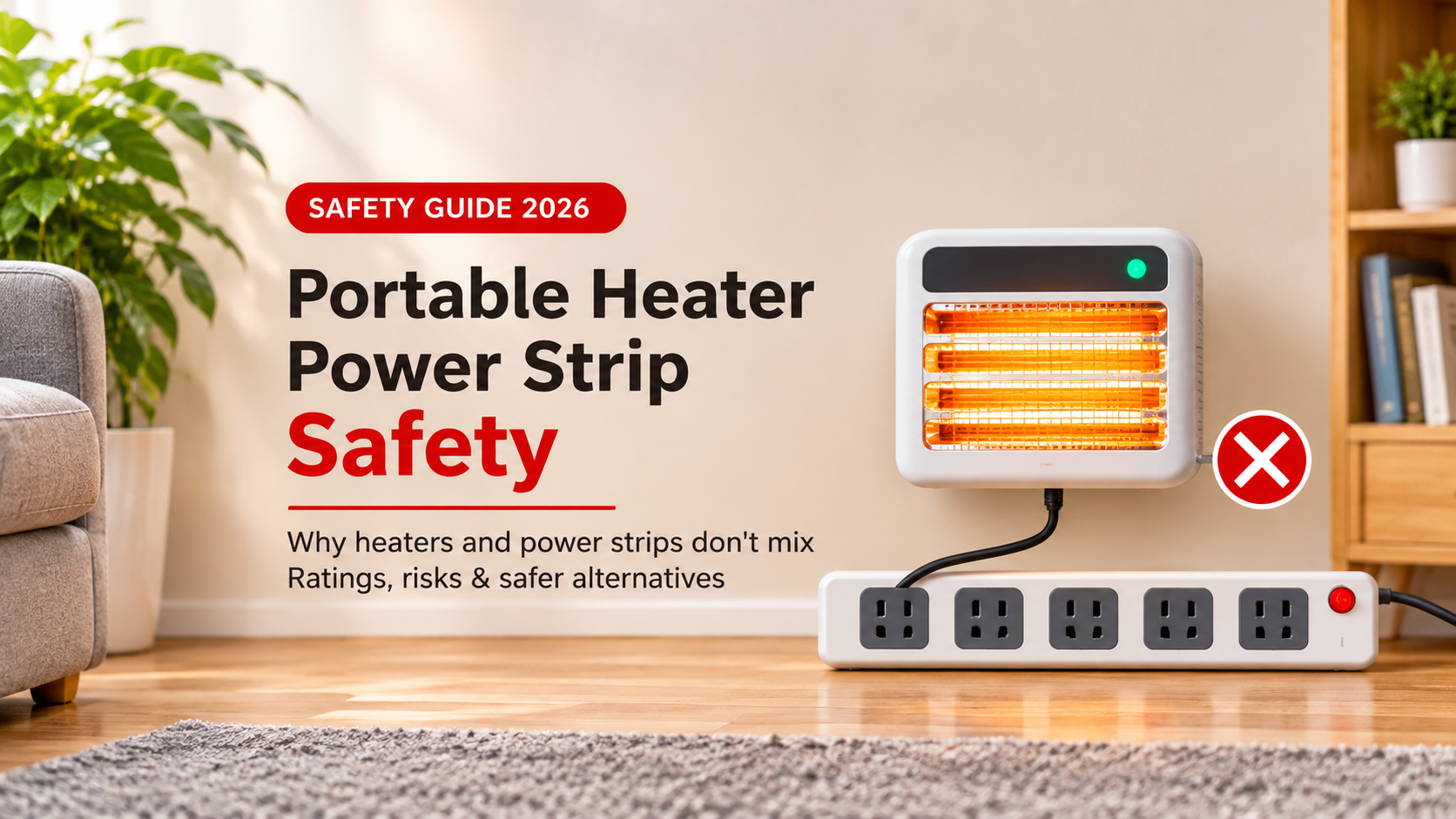
- Power strip: Several sockets on one strip. Most strips are made for light loads such as electronics. They can overheat when a heater is plugged in.
- Surge protector: Built to shield electronics from voltage spikes, not to carry a heater’s heavy load for hours. It should not power a heater.
Never plug a heater into a power strip or surge protector unless the strip is explicitly rated for that wattage, and even then it is better avoided.
Rules for Using an Extension Cord With a Heater (If You Must)
- Read your heater manual first: If it forbids extension cords, do not use one.
- Use only one cord: Never connect cords end to end (daisy-chaining).
- Use a heavy-duty cord: Prefer 12 AWG or a cord rated well above the heater’s current draw.
- Keep it short: Choose the shortest cord that works.
- Uncoil it fully: A bundled or reeled cord traps heat and can overheat.
- Do not cover the cord: Never run it under rugs, carpets, blankets or furniture.
- Do not plug anything else into the same cord or outlet: The heater should be the only load.
- Check the plug and cord regularly: Feel for warmth after 15 to 20 minutes of use. A warm cord is a warning, and a hot one means stop immediately.
- Inspect for damage: Look for cracks, bare wires, burn marks, discolouration or loose pins. Replace damaged cords at once.
- Never leave it running unattended: Turn the heater off when you leave the room or go to bed.
- Plug in firmly: Loose plugs arc and overheat.
- Keep cords away from heat: Do not let the cord touch the heater’s hot surfaces.
Warning Signs of a Dangerous Cord Setup
- The cord, plug or outlet feels warm or hot to the touch.
- You smell burning plastic or something scorched.
- The plug or outlet is discoloured, brown or melted.
- You hear buzzing, crackling or see sparks.
- The circuit breaker or fuse trips repeatedly.
- Lights dim when the heater switches on.
If you notice any of these, switch off the heater at its control, unplug it carefully and do not use that setup again until an electrician or the manufacturer has checked it.
Safer Alternatives to Using an Extension Cord
- Move the heater: Place it near a wall outlet. Heating the spot where you sit is often enough.
- Rearrange the furniture: A small layout change can free up a nearby outlet.
- Choose a heater with a longer built-in cord: Some models include a long, heavy cord designed for the appliance.
- Use a wall-mounted heater: A fixed unit connected properly by an electrician removes the cord problem altogether.
- Add a new outlet: A licensed electrician can install a socket where you need it, which is a permanent and safe solution.
- Choose a lower-wattage heater: A 750 W or 1,000 W model puts less strain on cords and circuits.
Should You Be Concerned About the Circuit Itself?
The cord is only part of the story. The wall circuit must also handle the load. A heater should ideally have a circuit to itself, without other high-power appliances such as a kettle, microwave, hair dryer or vacuum on the same line. If your breaker trips often, the circuit is overloaded, and you should call an electrician rather than resetting it again and again. Ground-fault or residual-current protection adds a valuable layer of safety, especially in damp areas.
Common Mistakes People Make
- Using a thin, light cord made for lamps or electronics.
- Buying the longest cord available “just in case”.
- Leaving a long cord wound on its reel while the heater runs.
- Plugging the heater into a power strip with other devices.
- Hiding the cord under a carpet to avoid tripping.
- Ignoring a warm plug or a hot cord.
- Continuing to use a cord with cracked insulation or bent pins.
Frequently Asked Questions (FAQ)
Is it safe to plug a space heater into an extension cord?
It is safest to plug it directly into a wall outlet. If you must use an extension cord, choose a short, heavy-duty cord with a rating higher than the heater’s power draw, and follow the safety rules above.
What gauge extension cord do I need for a 1,500 W heater?
A 12 AWG cord is a commonly recommended choice for heaters of this size, and 14 AWG may be acceptable only for very short runs within its rating. Always check the cord’s label.
Can I use a power strip with a portable heater?
No, this is not advised. Most power strips are not designed for the continuous high current a heater uses and can overheat.
How long can an extension cord be for a heater?
Keep it as short as possible. For most households, a cord of about 1 to 2 metres (3 to 6 feet) is a practical limit, and thicker wire is needed for any longer distance.
Why does my extension cord get hot when using a heater?
The cord is likely too thin, too long, coiled, damaged or overloaded. Stop using it right away and replace it with a suitable heavy-duty cord or plug into the wall instead.
Can I use an extension cord with an oil-filled radiator?
Oil-filled heaters also draw high current for long periods, so the same rules apply. Use a wall outlet whenever possible.
Do heaters with long cords exist?
Yes, some models are sold with longer built-in cords. Choosing one can remove the need for an extension cord altogether.
What happens if I use the wrong extension cord?
The cord and plugs can overheat, melt insulation, trip breakers or, in the worst case, start a fire. It can also cause the heater to perform poorly because of voltage drop.
Final Thoughts
When it comes to portable electric heater extension cord safety, the golden rule is simple: plug the heater straight into a wall outlet. If that is impossible, use a single, short, heavy-duty and properly rated cord, keep it fully uncoiled and uncovered, check it often for heat and damage, and never leave the heater running unattended.
Better still, solve the problem at the source by moving the heater, choosing a model with a longer built-in cord, or asking an electrician to add an outlet. A little care with the cord is a small price for a warm, safe home.