
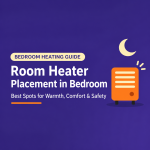
Where you put your heater in the bedroom makes a big difference. A poorly placed heater leaves cold spots, wastes electricity, and can be a serious fire risk. A well-placed one warms the room evenly, helps you sleep comfortably, and keeps you safe. This guide covers room heater placement in a bedroom: the best spots, the worst spots, how far to keep it from the bed, and how to adapt for different heater types and room layouts.
Why Heater Placement in the Bedroom Matters
- Even warmth: the right position spreads heat across the whole room, not just one corner.
- Lower energy use: good placement means the heater works less to reach the temperature you set.
- Fire safety: bedrooms are full of flammable items such as bedding, curtains, and clothes.
- Better sleep: being too close to a heater can cause overheating, dry air, and restless sleep.
- Protects family: children, pets, and elderly people are at higher risk of burns and trips.
The Golden Rule: Keep It Away From the Bed
The most important rule is simple: keep the heater at least 3 feet (about 1 metre) from the bed, bedding, curtains, clothes, and furniture. Always follow your heater manual if it asks for more space.

The Best Place for a Heater in a Bedroom
In most bedrooms, the best position is on the cold side of the room, near the window or an outside wall, on open floor space. Cold air tends to sink from windows and walls, so heating that area stops cold draughts and helps the warm air circulate through the room.

Why Near the Window or Outside Wall?
Windows and outside walls lose the most heat. Placing the heater there warms the cold air as it sinks, and sets up a circulation loop that carries heat across the room.

Choose a Position Diagonal to the Bed
If the heater is near the window, the bed is usually on a different wall. This diagonal arrangement keeps the sleeping area out of the direct hot-air stream, which is more comfortable and safer.
Place It Near a Wall Socket
Choose a position close to a wall socket so you can plug the heater in directly. Avoid extension leads and power strips, which can overheat. Route the cord along the wall, not across walkways.
Right vs Wrong Spots

Bedroom Heater Placement by Heater Type
| Heater Type | Best Bedroom Position | Placement Tips |
|---|---|---|
| Oil-filled radiator | Against or near the cold wall, on a flat floor | Very hot surface, so keep it away from the bed and children |
| Fan / ceramic heater | On the floor, facing into the room, away from the bed | Do not point it at bedding or curtains, and keep the intake clear |
| Panel / convection heater | Under a window or wall-mounted if designed for it | Follow wall mounting instructions and maintain clearance |
| Tower heater | In a corner or along a wall, upright and stable | Make sure it is on a flat surface and not near foot traffic |
| Infrared / radiant heater | Pointing at the area you want to warm, such as a desk or reading chair | Not for heating the whole room, and keep it far from flammable items |
| Small personal heater | On a hard surface close to where you sit, not on the bed | Do not leave it running while you sleep |
Placement Tips for Different Bedroom Types
Small Bedroom
Use a low-wattage heater (about 1000 to 1500 watts for many small rooms) and place it as far from the bed as the layout allows. Make sure the heater is not blocking the door or walkway.
Large Bedroom
Place the heater on the coldest side and think about a second heater or a more powerful model for even warmth. A fan can help circulate warm air.
Children’s Bedroom
Place the heater well out of reach, behind a safety guard or barrier. Choose a model with a cool-touch exterior, tip-over protection, and a child lock if possible.
Bedroom With High Ceilings
Warm air rises, so heat can collect near the ceiling. A ceiling fan on a low setting, in the right direction, helps push warm air back down.
Bedroom With Single-Glazed Windows
Windows are the main source of heat loss. Place the heater near the window, use thick curtains, and keep the curtains at a safe distance from the heater.
Common Heater Placement Mistakes in Bedrooms
- Putting the heater right beside the bed to feel warmer faster. This creates a fire and burn risk.
- Placing it under or near curtains.
- Using it on the bed, sofa, or soft carpet where it can tip or overheat.
- Blocking the heater with furniture, which stops airflow and causes overheating.
- Putting it in a walkway where it can be knocked over at night.
- Using extension cords because the socket is far away.
- Leaving it on all night and close to the bed.
How Warm Should a Bedroom Be for Sleeping?
Many sleep experts suggest a bedroom temperature in the range of about 16 to 20 degrees Celsius (roughly 60 to 68 degrees Fahrenheit) for comfortable sleep, though personal comfort varies. Use a thermostat and a timer to warm the room before bed, then switch the heater off before you sleep, unless your heater is designed for unattended use. Warm bedding and a hot water bottle can add comfort without running a heater all night.
Bedroom Heater Placement Checklist
- Is the heater at least 3 feet (1 metre) from the bed, curtains, and furniture?
- Is it on a flat, hard, stable surface?
- Is it plugged directly into a wall socket, with the cord out of the walkway?
- Is it on the cold side of the room, with open space in front?
- Can children and pets not reach it?
- Is the heater working with a thermostat or timer?
- Are there working smoke alarms in the bedroom or nearby?
What to Look for in a Bedroom Heater
If you are choosing a new heater for your bedroom, look for these features:
- Tip-over and overheat protection: important safety features, especially around beds.
- Quiet operation: look for low-noise models that will not disturb sleep.
- Adjustable thermostat and timer: keeps the temperature steady and limits run time.
- Dim or switch-off display light: prevents light from disturbing sleep.
- Cool-touch housing: reduces burn risk.
- Slim or compact design: fits easily beside the window or along a wall.
- Right wattage for the room: roughly 10 watts per square foot is a common starting point.
- Safety certification: check the product label for recognised safety marks.
Frequently Asked Questions
How far should a heater be from the bed?
At least 3 feet (about 1 metre), or the distance in the heater manual if it is larger.
Is it better to place a heater near the window?
In most bedrooms, yes. The window is the coldest area, so heating it helps stop cold air from sinking and spreads warm air across the room. Keep curtains well away from the heater.
Can I put a heater on the bed to warm it up?
No. A heater should never be placed on a bed or used to warm bedding directly, because this is a serious fire hazard.
Should I leave a heater on all night in the bedroom?
It is safer to turn it off before you sleep unless the manufacturer states it is designed for unattended use. Pre-warm the room with a timer instead.
Where should I put a heater in a small bedroom?
Put it as far from the bed as possible, on open floor space near the cold wall or window, and make sure it does not block the door.
Can I use an extension lead for a bedroom heater?
It is best to plug the heater directly into a wall socket. Extension leads and power strips can overheat under the heavy load of a heater.
Final Thoughts
Good heater placement keeps your bedroom warm, comfortable, and safe. Put the heater on the cold side of the room, keep at least 3 feet from the bed, curtains, and furniture, plug it directly into a wall socket, and never leave it running unattended while you sleep. With the right position and a few simple habits, you can enjoy a cosy bedroom all winter without taking risks.