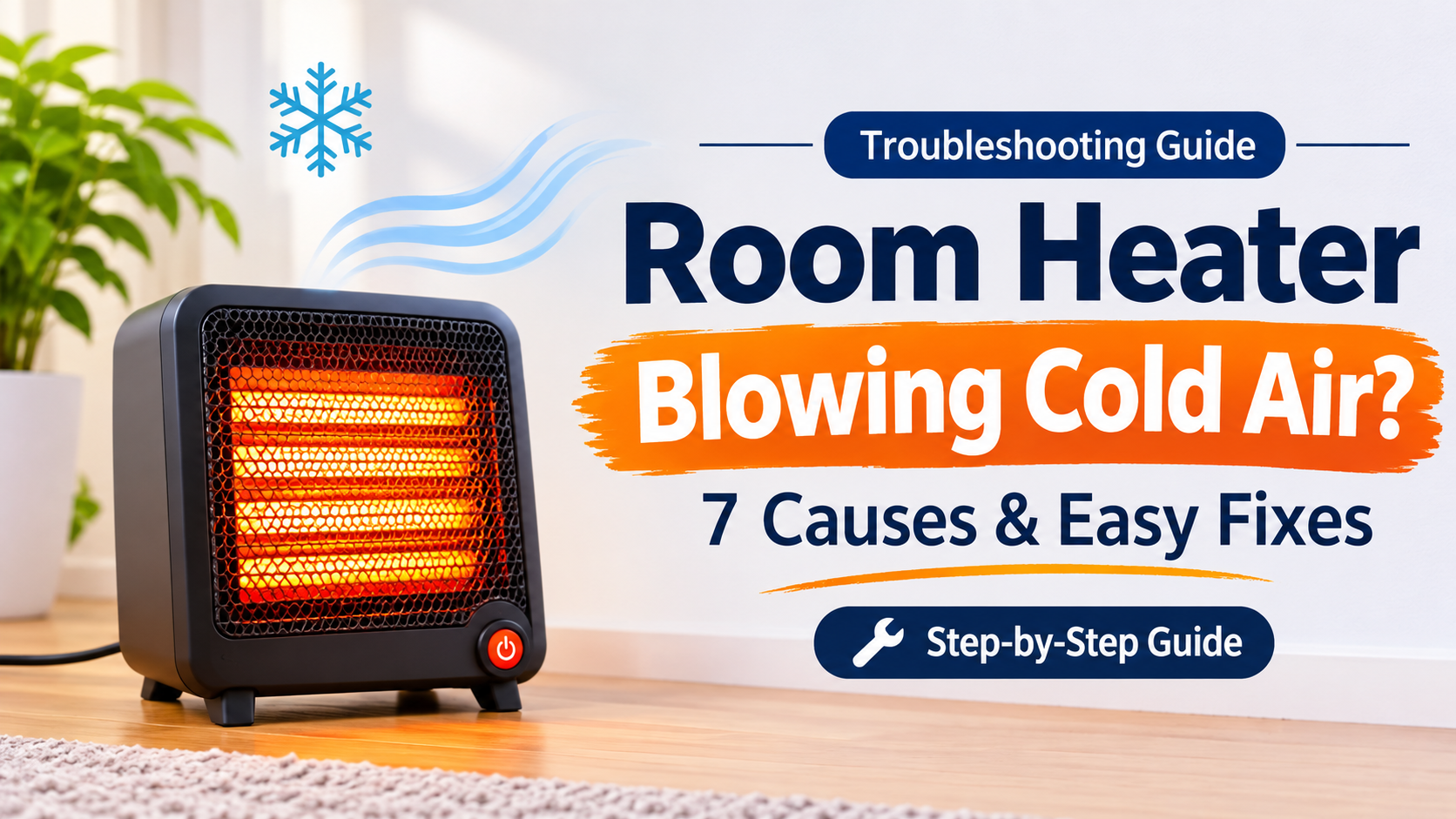

Room Heater Blowing Cold Air? 7 Causes and Easy Fixes
It is a cold evening, you switch on your heater, and instead of warm air you feel a cool breeze. A room heater blowing cold air is confusing because the fan is clearly running, yet the warmth is missing. The cause is usually simple, and many of the fixes take only a few minutes.
In this guide you will learn why a heater blows cold air, how to tell normal behavior from a real fault, how to troubleshoot step by step, and when to repair or replace your heater. The advice covers fan heaters, ceramic heaters, oil-filled radiators with fans, and halogen heaters.
Quick Answer: Why Is My Heater Blowing Cold Air?
The most common reasons are a thermostat set too low, a wrong mode such as fan-only, dust blocking airflow, a tripped overheat protection, a burnt-out heating element, low voltage, or a faulty thermostat or control board. Check the settings and clean the vents first, because they solve most cases.

Is Cold Air at Startup Normal?
Sometimes yes. Many heaters need 10 to 30 seconds before the element heats up, so the first air can feel cool. Oil-filled and some ceramic models warm up more slowly. Also, a heater that reaches your set temperature will pause heating and blow only room-temperature air.

If the air is still cold after about five minutes at maximum setting, there is a real problem.
1. Thermostat Set Too Low
The thermostat switches the heating element on and off. If it is set close to or below the current room temperature, the element stays off and only the fan runs, which feels like cold air.
Fix: Turn the thermostat to the maximum setting, wait a few minutes and feel the air again. If the heat returns, the heater is fine and you only need to adjust the setting.
2. Wrong Mode or Fan-Only Setting
Many heaters have separate options such as fan only, low heat and high heat. Selecting fan-only, eco, or a low-power mode can give you little or no heat.
Fix: Choose the highest heat mode and check that the heat indicator light is on. Read the control panel carefully, since symbols differ between models.
3. Dirty Filter or Blocked Vents
Dust and lint are the most common hidden cause. When the air intake or outlet is blocked, the heater overheats internally and the safety system reduces or turns off the heating element, while the fan still runs.
How to clean it safely:
- Switch off the heater, unplug it and wait at least 30 minutes.
- Remove or wipe the dust filter if your model has one.
- Use a soft brush or vacuum cleaner on the grille and vents.
- Wipe the outer body with a dry or slightly damp cloth. Never spray liquid inside.
- Make sure there is free space around the heater for airflow.

4. Overheat Protection Has Tripped
When the heater gets too hot, a thermal cut-off turns off the heating element to prevent damage or fire. In many models the fan keeps running to cool the unit, which is why you may feel cold air.
Fix: Unplug the heater and let it cool for 30 to 60 minutes. Clean the vents, press the reset button if there is one, and restart on a flat surface. If the problem comes back quickly, there is a deeper issue such as a weak fan or failing thermostat.
5. Burnt-Out or Damaged Heating Element
The heating element, a coil, ceramic plate or halogen tube, produces the heat. When it breaks, the heater still turns on and the fan blows, but the air stays cold. Signs include no glow in a visible element, no warm smell, and the heat indicator on but no warmth at all.
Fix: A burnt element usually needs professional replacement. For low-cost heaters, buying a new unit is often cheaper than repair.
6. Low Voltage or Power Supply Problem
A heater needs strong, stable power. Low voltage, a loose plug, a worn socket or an extension cord can reduce the power reaching the element so the heater produces weak heat.
- Plug the heater directly into a wall socket.
- Do not use thin extension cords or multi-plugs.
- Avoid running other heavy appliances on the same circuit.
- If lights dim when the heater starts, ask an electrician to check your supply.
7. Faulty Thermostat or Control Board
If the settings are right, the vents are clean and the heater still blows cold air, the thermostat sensor or control board may be failing. A bad thermostat can think the room is already warm and never turn on the element.
This repair involves internal parts, so it should be done by a qualified technician.
Cold Air Problems by Heater Type
| Heater Type | Common Cause | Quick Fix |
|---|---|---|
| Fan heater | Dust, overheat trip, fan-only mode | Clean vents, reset, select heat |
| Ceramic heater | Thermostat setting, blocked airflow | Set to max, clean grille |
| Oil-filled radiator | Slow warm-up, low power setting | Wait 15 to 30 minutes, set to max |
| Halogen / infrared | Burnt tube, tip-over safety | Level surface, check tube |
Step-by-Step Troubleshooting Checklist
- Wait 5 minutes at maximum heat to rule out a slow start.
- Check that the mode is set to heat, not fan-only.
- Turn the thermostat to maximum.
- Unplug, cool down, and clean the filter and vents.
- Reset the heater by leaving it unplugged for 30 to 60 minutes.
- Plug directly into a wall socket and test again.
- If the air is still cold, contact a technician or consider a replacement.
Repair or Replace?
Repair if the heater is relatively new, under warranty, or the fault is a thermostat or switch on a quality model.
Replace if the heater is more than 5 to 7 years old, the heating element is burnt, the repair cost is more than half the price of a new heater, or you notice melting, sparks or a strong burning smell.
Safety Tips
- Never leave a heater running while sleeping or away from home.
- Keep it at least 3 feet from beds, curtains, sofas and clothes.
- Do not use a heater with a damaged cord or plug.
- Stop using it at once if you smell burning or see sparks or smoke.
- Never open the heater while it is plugged in.
How to Prevent Cold Air Problems
- Clean vents and filters every 1 to 2 weeks in the heating season.
- Test your heater before winter arrives.
- Keep it on a flat, hard surface with free airflow.
- Choose the right wattage for your room size.
- Store it dry and covered after the season.
What to Look for in a New Room Heater
- Right wattage: about 1000 to 1500 W for a medium room, more for large rooms.
- Safety features: tip-over switch, overheat protection and cool-touch body.
- Adjustable thermostat and clear heat modes.
- Easy-to-clean design with a removable filter.
- Warranty and local service support.
Frequently Asked Questions (FAQ)
Why is my room heater blowing cold air instead of hot air?
The most common reasons are a low thermostat setting, fan-only mode, blocked vents, a tripped overheat protection or a burnt heating element.
Is it normal for a heater to blow cold air at first?
Yes, for a short time. Many heaters need 10 to 30 seconds to warm up, and some types take longer. If the air is still cold after five minutes, there is a problem.
Why does my heater blow cold air after running for a while?
This often means overheat protection has tripped because of dust or poor airflow, or the heater has reached the set temperature and paused heating.
Can a dirty filter cause cold air?
Yes. A clogged filter or vents block airflow, cause overheating and lead the safety system to shut off the element while the fan continues.
How do I know if the heating element is broken?
If the fan runs, the settings are correct, the vents are clean and there is still no heat even at maximum, the element is likely burnt out. A technician can confirm this.
Is it safe to use a heater that blows cold air?
If there is no burning smell, smoke or sparks, it is safe to run basic checks. If you notice any warning signs, unplug the heater and stop using it.
Final Thoughts
A room heater blowing cold air is usually caused by something simple: a low thermostat, the wrong mode, dust or a tripped safety cut-off. Follow the steps in this guide in order, clean your heater regularly and put safety first. If the heater still blows cold air after the basic checks, a professional repair or a new, correctly sized heater will keep your room warm all winter.