
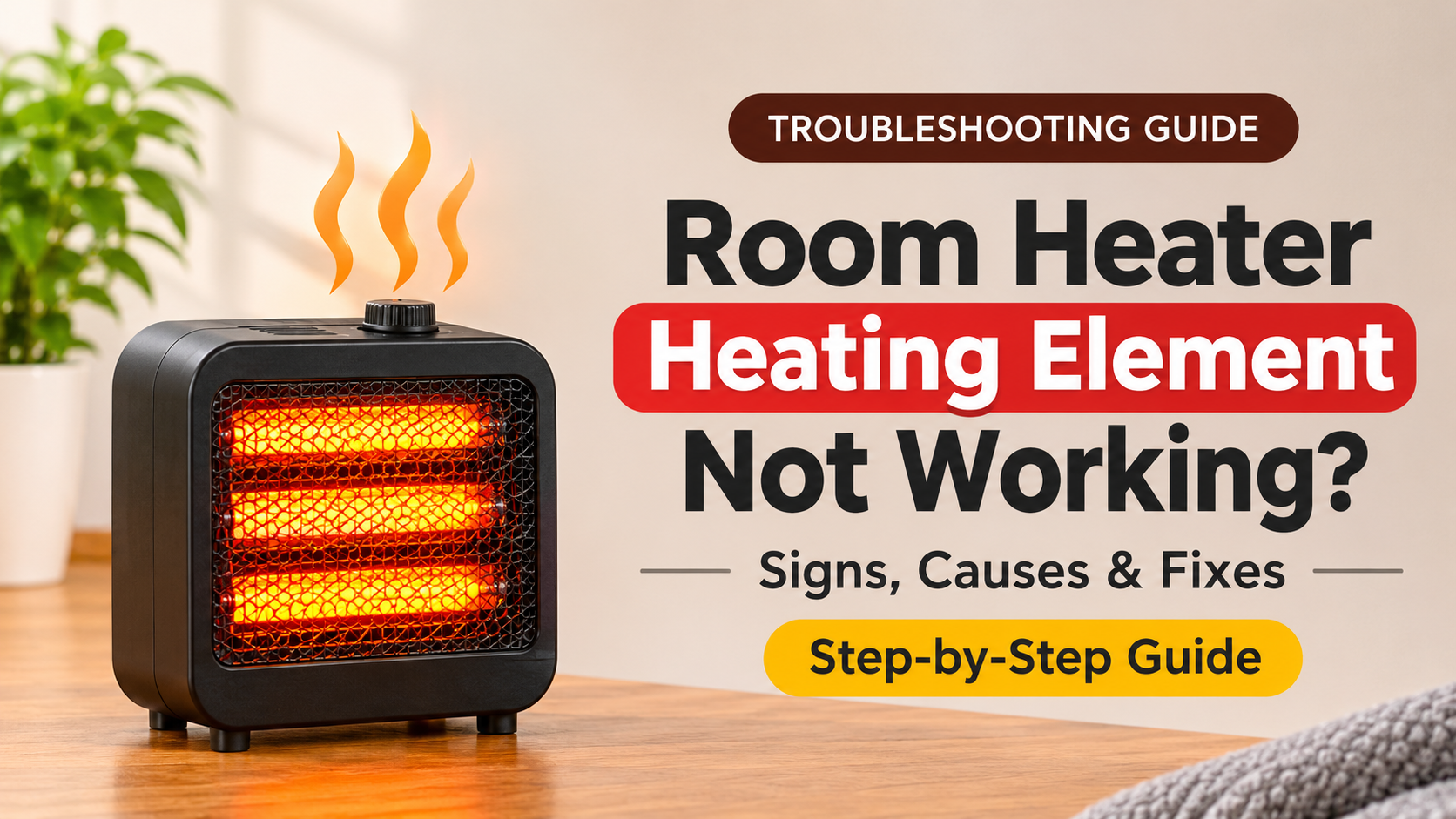

Room Heater Heating Element Not Working? Signs, Causes and Fixes
The heating element is the part of your room heater that actually makes the heat. When it fails, the fan may still run, the lights may still glow and the controls may still respond, but the air coming out stays cold. A room heater heating element not working is one of the most common reasons a heater stops warming a room.
In this guide you will learn what a heating element is, the clear signs of a failed element, the most common causes, how to rule out simpler problems first, what a technician will check, and when it is smarter to replace the whole heater.
Quick Answer: Why Is My Heater Element Not Working?
A heating element usually stops working because of age and wear, a broken or burnt coil, a blown thermal fuse, a loose wire or terminal, a faulty thermostat or switch that does not send power to it, a failed ceramic plate, damage from overheating or corrosion from moisture. Before blaming the element, check the thermostat, mode, power and safety switches, because they cause very similar symptoms.

What Is a Heating Element and How Does It Work?
A heating element is a resistor that turns electricity into heat. When current passes through it, it becomes hot. In a fan heater, the fan blows air across the element and into the room. In radiant heaters, the element glows or warms a surface that gives off heat.
| Element Type | Found In | How It Looks |
|---|---|---|
| Coil (nichrome wire) | Fan heaters, basic radiant heaters | Coiled metal wire that may glow orange |
| PTC ceramic plate | Ceramic and tower heaters | Honeycomb or flat ceramic plates, no glow |
| Quartz or halogen tube | Infrared and halogen heaters | Glass tube that glows orange or white |
| Immersion element in oil | Oil-filled radiators | Sealed inside the oil, not visible |
Signs That the Heating Element Has Failed
- The fan runs but the air stays cold at every setting.
- No glow in the coil or tube on heaters where it normally glows.
- Heat at only one setting: some heaters have two or more elements, and one may fail.
- Weak or uneven heat and a long time to warm the room.
- The breaker trips the moment the heat starts.
- A burning, sparking or crackling sign from the element area.
- A visible break: a snapped, sagging or blackened coil or a cracked glass tube.
Is It Really the Element? Check These First
Many heater problems look like element failure but are not. Rule these out first, because they are much cheaper and easier to fix.

- Thermostat set too low so the heater thinks the room is warm.
- Fan-only or eco mode selected instead of heat.
- Overheat protection tripped because of dust or blocked vents.
- Tip-over switch engaged because of a tilted heater.
- Loose plug, bad socket or tripped breaker reducing power.

1. Age and Normal Wear
Heating elements work under high temperature every day. After years of heating and cooling, the metal becomes brittle and thin and can eventually break, especially in heaters used heavily every winter.
Fix: On an old heater, a failed element is a sign that the heater is near the end of its life. Replacement of the heater is usually the better choice.
2. Broken or Burnt Coil
A coil can snap from vibration, a hard knock, overheating or a power surge. A broken coil stops the current, so there is no heat even though the fan works.
Signs: a visible gap, a sagging coil or black burn marks, or a coil that no longer glows.
3. Blown Thermal Fuse
Many heaters have a one-time thermal fuse in series with the element. If the heater overheats badly, the fuse blows and cuts power to the element permanently.
Sign: the fan and lights work but the element stays cold, often after an earlier overheating or burning smell. Replacing a thermal fuse should be done by a technician, and the cause of the overheating must be found first.
4. Loose Wire or Terminal
Vibration and repeated heating can loosen the wires or terminals that feed the element. A loose connection can cause on and off heating, sparks, a hot connector or no heat at all.
This is an internal electrical fault. Do not open the heater to tighten wires yourself unless you are trained.
5. Faulty Thermostat or Switch
Sometimes the element is fine, but the thermostat, power selector or relay does not send power to it. The result looks the same: fan runs, no heat.
Clue: the heater works at some settings but not others, or the dial feels loose and does not click. A technician can test the controls and the element separately.
6. Failed PTC Ceramic Plate
Ceramic heaters use PTC (positive temperature coefficient) plates that limit their own temperature. They can crack from knocks, heat cycles or dust. A cracked plate may heat weakly or not at all.
Fix: PTC plates are often replaced as a module by a technician. On low-cost ceramic heaters, buying a new heater is usually more practical.
7. Overheating Damage
Dust, blocked vents or a weak fan make the element run hotter than designed. Over time this weakens the element and surrounding parts and can blow the thermal fuse.
- Unplug the heater and let it cool for at least 30 to 60 minutes.
- Clean the vents and grille with a soft brush or vacuum.
- Keep at least 3 feet of free space around the heater.
- Never cover the heater or dry clothes on it.
8. Moisture or Corrosion
Humidity, spills or use in a damp area such as a bathroom can corrode the element or its connections and cause failure or short circuits. In oil-filled heaters, a leak can also damage the element.
Fix: Keep the heater dry and use only heaters rated for damp areas in bathrooms. If the heater got wet, unplug it and do not use it until it has been checked.
Heating Element Problems by Heater Type
| Heater Type | Likely Element Problem | Practical Option |
|---|---|---|
| Fan heater (coil) | Broken coil, blown fuse | Replace unit unless premium |
| Ceramic heater (PTC) | Cracked plate, control fault | Technician or replace |
| Halogen / infrared (tube) | Burnt or cracked tube | Tube is replaceable on many models |
| Oil-filled radiator | Element failure or oil leak | Replace unit |
Step-by-Step Troubleshooting Checklist
- Check the socket, plug and breaker, then try another socket.
- Make sure the mode is set to heat and the thermostat is at maximum.
- Place the heater on a flat, hard surface to rule out the tip-over switch.
- Unplug the heater and let it cool for at least 30 to 60 minutes.
- Clean the vents and grille, then restart and press reset if your model has one.
- With the heater unplugged and cool, look through the grille for a broken, sagging or blackened coil or a cracked tube. Do not touch it.
- If the heater still has no heat and the fan runs, the element, thermal fuse or controls are likely at fault. Stop using it and contact a technician.
What a Technician Will Check
A qualified technician can test the element with a meter to see whether current can flow through it, and check the thermal fuse, thermostat, switch and wiring separately. This testing is done with the heater unplugged and requires knowledge of electrical safety, so it should not be attempted at home without training.
Repair or Replace?
Repair if the heater is relatively new, still under warranty, or a premium model where the element, tube or fuse is easy to replace.
Replace if the heater is more than 5 to 7 years old, the element is burnt, the oil radiator is leaking, other parts are failing or the repair cost is more than half the price of a new heater.
Safety Tips
- Never open a heater while it is plugged in or touch the element.
- Do not use a heater that sparks, smokes, smells of burning or trips the breaker repeatedly.
- Do not use extension cords or multi-plugs with a room heater.
- Keep the heater away from curtains, beds and furniture.
- Never leave a heater running while you sleep or are away.
How to Make a Heating Element Last Longer
- Clean vents and the grille every 1 to 2 weeks in the season.
- Keep the heater on a flat, stable surface and avoid knocks and drops.
- Do not cover it or block airflow.
- Use the thermostat and timer instead of running it nonstop.
- Use a direct wall socket and avoid voltage drops from extension cords.
- Store it dry and covered after winter and test it before the next season.
What to Look for in a New Room Heater
- Durable heating element type such as ceramic PTC for safe, self-limiting heat.
- Overheat protection, tip-over switch and a cool-touch body.
- Adjustable thermostat and multiple heat settings.
- Right wattage for your room size.
- Easy-to-clean design with a removable filter or grille.
- Warranty and local service support.
Frequently Asked Questions (FAQ)
How do I know if my heater element is bad?
The most common sign is a heater that runs, with a working fan and lights, but produces no heat at any setting. A visible broken coil or a coil that no longer glows also points to a bad element.
Why is my heater fan working but there is no heat?
The fan and the element are separate parts. If the fan works but the air is cold, the cause is usually the element, a blown thermal fuse, a faulty thermostat or switch, or a tripped overheat protection.
Can I replace a heater element myself?
It is not recommended unless you are trained. Elements are connected to high-current wiring, so replacement should be done by a qualified technician with the heater unplugged.
How long does a heater element last?
With normal use and good care, a heating element can last many years, often as long as the heater itself. Heavy use, dust, overheating and knocks can shorten its life.
Is it worth repairing a heating element?
For low-cost heaters, replacing the heater is usually cheaper. For premium heaters or those under warranty, repair can be worthwhile.
Why does my heater only work on the high setting?
Some heaters use more than one element. If one fails, you may get heat only at the higher setting. A faulty switch or thermostat can also cause this.
Is a heater with a bad element dangerous?
A dead element itself is not dangerous, but the cause can be. If there is a burning smell, sparks, smoke or a tripping breaker, unplug the heater and stop using it.
Final Thoughts
When a room heater heating element is not working, the heater may look fine but give you no warmth. Check the simple causes first, such as the thermostat, mode, safety switches and power supply, then clean the vents and look for obvious damage with the heater unplugged and cool. If the fan runs but there is still no heat, the element, thermal fuse or controls need professional attention. For older or low-cost heaters, replacing the heater with a safe, well-built model is often the smartest choice.