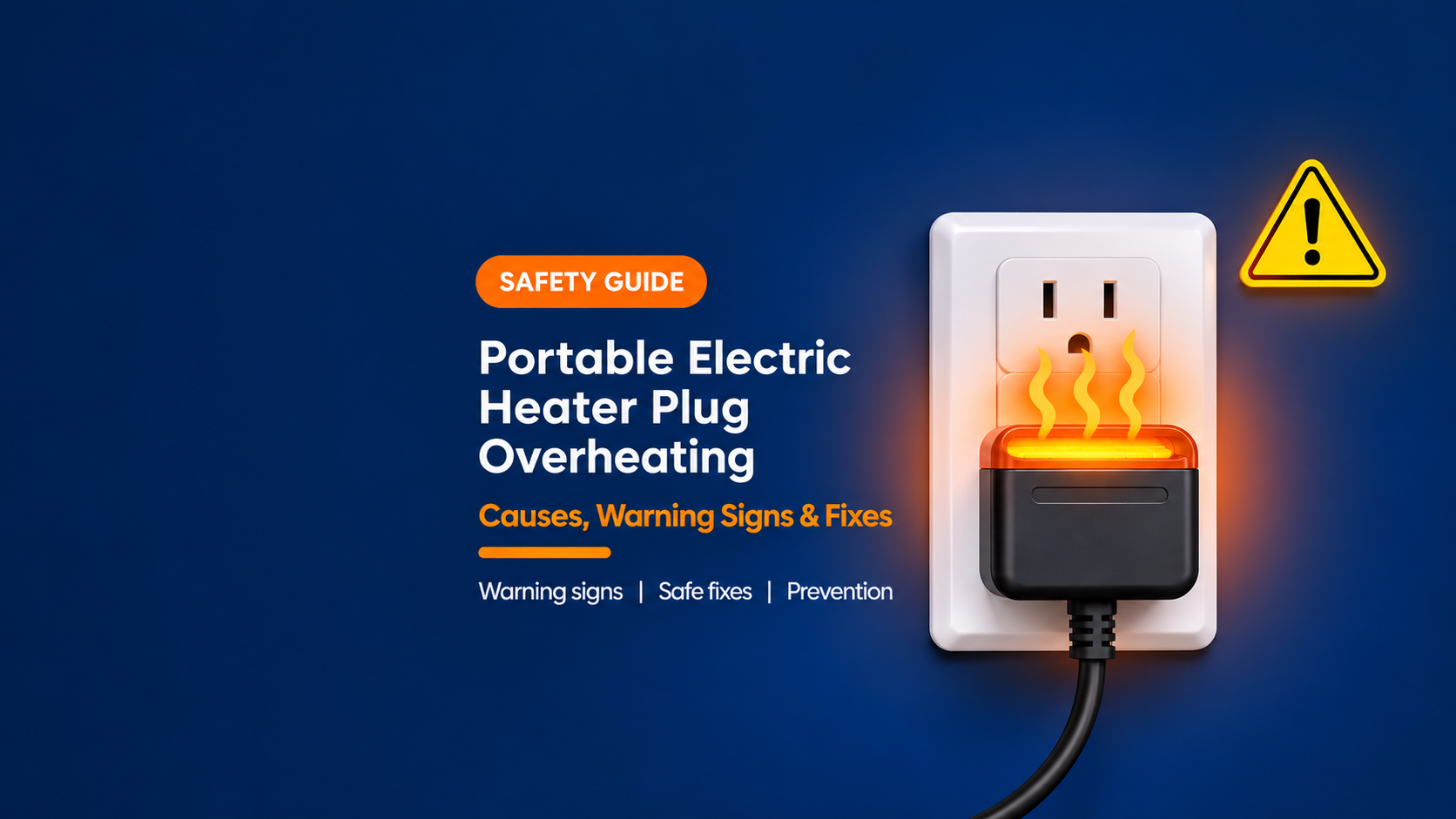
Portable Electric Heater Plug Overheating: Causes, Warning Signs and How to Fix It

You have been running your portable electric heater for an hour, and when you reach down to check the plug it feels hot. Maybe the plastic looks slightly discoloured, or the socket smells a little off. A hot plug is one of the most common warning signs of an electrical problem with portable heaters, and it deserves your attention.
This guide explains why a portable electric heater plug overheats, how to tell normal warmth from dangerous heat, what to do immediately, and how to prevent the problem. It applies to ceramic fan heaters, oil-filled radiators, convection panels and infrared heaters, because they all draw a lot of power through the same kind of plug and socket.
Key Takeaways
- Portable heaters draw a high current, so a plug that is slightly warm after long use can be normal. A plug that is too hot to hold comfortably is not.
- The most common causes are a loose plug fit, a worn or damaged socket, an extension cord or power strip, an overloaded circuit and a damaged cord.
- Discolouration, soft or melted plastic, a burning smell, buzzing, crackling or a tripping breaker are signs to stop using the heater.
- Plug the heater directly into a good wall socket, and do not share that socket with other high-power appliances.
- Do not repair plugs or wiring yourself. Replace damaged parts and have sockets checked by a qualified electrician.
In This Guide
- Why heater plugs get hot
- How much current a heater really draws
- Normal warmth versus overheating
- Warning signs to watch for
- Is it the plug or the socket?
- What to do right now
- How to prevent plug overheating
- Buying tips and FAQs
Why Does a Portable Electric Heater Plug Get Hot?
Electric current always produces some heat as it flows through a conductor. Normally the plug, cord and socket are designed to carry the current with very little resistance, so the heat is small and harmless. Problems start when something adds resistance at a connection point. The same current then produces much more heat in a small area, and the plug or socket can overheat.

1. A Loose Plug Fit
If the plug does not grip the socket firmly, the metal contacts touch only lightly. That poor contact adds resistance and creates a hot spot. Sockets lose their grip over time, especially if they have been used with heavy plugs or have been pulled on repeatedly. A plug that wobbles or slides out easily is a warning sign.
2. Extension Cords and Power Strips
Many heater manuals tell you to plug the heater directly into a wall socket. Extension cords and power strips add extra connections, and many are not rated for the continuous high current a heater draws. Thin or coiled cords, and strips with several appliances plugged in, can overheat quickly. This is one of the most common causes of dangerous plug and cord heating.
3. An Overloaded Socket or Circuit
Heaters are among the highest-power appliances in a home. If other high-power devices share the same socket or circuit, the total current may exceed what the wiring is designed to carry for long periods. The plug may then run hot, the breaker may trip, or the wiring behind the wall may be stressed.
4. A Damaged Plug or Cord
Cracked plug bodies, bent pins, frayed insulation and cords that have been crushed, kinked or pulled can increase resistance at the damaged spot. Because a heater draws a lot of current, even a small fault can produce noticeable heat.
5. A Worn, Dirty or Burnt Socket
Corroded, dirty or previously scorched socket contacts do not conduct as well as clean ones. Once a socket has overheated, it tends to get worse each time, because the damaged contacts create more resistance. A scorched or brown socket should not be used again until an electrician has checked it.
6. A Low-Quality Cord or Plug
Heaters with thin cords, poorly made plugs or loose internal connections can struggle to handle their rated power. Cheap, uncertified products are more likely to have these problems, which is why safety markings and good build quality matter.
How Much Current Does a Portable Heater Draw?
Understanding the numbers shows why heater plugs are more demanding than the plugs on lamps or phone chargers. The current in amps equals the power in watts divided by the voltage. Most portable heaters are rated between 1,000 and 2,000 watts.
| Heater Power | Approx. Current at 120 V | Approx. Current at 230 V |
|---|---|---|
| 1,000 W | about 8.3 A | about 4.3 A |
| 1,500 W | about 12.5 A | about 6.5 A |
| 2,000 W | about 16.7 A | about 8.7 A |
Values are calculated approximations. Always check the rating label on your own heater and the limits of your socket and circuit.
On a 120 V supply, a 1,500 watt heater draws around 12.5 amps, which is a large share of a typical 15 amp circuit. In regions that use a common guideline of keeping continuous loads below about 80 percent of a circuit’s rating, that leaves very little room for anything else on the same circuit. On 230 V supplies the current is lower, but a heater still draws far more than most household devices, so connection quality still matters.
Normal Warmth or Overheating?
Because heaters draw so much current, a plug can feel slightly warm after hours of use and still be working within safe limits. The key is how warm, and whether anything else seems wrong. If the plug is too hot to keep your hand on, or you notice other warning signs, it is overheating.

To check, switch the heater off and unplug it after it has been running for a while, then touch the plug body briefly and carefully. Do not grab hot metal contacts, and never touch a plug that is smoking, melting or sparking. If you are not sure, treat it as overheating.
Heater Plug Warning Signs
Overheating often gives warnings before something fails. Watch for the signs below, and act according to how serious they are.

A Hot Plug, Cord or Socket
If the plug, the cord near the plug or the wall plate around the socket is noticeably hot, something is creating resistance. Unplug the heater, let everything cool and stop using that combination until you find the cause.
Discolouration or Scorch Marks
Brown or black marks on the plug pins, the plug body or the socket show that heat has already damaged the parts. This will not fix itself. The damaged parts should not be used again.
Soft or Melted Plastic
Plastic that is soft, deformed or melted means the temperature has become severe. Unplug the heater only if it is safe to do so, and do not use it again.
Burning Smell, Buzzing or Crackling
A burning smell near the plug, or buzzing and crackling sounds from the socket, can indicate arcing, which is when electricity jumps across a poor connection. This is dangerous. Stop using the heater and, if it is safe, switch off the power at the breaker.
Tripping Breakers or Flickering Lights
A breaker that trips whenever the heater runs points to an overload or an electrical fault. Repeatedly resetting it is not a solution. Stop using the heater and have the circuit checked.
Is It the Plug or the Socket?
Working out where the problem is helps you decide what to replace. If the plug and cord are undamaged, you can compare how the plug behaves in different sockets, one at a time, on separate circuits. Never test a plug that shows melting, scorching or damage.
| What You Notice | Likely Problem | What to Do |
|---|---|---|
| Plug gets hot in one socket but stays cool in another | Worn, loose or overloaded socket or circuit | Stop using that socket and have an electrician check it |
| Plug gets hot in every socket | Faulty plug, cord or heater | Stop using the heater and replace it or the cord |
| Cord is warm along its length | Damaged, coiled or undersized cord | Uncoil it fully. If it is damaged, stop using it |
| Extension cord or strip is hot | Cord not rated for the heater’s power | Remove it and plug directly into a wall socket |
What to Do If Your Heater Plug Is Overheating
If you find a hot plug, act in this order.

- Switch off the heater. Use the heater’s own switch first.
- Unplug it carefully. Pull the plug body, not the cord. If the plug is melting, sparking or smoking, do not touch it. Switch off the power at the breaker instead, if you can do so safely.
- Let everything cool. Wait until the plug, cord and socket are completely cool.
- Inspect the parts. Look for discolouration, melting, bent pins, cracks, frayed insulation or a loose fit in the socket.
- Stop using damaged parts. Do not use a damaged heater, cord or socket, even if it seems to work.
- Get it checked. Replace the heater or cord if they are damaged, and have a qualified electrician inspect any socket that is loose, hot or scorched.
If You See Smoke, Sparks or Flames
Do not touch the plug or try to put out an electrical fire with water. If it is safe, switch off the power at the main breaker. Leave the room, get everyone out of the building and call your local emergency services.
Should You Replace the Plug Yourself?
Rewiring or replacing a plug on a heater is not a casual repair. Heaters carry high current, and a poorly fitted plug can overheat even more than the original. Unless you are qualified, do not cut off or refit a plug. A damaged heater cord or plug is best handled by replacing the whole heater or having a qualified technician repair it. Fixed wiring and wall sockets should only be repaired by a qualified electrician.
How to Prevent a Heater Plug From Overheating
Most plug overheating is preventable with a few safe habits.

- Plug directly into a wall socket. Avoid extension cords and power strips unless the heater’s manual specifically allows them.
- Check the socket first. It should grip the plug firmly and show no scorch marks, cracks or looseness.
- Give the heater its own socket. Do not run other high-power appliances from the same socket or double adapter.
- Push the plug in fully. A half-inserted plug has poor contact and heats up.
- Inspect the cord and plug regularly. Look for fraying, cracks, kinks, bent pins and discolouration.
- Keep the cord uncoiled and clear. Do not run it under rugs or furniture, and avoid tight bends near the plug.
- Do not tape or wrap the plug. Covering a plug traps heat and can hide damage.
- Unplug by the plug body. Pulling on the cord can loosen internal connections over time.
- Do not leave the heater unattended. Switch it off and unplug it when you leave the room or go out, unless the manual says otherwise.
If You Must Use an Extension Cord
The safest choice is always to plug the heater directly into the wall. If you genuinely have no alternative and the heater’s manual allows it, use a single heavy-duty extension cord that is clearly rated for at least the heater’s power. Keep it as short as possible, uncoil it completely, plug nothing else into it, and check it regularly for warmth. If the cord ever feels hot, stop using it. A power strip or multi-way adapter is not a safe substitute for a wall socket when running a heater.
Choosing a Heater With Safer Electrical Design
If you are replacing a heater because of plug problems, these features are worth looking for:
- A thick, well-made cord and a solid plug suited to the heater’s rated power.
- A recognised safety certification mark showing the product was tested to a safety standard.
- Overheat protection and tip-over protection to cut power in unsafe conditions.
- A reliable thermostat so the heater cycles rather than drawing full power continuously.
- Adjustable power settings so you can use a lower wattage when full power is not needed.
- Extra plug protection on a few models that cut power if the plug overheats. Check the product description for details.
Choose a heater whose wattage suits your room. A well-matched heater reaches the target temperature and then cycles, rather than drawing maximum current for hours.
Frequently Asked Questions
Is it normal for a portable heater plug to be warm?
A plug can feel slightly warm after long use because heaters draw a high current. It should not be too hot to hold, keep getting hotter, or show any discolouration, smell or noise. If you are unsure, unplug the heater and investigate.
Why is my heater plug hot but the heater seems fine?
The heater itself may be working normally while the plug, socket or cord has a poor connection. Heat builds up where there is extra resistance, so a loose fit, worn socket or damaged plug can overheat even when the heater is fine.
Can I use an extension cord with a portable heater?
The safest option is to plug the heater directly into a wall socket. Many manufacturers advise against extension cords. If one is unavoidable, it must be heavy-duty, fully uncoiled and rated for at least the heater’s power.
Can I use a power strip with a heater?
No. Power strips are not designed for the continuous high current of a heater, and they add extra connections that can overheat. Plug the heater directly into a wall socket.
Can an overheating plug cause a fire?
Yes. Overheating plugs and sockets can melt plastic and ignite nearby materials. That is why discolouration, a burning smell or melted plastic should be treated as a reason to stop using the heater immediately.
Why does the plug only get hot on the highest setting?
The highest setting draws the most current, so any weakness in the plug, cord or socket shows up most there. Treat that as a sign of a weak connection or an overloaded circuit, and check the plug and socket before using the heater again.
Should I replace a heater with a hot plug?
If the plug shows damage or discolouration, or stays hot in every socket you try, replacing the heater is usually the safest option. If the plug only heats in one socket, the socket may be at fault and should be checked by an electrician.
Final Thoughts
A hot plug is your heater’s way of telling you that electricity is meeting resistance somewhere it should not. Mild warmth after long use can be normal, but a plug that is too hot to hold, discoloured, smelly, noisy or soft is a warning to stop. Most problems come from loose or worn sockets, extension cords and power strips, overloaded circuits and damaged cords.
Plug your heater directly into a good wall socket, give it a circuit to itself where possible, inspect the cord and plug regularly, and never ignore the warning signs. If a plug or socket is damaged, replace the heater or have an electrician fix the socket. A few simple checks can keep you warm and keep your home safe.