Portable Electric Heater Tip-Over Switch: How It Works, Why It Trips and How to Fix It
Few safety features are as simple, or as important, as the tip-over switch in a portable electric heater. Heaters get knocked by pets, bumped by children and nudged by vacuum cleaners, and a heater that keeps running while lying on its side can ignite carpet, bedding or curtains within minutes. The tip-over switch is there to make sure that never happens.
It is also one of the most common reasons a perfectly good heater will not turn on, or keeps shutting itself off. This guide explains what a tip-over switch is, how the different types work, why yours might be tripping when the heater looks upright, and how to fix it safely. You will also find buying advice for choosing a stable, well-protected heater.
A tip-over switch (also called a tilt switch or fall-over switch) automatically cuts power to a portable heater if it tilts, falls or is lifted. If your heater will not start or keeps turning off, the switch is probably being triggered by an uneven or soft surface, a missing foot, dust or debris stuck in the switch, or a worn switch. Unplug the heater, place it on a flat, hard floor, check the base and feet, clear any dust from the switch area and test it again while you watch. Never tape, wedge or hold the switch down to bypass it.
In this guide you will learn:
- What a tip-over switch is and why every portable heater needs one
- How mechanical, ball-type and electronic tilt sensors work
- The most common reasons a tip-over switch trips
- A 5-step fix for a heater that will not stay on
- Signs that the switch has failed and the heater should be replaced
- What to look for in a stable heater with reliable tilt protection
What Is a Tip-Over Switch?
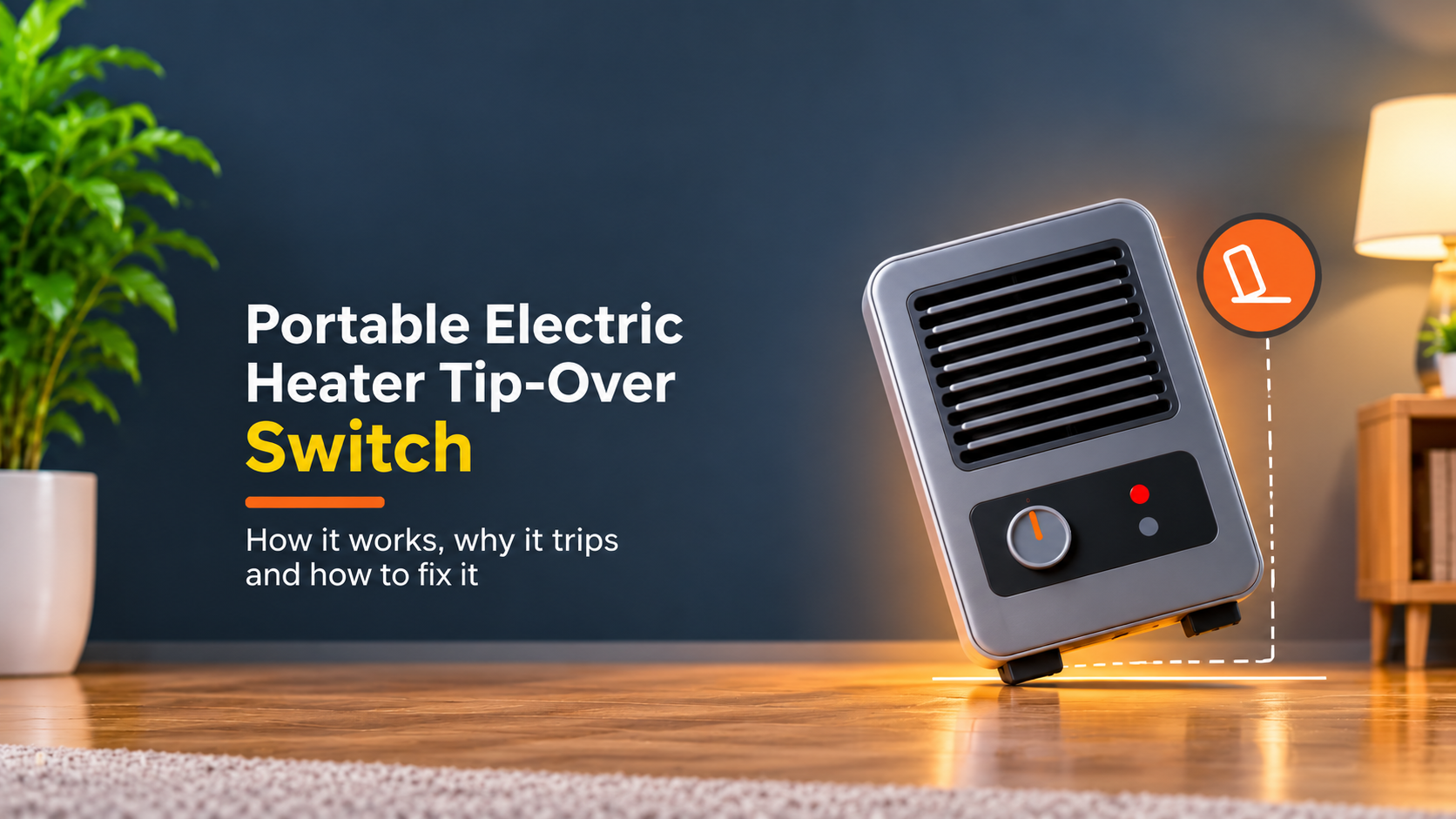
A tip-over switch is a safety device inside a heater that detects when the heater is no longer standing upright on a stable surface. When that happens, it breaks the electrical circuit to the heating element, so the heater stops producing heat almost immediately. Once the heater is upright and stable again, most models restart automatically or after you press the power button or reset.
The feature is standard on reputable portable heaters, and major safety standards for portable room heaters commonly require protection against tipping. It is designed to guard against two main risks: a fallen heater igniting whatever it lands on, and a heater being carried or moved while still hot and powered.
How a Tip-Over Switch Works
The basic idea is the same on every heater: the switch stays closed only while the heater is upright and resting on its base. Tilt it beyond a set angle, or lift it off the floor, and the switch opens.
Mechanical (plunger or button) switches
Many heaters use a spring-loaded plunger or button on the underside. The heater’s weight pushes it in against the floor, which keeps the circuit closed. If the heater falls over or is lifted, the spring pushes the plunger out and the contacts open. These switches are simple and reliable, but they can be affected by dust, fluff, a rug edge or a missing foot that changes how the heater rests on the floor.
Ball or pendulum tilt switches
Another common design uses a small metal ball or weighted pendulum that rests in a cradle inside the heater and holds the contacts together. If the heater tilts past a certain angle, the ball rolls out of position or the pendulum swings away, and the circuit opens. Because the switch senses angle rather than floor contact, it can trip on a sloping floor or when the heater leans against a wall.
Electronic tilt sensors
Many digital and smart heaters use an electronic sensor, such as an accelerometer, connected to a control board. The board constantly monitors the heater’s orientation and cuts power if it detects a fall or a lean beyond a set limit. Some models also display a warning or error code when this happens, which makes problems easier to diagnose.
The exact tilt angle that triggers the switch differs between models. Taller, narrower heaters usually have a smaller margin than wide, low ones, which is why a tower heater on slightly uneven carpet may trip more often than a compact one.
Tip-Over Switch vs Other Heater Safety Features
| Safety feature | What it protects against | What triggers it | Typical reset |
|---|---|---|---|
| Tip-over switch | Fire from a fallen or lifted heater | Tilt, fall or being lifted | Automatic once upright, or a restart |
| Overheating protection | Dangerous internal temperatures | Blocked airflow, dust, failing parts | After cooling, or never (thermal fuse) |
| Thermostat | Wasted energy and unwanted heat | Room reaches the set temperature | Automatic |
| Timer / auto shut-off | Heater left on for too long | Set time runs out | Set it again |
| Plug-level protection | Cord faults and leakage current | Fault in the cord or plug | Reset button on the plug |
Why Your Heater’s Tip-Over Switch Keeps Tripping
If your heater looks upright but will not start, or switches off for no clear reason, one of these causes is usually responsible.
1. It is sitting on a soft, uneven or sloped surface
Thick carpet, rugs, beds and sofas all let a heater lean slightly, and a slightly sloped floor can lean it just enough for the switch to open. This is the most common cause of tip-over trips.
2. The switch or plunger is stuck, dirty or blocked
Dust, pet hair, lint and tiny bits of debris can jam a plunger or stop a ball moving freely. A switch that cannot move properly may stay in the “tipped” position even though the heater is perfectly upright.
3. A foot, wheel or base part is missing or loose
If a foot has fallen off, a wheel is damaged or the base is cracked, the heater will no longer sit level. Even a small change can shift the pressure on the switch.
4. The heater is leaning against a wall or object
Pushing a heater up against a wall, a piece of furniture or another object can tilt it slightly. It is also a fire risk, because it blocks airflow.
5. Vibration or being bumped
Walking heavily on a wooden floor, a vibrating washing machine nearby or a passing pet can briefly shake a sensitive switch. Light heaters on hard floors are the most vulnerable.
6. The switch is worn or has failed
Springs weaken, contacts wear out and electronic sensors fail. If you have ruled out everything above and the heater still will not run, the switch itself is probably at the end of its life.
How to Fix a Heater That Keeps Tripping Its Tip-Over Switch
Work through these steps in order. They take about 15 minutes and fix the majority of cases.
- Unplug the heater and let it cool. Wait 15 to 30 minutes before touching the base.
- Move it to a flat, hard surface. A tiled, wooden or vinyl floor away from walls and furniture is ideal. Keep at least 3 feet (1 metre) of clear space around it.
- Check the base. Make sure all feet or wheels are present, firmly attached and not damaged, and that nothing is stuck underneath.
- Free and clean the switch. With the plug out, find the plunger or button on the underside and press it gently by hand. It should move freely and spring back. Brush away dust, fluff and hair with a soft brush or use a vacuum. Do not use oil or spray lubricant near electrical parts.
- Test it while you watch. Plug it in directly to a wall outlet, switch it on and stay in the room for 30 minutes. If it runs normally, the cause was surface, dust or placement.
Do not tape the switch down, wedge it with an object, hold it in with a weight or open the heater to disable it. The switch exists to stop a fallen heater from starting a fire. If it will not work properly, replace the heater.
Do not tip a running or hot heater to see whether the switch works. Check the switch only with the heater unplugged and cool, and follow the instructions in your manual. If you doubt the switch is working, stop using the heater.
Signs the Tip-Over Switch Has Failed
A failed switch can fail in two ways: it can stay open, so the heater will not start, or it can stay closed, so the heater keeps running when it should not. The second is the more dangerous. Stop using the heater and replace it if you notice any of these:
- The heater will not turn on even on a flat, hard floor with a clean base
- It shuts off randomly, or clicks on and off with the slightest vibration
- The plunger or button is stuck, broken or does not spring back
- You can hear something rattling loose inside the base
- The heater stays on after being tipped or lifted (do not test this on purpose)
- The base is cracked or the heater no longer stands level
Repair or Replace?
Because the tip-over switch is a safety component, it should not be repaired by amateurs. Switches are often soldered into the wiring, replacement parts can be hard to find and a poor repair can leave the heater with no protection at all. If the heater is under warranty, contact the seller or manufacturer. If it is out of warranty, replacing the heater is usually the safest and most economical choice.
Choosing a Heater With Reliable Tip-Over Protection
If you are buying a new heater, a few design details make a real difference to stability and safety.
- Tip-over protection listed in the specifications. Look for it in the product features or the manual.
- A wide, low base. The wider and lower the heater, the harder it is to knock over.
- Non-slip, firmly attached feet. Rubber feet grip hard floors and reduce vibration trips.
- A recognised safety mark. Look for marks such as UL, ETL, CSA, CE or UKCA, depending on your country.
- Overheating protection as well. The best heaters combine tilt protection with a thermal cut-out and a thermostat.
- A good cord and plug. A thick cord and a firm plug reduce heat at the connection.
| Heater type | Stability | Tip-over considerations |
|---|---|---|
| Compact ceramic fan heater | Good, low and light | Can be knocked easily by pets and children, so a reliable switch matters |
| Tower heater | Moderate, tall and narrow | More likely to tilt on carpet, and the switch is more sensitive |
| Oil-filled radiator | Good, heavy and wide | Very stable, but can tip when moved on its wheels while hot |
| Panel / convection heater | Good when fitted with its feet | Make sure the feet are attached correctly, or use the wall bracket |
| Infrared / radiant heater | Varies by model | Check for a wide base and clear tilt protection |
Safe Habits for Using a Portable Heater
- Always use the heater on a flat, hard surface, never on a bed, sofa or thick rug.
- Place it where people and pets are unlikely to knock it, away from doorways and walkways.
- Keep at least 3 feet (1 metre) of space between the heater and anything flammable.
- Plug it directly into a wall outlet, not into an extension cord or power strip.
- Switch it off and unplug it before moving it.
- Clean the vents and base regularly, particularly if you have pets.
- Never leave it running while you sleep or when nobody is home, unless the manual explicitly says it is designed for that.
Frequently Asked Questions
What is a tip-over switch on a space heater?
It is a safety device that cuts power to the heater if it tilts, falls over or is lifted. It prevents a fallen heater from continuing to heat and igniting nearby materials.
Where is the tip-over switch located?
On many heaters it is a small button or plunger on the underside of the base. On others it is a ball or pendulum switch or an electronic sensor inside the casing, which cannot be seen from outside.
Why won’t my heater turn on even though it is upright?
The tip-over switch may be stuck, blocked by dust or triggered by a soft or uneven surface. Unplug the heater, move it to a flat, hard floor, check the feet and clean around the switch. If it still will not start, the switch may have failed.
Does the tip-over switch reset automatically?
On most heaters, yes. Once the heater is upright and stable, it restarts, sometimes after you press the power button again. Some models need to be unplugged and plugged back in, so check your manual.
Can I turn off or disable the tip-over switch?
No, and you should not try. Disabling it removes a key protection against fire and burns. If the switch is causing problems, fix the cause or replace the heater.
Is it safe to use a heater on carpet?
Thin, firm carpet is usually fine if the heater sits level, but thick or soft pile can make it lean and trip the switch. A hard, flat floor is the safest option.
Is a tip-over switch the same as overheating protection?
No. A tip-over switch reacts to tilt or a fall, while overheating protection reacts to high internal temperature. A good heater has both.
Final Thoughts
A tip-over switch is a small part with a big job. Most of the time, when it trips, it is simply telling you the heater is sitting on the wrong surface, has dust in the switch or has a base problem. Move the heater to a flat, hard floor, check the base and clean the switch, and it will usually run normally. If it does not, or if the switch seems damaged, replace the heater rather than working around it. And when you shop for a new one, look for a stable base and layered protection, so your heater keeps you warm without becoming a risk.
This article is for general information only. Always follow the manual for your specific heater and have a qualified electrician check any signs of damaged wiring or repeated breaker trips.