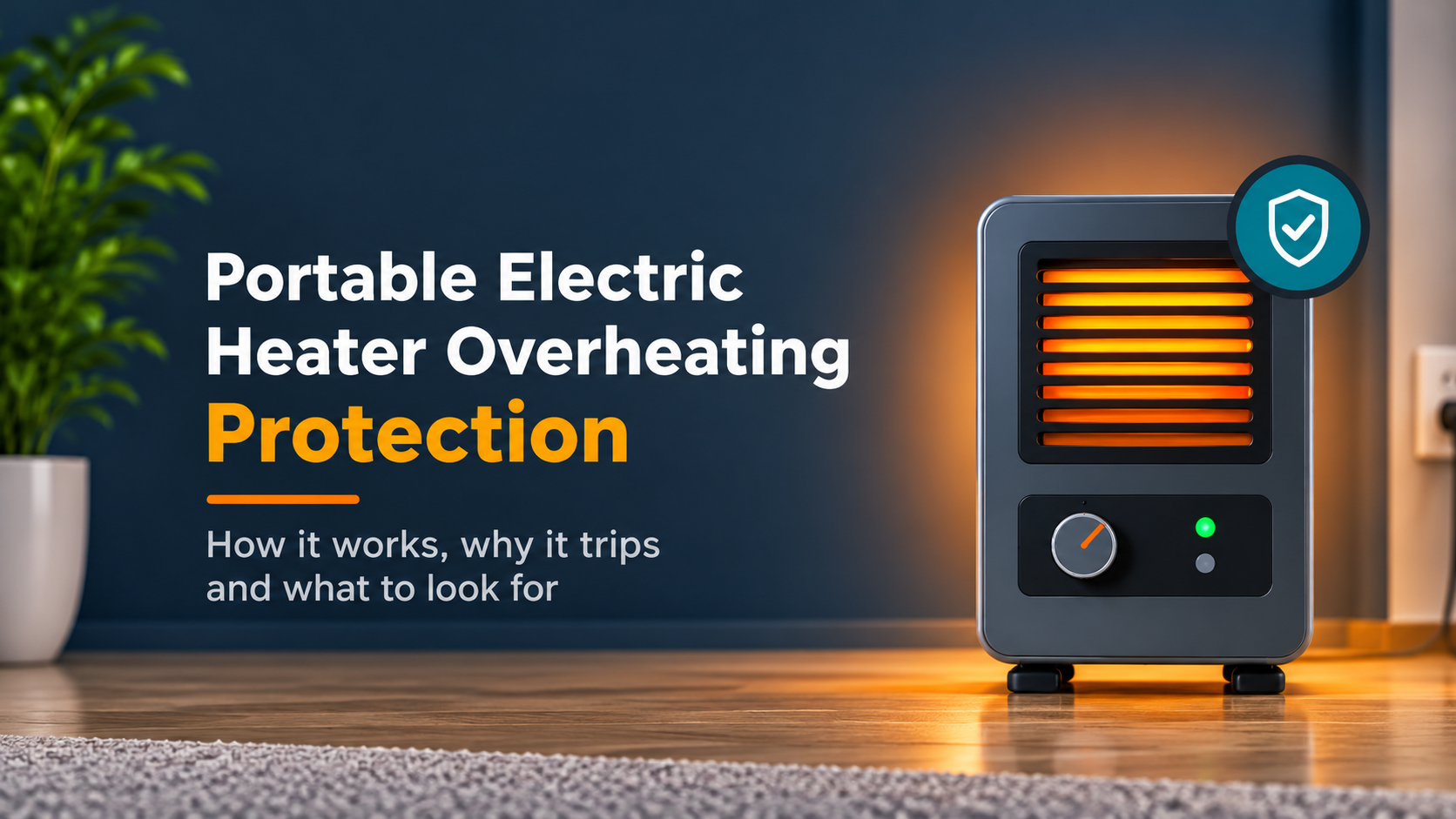
Portable Electric Heater Overheating Protection: How It Works, Why It Trips and What to Look For
A portable electric heater turns almost every watt it draws into heat, and that heat has to be managed. If airflow is blocked, a part fails or the heater is used carelessly, internal temperatures can rise fast. Overheating protection is the safety system that steps in before that becomes a burn, a melted plug or a fire.
Understanding how it works is useful whether your heater has just shut off unexpectedly or you are choosing a new one. This guide explains what overheating protection is, how the different types work, why it trips, what to do when it does, and which features to look for when you buy. It also clears up a few dangerous myths along the way.
Overheating protection is a built-in safety device, usually a thermal cut-out and often a backup thermal fuse, that cuts power to a portable heater when internal temperatures become unsafe. It most often trips because of blocked vents, dust, poor placement or a failing part. If it trips, unplug the heater, let it cool, clean it and move it to a clear spot. If it keeps tripping, stop using it. Never bypass or cover the protection to keep a heater running.
In this guide you will learn:
- What overheating protection is and why every portable heater needs it
- How thermostats, thermal cut-outs, thermal fuses and electronic sensors differ
- The most common reasons overheating protection activates
- What to do, step by step, when your heater trips
- Common myths that put people at risk
- Which safety features to look for in a new heater
What Is Overheating Protection in a Portable Heater?
Overheating protection, sometimes called an overheat cut-out, thermal protection or thermal shut-off, is a safety mechanism that monitors the temperature inside the heater and switches off the heating element when it passes a safe limit. The limit is chosen by the manufacturer and is set well above the temperatures reached in normal use, so you should not see it activate during everyday heating.
It is separate from the thermostat. The thermostat controls comfort by switching the heat on and off to match your chosen room temperature. Overheating protection controls safety and acts only when something has gone wrong, such as restricted airflow or a faulty component.
How Overheating Protection Works
Most portable heaters use more than one layer of protection, and each layer responds at a higher temperature than the one before it. Think of it as a ladder: if the first rung does not stop the problem, the next one will.
Thermal cut-out (bimetallic switch)
This is the most common form of overheating protection. It uses a strip made of two different metals bonded together. The metals expand at different rates, so the strip bends as it heats up. At a set temperature it bends far enough to open an electrical contact and cut power to the heating element. When the heater cools, the strip returns to its original shape. Depending on the design, the heater then either restarts by itself (automatic reset) or stays off until you press a reset button (manual reset).
Thermal fuse
A thermal fuse is a one-time backup. It contains a temperature-sensitive link that melts at a set temperature and permanently breaks the circuit. Because it cannot be reset, a blown thermal fuse means the main protection did not do its job or something has failed badly. The heater should be replaced rather than repaired.
Electronic temperature sensors
Many digital and smart heaters use a temperature sensor, often a thermistor whose electrical resistance changes with heat, connected to a control board. The board reads the sensor many times per second and shuts the heater down if the reading is too high. Electronic systems can be more precise and can show an error code or warning light that tells you what happened.
Related safety features that work alongside it
- Tip-over switch: cuts power if the heater falls or tilts.
- Overheat-resistant materials: flame-retardant plastics and heat-resistant internal parts slow the spread of heat.
- Cool-touch housing: keeps the outer surface at a safer temperature, which is especially useful around children and pets.
- Plug-level protection: some heaters have a plug with a built-in protection device and TEST and RESET buttons that cuts power if it detects a fault in the cord.
Comparing the Main Types of Protection
| Protection | What it senses | What happens when it trips | Resets? |
|---|---|---|---|
| Thermostat | Room or air temperature | Heating element switches off, then on again as the room cools | Automatically |
| Thermal cut-out | Internal temperature of the heater | Power is cut to the heating element | Automatically or with a reset button |
| Thermal fuse | Extreme internal temperature | Circuit is broken permanently | No, the heater must be replaced |
| Electronic sensor | Temperature at one or more points | Control board shuts the heater down and may show a warning | Usually after cooling or a power reset |
| Tip-over switch | Tilt or fall | Power is cut immediately | Automatically once upright |
Why Overheating Protection Activates
When the protection trips, it is almost always reacting to a real problem. These are the most common causes.
- Dust and lint on the vents, filter or fan. Dirt restricts airflow so heat builds up inside the casing.
- Blocked airflow from poor placement. A heater pushed against a wall, sofa, bed or curtains cannot release its heat.
- Covered heater. Draping clothes, towels or blankets over a heater to dry them is a common cause and a serious fire hazard.
- A failing or stuck fan. Without a working fan, a fan heater overheats very quickly.
- Heater too small for the room, running flat out for hours. A heater under constant strain runs hotter inside than one used within its limits.
- Poor electrical connections. A loose plug or damaged cord can overheat at the connection, and some heaters will shut down when they detect it.
- Age and wear. Over time, components drift and become less reliable, so protection devices may trigger at lower temperatures or the heater may overheat more easily.
What to Do When Your Heater Trips
- Switch it off and unplug it. Do not keep pressing the power button.
- Let it cool completely. Allow at least 30 minutes before touching it or cleaning it.
- Look for obvious causes. Check for blocked vents, items touching the heater and a loose or damaged plug.
- Clean it. Vacuum the intake and outlet grilles, clean the filter if it has one and brush dust from the fan area. Keep water away from internal parts.
- Move it. Place it on a flat, hard surface with about 3 feet (1 metre) of clear space on every side and plug it straight into a wall outlet.
- Reset it if needed. If your model has a reset button, press it only after the heater has cooled and the cause has been dealt with.
- Test it while you watch. Run it for around 30 minutes and stay in the room. If it trips again, stop using it.
Do not cover a heater or block its vents to see if the protection works. A faulty or worn device might not trip in time. If you think the protection is not working, stop using the heater and replace it.
Signs the Protection Is Failing or the Heater Is Unsafe
Stop using the heater and do not plug it in again if you notice any of these:
- It trips repeatedly even after cleaning and moving it
- The casing, plug or cord is too hot to touch or looks discolored or melted
- You smell burning plastic or an electrical odor that does not fade
- You see sparks, hear crackling or notice smoke
- It will not turn on at all after a trip, which can mean a blown thermal fuse
- The fan grinds, rattles or no longer spins
A heater that shuts down repeatedly is not a heater that is being cautious. It is a warning that something needs attention.
Common Myths About Overheating Protection
| Myth | The reality |
|---|---|
| “Overheating protection means I can leave the heater on all night.” | It is a last line of defense, not a replacement for supervision. Heaters should not be left running unattended unless the manual explicitly says it is designed for it. |
| “If it trips, the heater is defective.” | Usually the protection is working correctly and reacting to dust, poor placement or a blocked vent. |
| “I can drape clothes over it to dry them quickly.” | Covering a heater is one of the most common causes of overheating and fires. |
| “I can bypass the safety switch if it keeps tripping.” | Bypassing a protection device removes the barrier between a fault and a fire. Replace the heater instead. |
| “A heater that restarts by itself after cooling is fine.” | Repeated trip-and-restart cycles mean the cause has not been fixed and the heater is being stressed again and again. |
| “Higher wattage always means better heating.” | A heater that is too powerful for its room, or one running on an overloaded circuit, creates extra risk. Match the heater to the room. |
How to Choose a Heater With Reliable Overheating Protection
If you are buying a new heater, check the specifications and product label for safety features rather than relying on marketing claims. The graphic below summarizes what to look for.
Match the heater to the room
A common rule of thumb is about 10 watts of heating power per square foot of floor area, so a 150 square foot room needs around 1,500 watts. Choosing a heater that fits the room means it will not need to run flat out for hours, which reduces strain on the protection system.
Consider the heater type
| Heater type | Overheating risk factors | Good to know |
|---|---|---|
| Ceramic fan heater | Dust on the intake and a failing fan | Heats quickly but needs regular cleaning |
| Oil-filled radiator | Covering the fins, for example with laundry | Surface stays hot for a while after switching off |
| Infrared / radiant heater | Objects placed too close to the front | Heats people and objects directly, so clearance matters |
| Panel / convection heater | Blocked top and bottom vents | Low surface temperature and low noise |
Safe Habits That Keep Overheating Protection From Tripping
- Plug the heater directly into a wall outlet and avoid extension cords and power strips.
- Keep at least 3 feet (1 metre) of clear space around it, especially in front.
- Vacuum the vents and filter regularly, and more often if you have pets.
- Use it on a flat, hard surface rather than on thick carpet or a bed.
- Never cover it or use it to dry clothes.
- Inspect the plug and cord every month and stop using the heater if they show damage.
- Switch it off and unplug it when you leave the room or go to sleep, unless the manual says otherwise.
- Store it clean and dry at the end of the heating season.
Frequently Asked Questions
What is overheating protection on a space heater?
It is a built-in safety device that cuts power to the heating element when the heater’s internal temperature becomes unsafe. It is usually a thermal cut-out, often backed up by a thermal fuse or an electronic temperature sensor.
How do I reset the overheat protection on my heater?
Unplug the heater, let it cool for at least 30 minutes, and deal with the cause by cleaning the vents and moving it to a clear spot. Many heaters reset automatically once cool. If yours has a reset button, press it after cooling. If the heater will not turn on at all, a thermal fuse may have blown and the heater should be replaced.
Why does my heater keep tripping its overheat protection?
The usual causes are dust on the vents or filter, blocked airflow because the heater is too close to objects, a failing fan or an aging internal component. Clean it and move it first. If it keeps tripping, stop using it.
Is it safe to keep using a heater that has overheated?
Only if you have found and fixed a simple cause such as dust or poor placement, and the heater then runs normally. If the overheating continues, or you see damage or smell burning, stop using it and replace it.
Can overheating protection fail?
Yes. Like any component, it can wear out, stick or fail, especially in older or very cheap heaters. That is why you should not rely on it to protect a heater that is covered, blocked or left unattended.
Do all portable heaters have overheating protection?
Reputable heaters sold by established brands include it, but quality varies. Check the product specifications for overheat protection and look for a recognised safety mark. Be cautious with unbranded heaters that list no safety features.
What is the difference between a thermostat and overheating protection?
A thermostat keeps the room at a comfortable temperature by cycling the heat on and off. Overheating protection is a safety device that only activates when the heater itself gets too hot.
Final Thoughts
Overheating protection is one of the most important safety features in a portable electric heater, but it works best as a backup, not a habit. Keep vents clean, give the heater room to breathe, plug it directly into the wall and never cover it. When you buy a new one, choose a heater with layered protection, a tip-over switch, a recognised safety mark and a solid cord and plug. If your heater trips again and again, treat it as a warning and replace it rather than working around it.
This article is for general information only. Always follow the manual for your specific heater and have a qualified electrician check any signs of damaged wiring or repeated breaker trips.